Investigative Stories
Who Is Killing Eastern Nepal’s Elephants?
Over the past decade, 35 wild elephants have died in the forests of eastern Nepal. Their deaths were not simply the natural outcome of human–elephant conflict. At least five were killed by organized poachers.

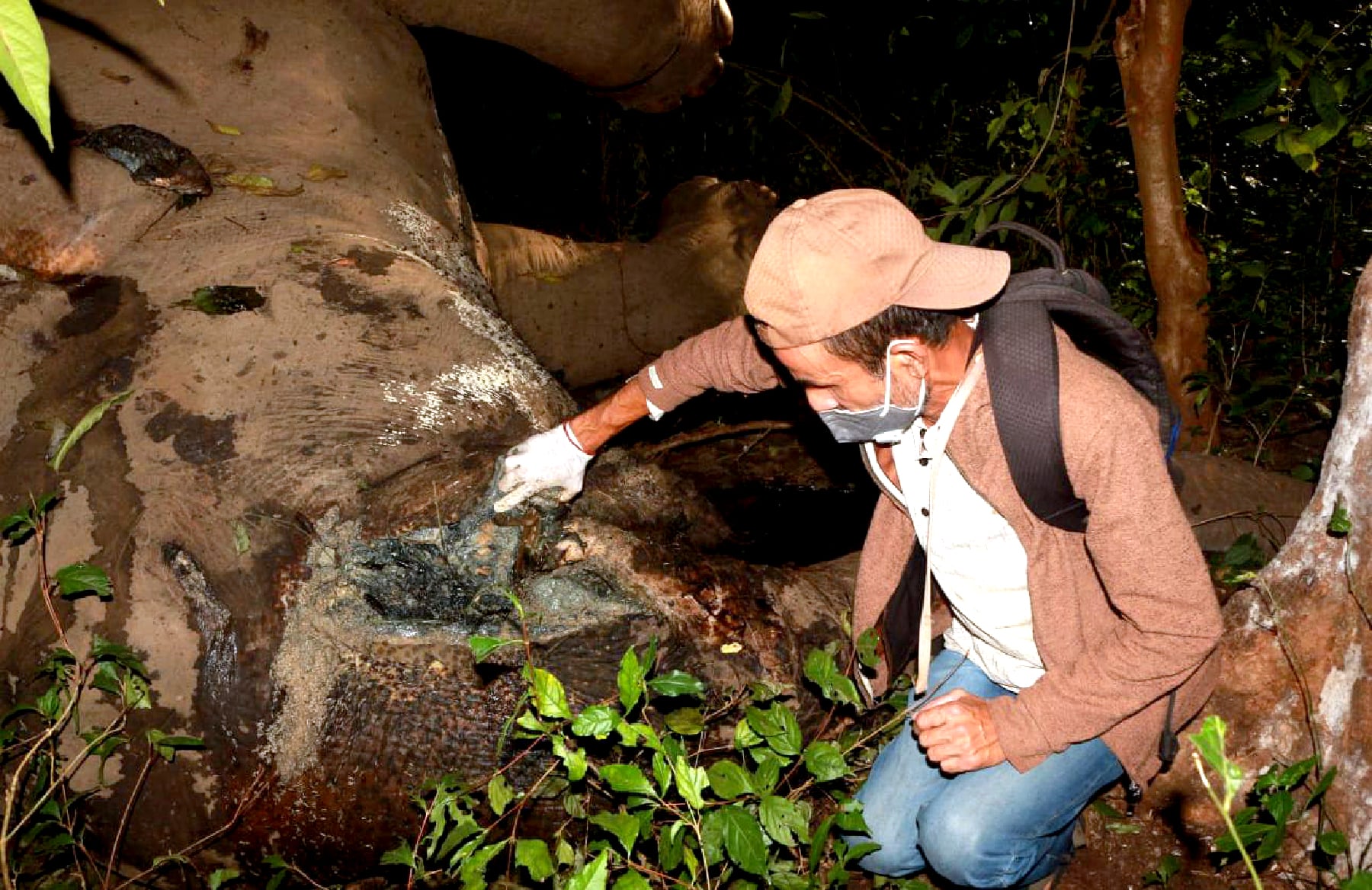
Jhapa – On 16 April 2024, a dead male elephant was discovered inside Kalika Community Forest in Mechinagar-12, Jhapa. Its tusks had been cut off, and even the hair from its tail had been pulled out. Technicians from the National Trust for Nature Conservation, officials from the Division Forest Office, and representatives of the community forest inspected the site and concluded that the elephant had not died of natural causes. The post-mortem report confirmed it had been killed by gunshot wounds.
The perpetrators have yet to be identified. Shankar Luitel of Mechinagar-4, long active in elephant conservation in eastern Nepal, says he has seen three other cases in which elephants’ tusks were missing. Luitel, from Bahundangi in Jhapa – the main entry point for wild elephants crossing into Nepal from India – has spent the past two decades closely tracking the movement, behavior, and condition of elephants along the Nepal-India border.
As a conservation campaigner often called in to assist with everything from post-mortems to cremations, Luitel says the disappearance of tusks no longer surprises him. “Elephants dying overnight deep inside dense forests, and then their tusks, tail hair, and feet going missing, is clearly not normal,” he said.
Wild elephants die in eastern Nepal every year. Farmers frequently string electric fencing around their fields to keep out herds that descend from forest into cropland. When elephants touch those wires, they are often electrocuted. As a result, even when dead elephants undergo post-mortem examination, investigations into possible criminal involvement are rare.
Our investigation found that 15 percent of elephant deaths were caused by poaching. Of the 35 elephants that died over the past decade, five were confirmed killed by poachers – through gunfire or electrified traps. Yet none of these cases has led to effective investigation or prosecution.
On 17 July 2018, a dead male elephant was found inside Panchpokhari Community Forest in Buddhashanti Rural Municipality-5, Jhapa. Both tusks were missing. Forest staff and technicians, including the post-mortem team, deemed the death suspicious after receiving information about the carcass deep inside the forest. The elephant, found near a pond, was also missing its tail. A post-mortem record from the National Trust for Nature Conservation at Koshi Tappu Wildlife Reserve in Sunsari noted the carcass was already decomposed.
Two years later, on 30 October 2020, a strikingly similar case was recorded in the same forest. A dead male elephant had again had its tusks cut off at the base. The Trust’s post-mortem report said the elephant died from wound infection. According to Karn Bk, a forest guard at the Area Forest Office in Dhaijan, the elephant was found partly submerged in a pond, decomposing, with its tusks cut off. “Its tusks had been cut in exactly the same way as the elephant found dead in this same forest earlier,” he said.
On 22 September 2017, a dead male elephant was found inside Bichkeshwari Community Forest in Belaka Municipality-8, Udayapur. Its tusks had been cut off at the base and taken away. A field investigation report noted that even the hair from its tail and its feet were missing. The National Trust for Nature Conservation classified the incident as poaching.
Similarly, on 31 December 2023, police reached Janajagaran Community Forest in Sundarharaicha-10, Morang, after receiving information that poachers had killed an elephant. By the time officers arrived, the shooter had fled with the elephant’s tail. That person has still not been identified. Because police responded quickly, however, the group was unable to take the tusks.
In these cases, tusks, feet, or tail hair were removed from dead elephants. According to Birendra Gautam, chief of the Koshi Conservation Centre in Sunsari under the National Trust for Nature Conservation, this confirms that theft and smuggling of elephant body parts is thriving in eastern Nepal.
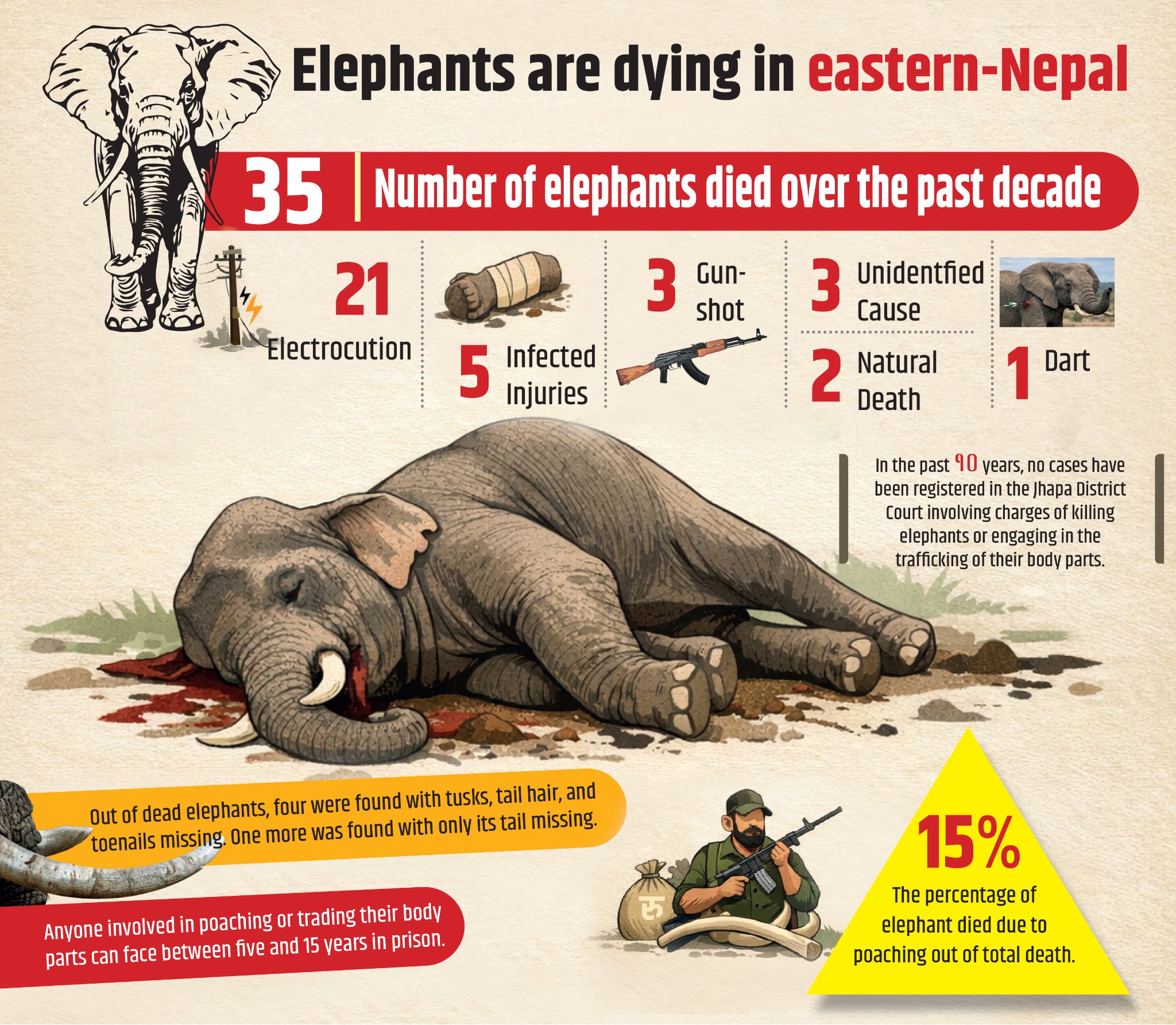
Since 2015 alone, 35 elephants have died across districts in eastern Nepal. Of those, four were found with tusks, tail hair, and toenails missing. One more was found with only its tail missing.
Of all elephants found dead over the past decade, the highest number – eight – died in fiscal year 2023/24 alone, nearly one-quarter of all deaths recorded in that period. Five elephants died in 2024/25, and in just the first eight months of the current fiscal year, four elephants have already died in Jhapa alone.
Post-mortem reports show elephants were killed using poison, electric current, and gunfire. Some also died after sustaining serious injuries in fights with other elephants, later succumbing to infection. According to the National Trust for Nature Conservation, of the elephants found dead over the past 10 years, 21 died from electrocution, three from gunshot wounds, five from infected injuries (with the original cause undetermined), and two from natural causes. Three were found in such advanced decomposition that the cause of death could not be established, said Gautam.
A month ago, on 11 February 2026, another elephant died inside a community forest in Kachankawal, Jhapa. The elephant, found injured, died while being darted for treatment.
Ramesh Thapa of Ujyalo Nepal, a non-governmental organization active in wildlife conservation, says the disappearance of body parts from that elephant also points to the continued activity of poaching networks.
No Investigation, No Prosecution
Despite repeated cases in which body parts were removed from dead elephants, no criminal investigation has yet been launched. Officials at the Division Forest Office, the first agency responsible for investigating the theft and smuggling of wildlife parts, acknowledge that trafficking networks are active. But Nathuni Gohiwar Yadav, chief of the Division Forest Office in Jhapa, says no one has been arrested because no formal complaint has been filed naming those involved in the poaching.
“We cannot begin an investigation if no one files a complaint,” Yadav said. “Even when we question people after an elephant dies, local residents often react angrily and ask, When a person dies, no one investigates, but when an elephant dies, suddenly there is concern?” Yet under the law, no formal complaint is required to investigate the killing of any protected wildlife species, including wild elephants.
Yadav noted that there is no statute of limitations in such cases, meaning a complaint can be filed at any time and an investigation can follow. Officials say that when an elephant dies, they at least appoint an investigating officer and prepare a report documenting the apparent cause of death, statements from local residents, and other details.
In one case, however, police arrested 47‑year‑old Tikh Bahadur Bishwakarma of Jaruwatol, Arjundhara‑7, after recovering an elephant tusk from his home. Another man, 48‑year‑old Chek Bahadur Limbu, was arrested alongside him. Limbu told police he had found the tusk in the nearby Bhiring riverbed while extracting sand. Bishwakarma claimed he was not at home when Limbu brought the tusk to have it weighed, and that he was arrested in the process.
What remains unclear is whether the tusk recovered from the two men belonged to one of the five elephants confirmed poached in recent years, to an elephant killed earlier or later, or even to one from across the border in India. There is no record of any elephant death in Jhapa around the time the tusk was recovered. Nirajan Thapa, senior scientist at the National Forensic Science Laboratory, said laboratory testing can confirm whether an item is ivory but cannot determine much beyond that.
The tusk, recovered on 2 November 2023, was sent by Nepal Police’s Central Investigation Bureau for forensic examination. After it was confirmed to be elephant ivory, it was transferred to Chitwan National Park for storage.
The bigger questions remain unanswered: Where did the tusk come from? How old was it? Was it taken through poaching, or cut from an elephant that died of other causes? Who removed it? Even so, both Bishwakarma and Limbu were sentenced to five years in prison by the Jhapa District Court on 23 February 2024. A bench led by District Judge Ishwari Man Ojha convicted them on charges related to the purchase, sale, and transport of parts from a protected wildlife species.
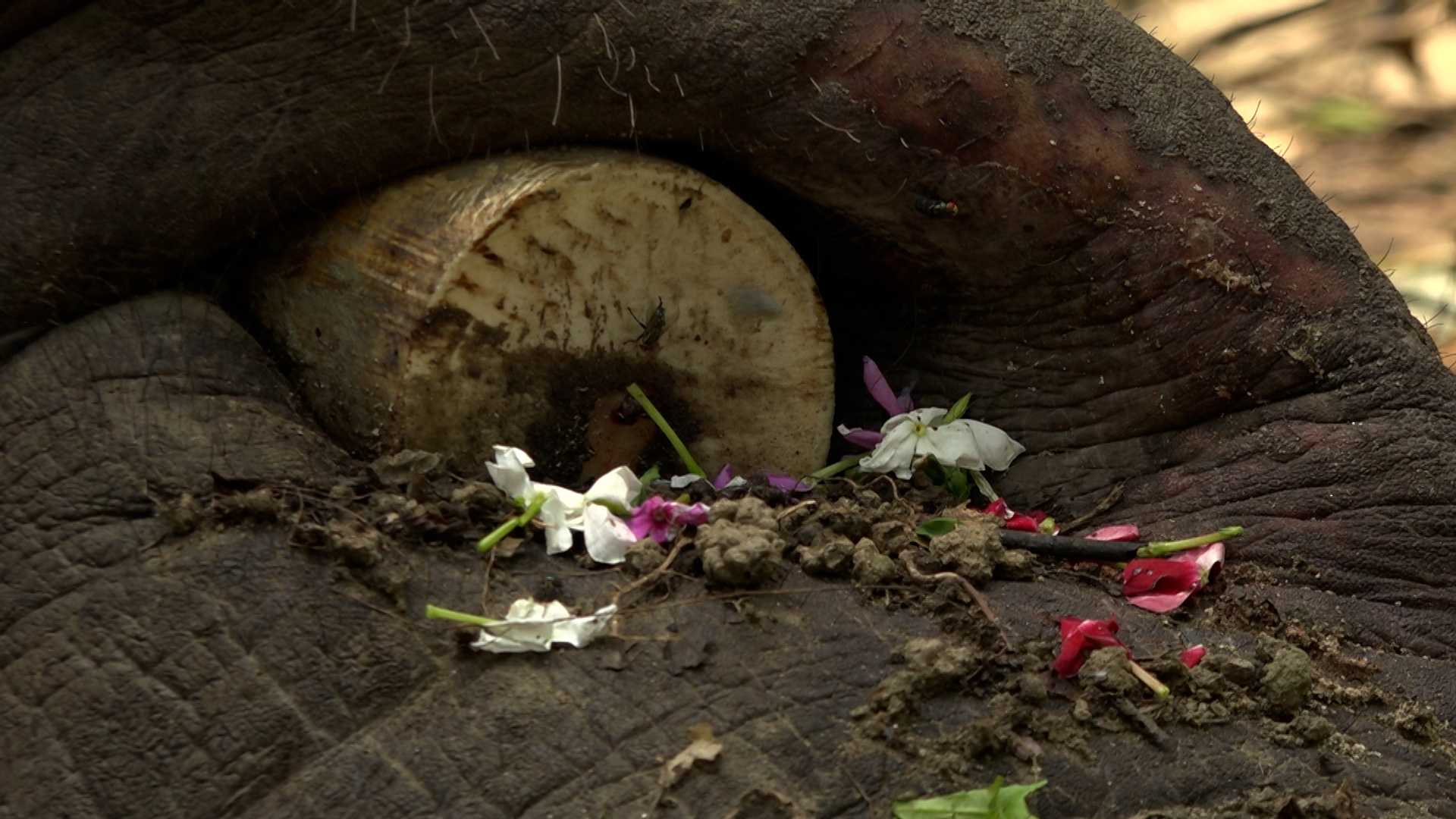
Both men are currently serving their sentences at Jhapa District Prison. Both come from poor economic backgrounds. Limbu, who migrated to Arjundhara from Panchthar, had spent some years working abroad before returning home and supporting his family through wage labor.
Limbu’s eldest son, Manoj, says the family still does not know where his father found the tusk. Insisting his father was not involved in such trade, he said, “If he were the kind of person doing that sort of shady business, would we still be living in a hut like this?”
Bishwakarma’s family circumstances are similar. Having moved from Sikkim a few years ago, he is locally known as Sikkime Sahinlo. He drove a private school bus for a in Birtamod and ran a small shop in the village. According to his elder brother, Dhan Bahadur Limbu had brought the tusk to that shop to weigh it on the scale.
Apart from this case, no charges have been filed in the Jhapa District Court in the past 10 years against anyone accused of killing an elephant or smuggling elephant body parts, according to court information officer Ramchandra Basnet.
A Cross-Border Trade
Arjun Karki, ward chair of Mechinagar‑4, suspects that the repeated removal of tusks, tails, and hair from dead elephants points to the involvement of an organized criminal network.
The pattern is also evident in arrests made in India involving elephant ivory, suggesting a trafficking chain that runs through Nepal and extends into India and Bhutan. On 3 April 2024, forest personnel in India’s Lataguri Range arrested one Indian national and one Bhutanese national with two elephant tusks. The men were identified as Yaska Dukpa of Alipurduar, India, and Wangdi, a Bhutanese citizen.
In another case, members of India’s South Regional Task Force and forest officials arrested Deepak Thapa, a man of Nepali origin, in Hyderabad while he was allegedly attempting to sell ivory. According to a report in Siliguri Times, Thapa had been living under the name Mohammad Rehan while operating a beef shop.
Thapa reportedly told investigators he had been in contact with Mirza Saqib Beg of Mumbai and had purchased the ivory from him. Thapa was arrested while trying to sell the tusk for 1.5 million Indian rupees.
-1774350763-1776063998.jpg)
Then, on 21 December 2025, forest officials from India’s Kurseong Forest Division recovered ivory from a Nepal‑registered vehicle on the flyover of Asian Highway 2 in Bagdogra. Nepal’s 21‑year‑old Ganesh Shah and 51‑year‑old Kamal Agrawal of Khalpara, Siliguri, were arrested in that case.
Prashant Acharya, a journalist based in Bagdogra who reported on these cases, says they point to a broader pattern in which tusks and other elephant parts are being trafficked from Nepal into India. “The traffickers’ attention appears to be shifting toward Nepal,” he said.
Manjil Dewan, secretary of the Human‑Elephant Conflict Management and Environmental Conservation Forum in Bahundangi, Jhapa, says Indian nationals have been known to visit border villages in search of tusks, tail hair, and other body parts. He recalls a cattle trader involved in cross‑border smuggling telling him a few months ago that buyers were looking for elephant tusks. According to Dewan, those traders said they were in contact with Bhutanese buyers and were openly quoting prices for various parts.
Padam Shrestha, senior advocate and chair of the Environmental Law Society Nepal, says tusks, tail hair, bones, and other elephant parts command high prices on the international market. Members of his organization recently spent six months investigating the trafficking of wildlife trophies from eastern Nepal. Their report is now being prepared for publication.
According to Shrestha, the investigation found major loopholes in Nepal’s laws, as well as widespread public ignorance about them, both of which have enabled trafficking. It also found that Nepal’s open border with India makes it easy for elephant parts to move across, while parts from India, Bhutan, and Bangladesh are also trafficked through Nepal onward to China.
What Does the Law Say?
Nepal’s National Parks and Wildlife Conservation Act, 1973 lists the Asian elephant as a protected species. Anyone involved in poaching or trading their body parts can face between five and 15 years in prison. Nepal is also a state party to the Convention on International Trade in Endangered Species of Wild Fauna and Flora (CITES). Under the convention, elephants are listed in Appendix I, meaning international commercial trade in their body parts is fully prohibited.
In addition, provisions under Nepal’s National Penal Code, 2017 related to organized crime, smuggling, and money laundering could potentially apply in such cases. Yet there is still no known example of a case involving elephant body‑part trafficking being prosecuted in Nepal as organized crime.
More Investigative Stories

Who Does The Annapurna Belong To?
In fiscal year 2082/83 BS, the Annapurna Conservation Area Project (ACAP) received 508,000 visitors and collected more than NPR 1.77...
Politicized Budget Distribution in Madhesh is Contrary to the Spirit of Federalism
From small projects that local governments can implement themselves to the selection of projects based on political connections, the pattern...
Comment Here