Investigative Stories
A Rs. 1.43 Billion Land Grab, Enabled by the Metropolitan City
The Constitution assigns local governments the responsibility of protecting public and government land. Yet Birgunj Metropolitan City appears to have become an enabler in a land mafia operation that has gone so far as to seize privately owned land. How did this happen?
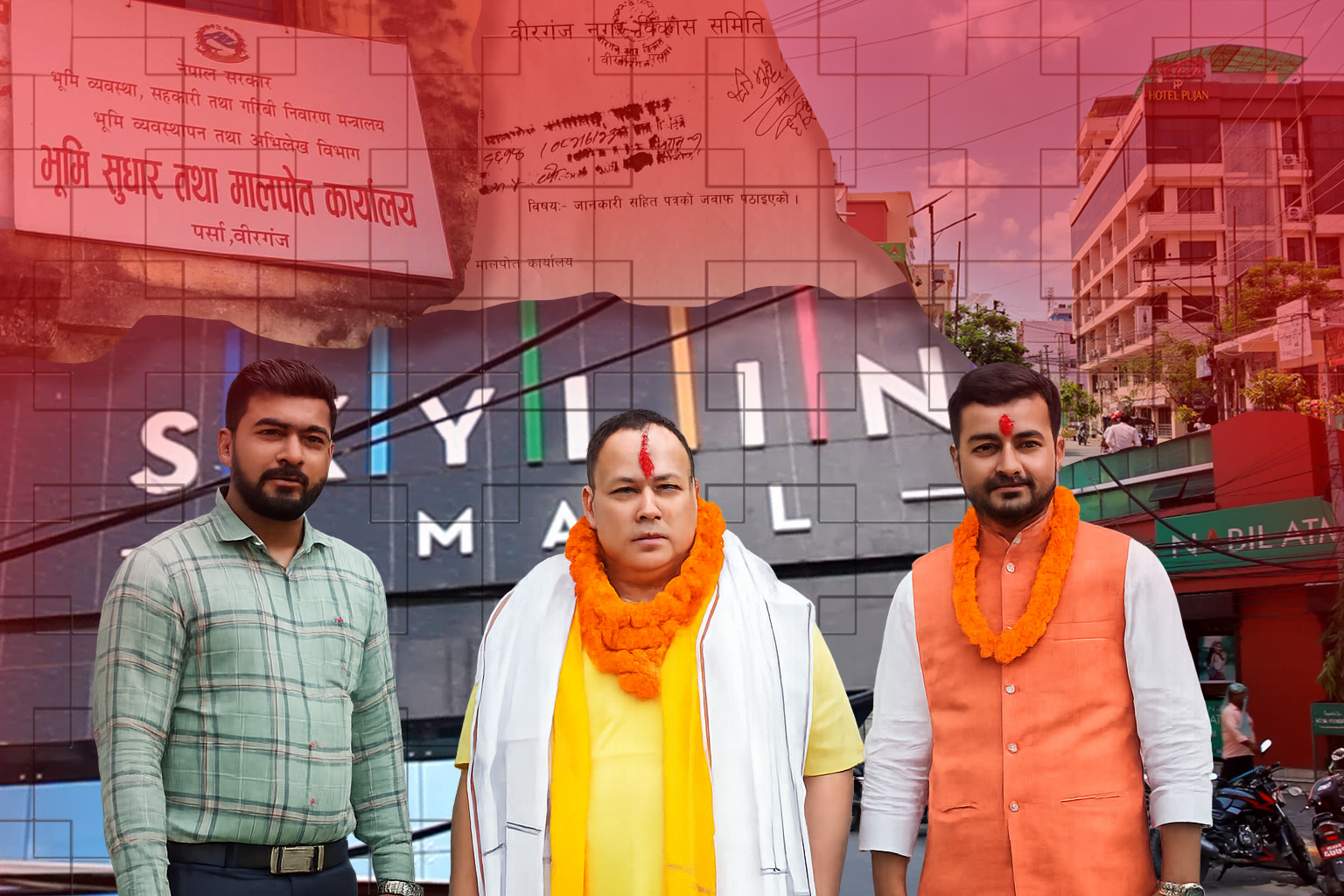
Imagine owning a valuable plot of land in a city neighborhood. After some time, you decide to build a house on it. You go to the government office to obtain permits and complete the required procedures. And then you learn that you no longer own the land. How would you feel?
That is exactly what happened to Nikhat Parveen Ansari of Birgunj.
Without her knowledge, her land had been transferred into someone else’s name. Twelve years on, she is still fighting to reclaim it. Taking on a nexus of powerful politicians, land brokers, and complicit officials has not been easy. This investigation traces how land worth Rs. 1.43 billion belonging to Nikhat and another landowner became the target of a coordinated grab, detailing the role of land mafias, the complicity of local government, and the involvement of influential officials and political actors.
The Origins of the Land Dispute
The story begins in 2023 BS (1966–67 AD). In what was then Ward–9 of Shreepur (B), under the former Birgunj Municipal Panchayat, Purendra Bikram Shah subdivided his land parcel measuring 10 kattha 1.5 dhur (3411.4 square meters), recorded as Parcel 13. He sold part of it as Parcel 26. The remaining land, Parcel 25, was further subdivided into Parcels 105, 106, and 107, which were distributed among his sons. Parcel 105, measuring 3 kattha (1015.9 square meters), went to his youngest son, Naresh Bahadur Shah.
On Mangsir 19, 2056 BS (December 5, 1999), Naresh Bahadur transferred this parcel to Ram Bindu Raut Kurmi through the Parsa Land Revenue Office for Rs. 160,000, as per the prevailing rate.
Three years later, on Ashoj 28, 2059 BS (October 14, 2002), Ram Bindu sold the land to Nikhat Parveen Ansari for Rs. 300,000. Nikhat is the granddaughter of Abdul Suhan Ansari, a former employee of Nepal Rastra Bank, and the daughter of Abdul Kasim Ansari, a hardware and fertilizer trader in Birgunj.
Shortly after purchasing the land, Nikhat was married in Areraj, in East Champaran district of Bihar, India. While managing her household there, she continued to pay land taxes regularly to the then Birgunj Sub-Metropolitan City.
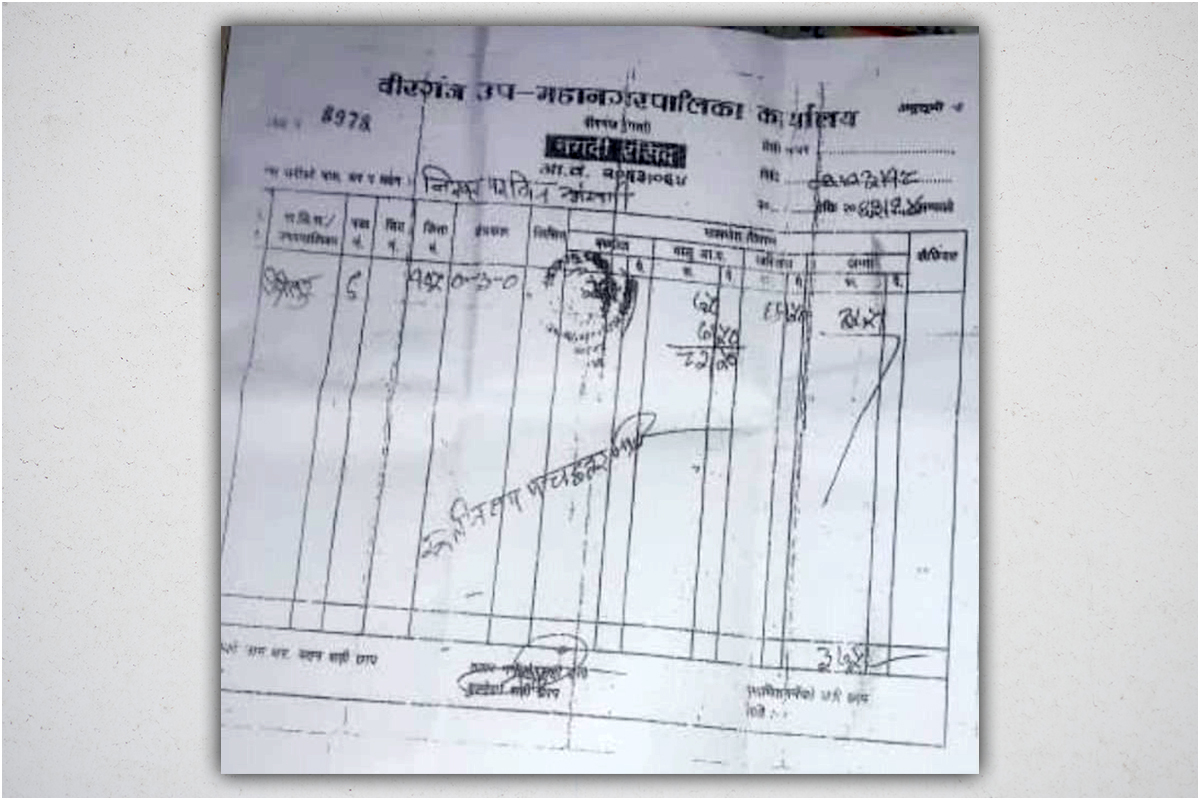
On Ashoj 16, 2069 BS (October 2, 2012), with plans to build a house, she applied to the Parsa Land Revenue Office for reconciliation and updating of ownership records, commonly referred to as mutation (haal-sabik). When no action was taken for two months, she followed up, only to be told that her application had been “lost.” On the advice of officials, she submitted a second application on Mangsir 29, 2069 BS (December 14, 2012), recorded under registration number 9440.
Still, no action was taken. In the meantime, she had to return to India due to family obligations.
Then something highly unusual happened.
On Falgun 25, 2070 BS (March 9, 2014), a year after she filed for mutation, records emerged showing her land had been transferred to a woman named Rina Devi Sah. Why would Nikhat process the transfer of her land through the neighboring district of Bara, when the Parsa Land Revenue office is 400 meters distance from her parent’s home.
She wouldn’t have, because she didn’t.
The transfer was executed using a forged identity of the landowner while Nikhat was physically in India.
There was another anomaly. The transfer was recorded at a declared value of just Rs. 100,000. Yet the same land had previously been sold for Rs. 160,000 in 2056 BS and Rs. 300,000 in 2059 BS. Even by basic logic, a property does not sell at a lower declared value over time under normal circumstances.
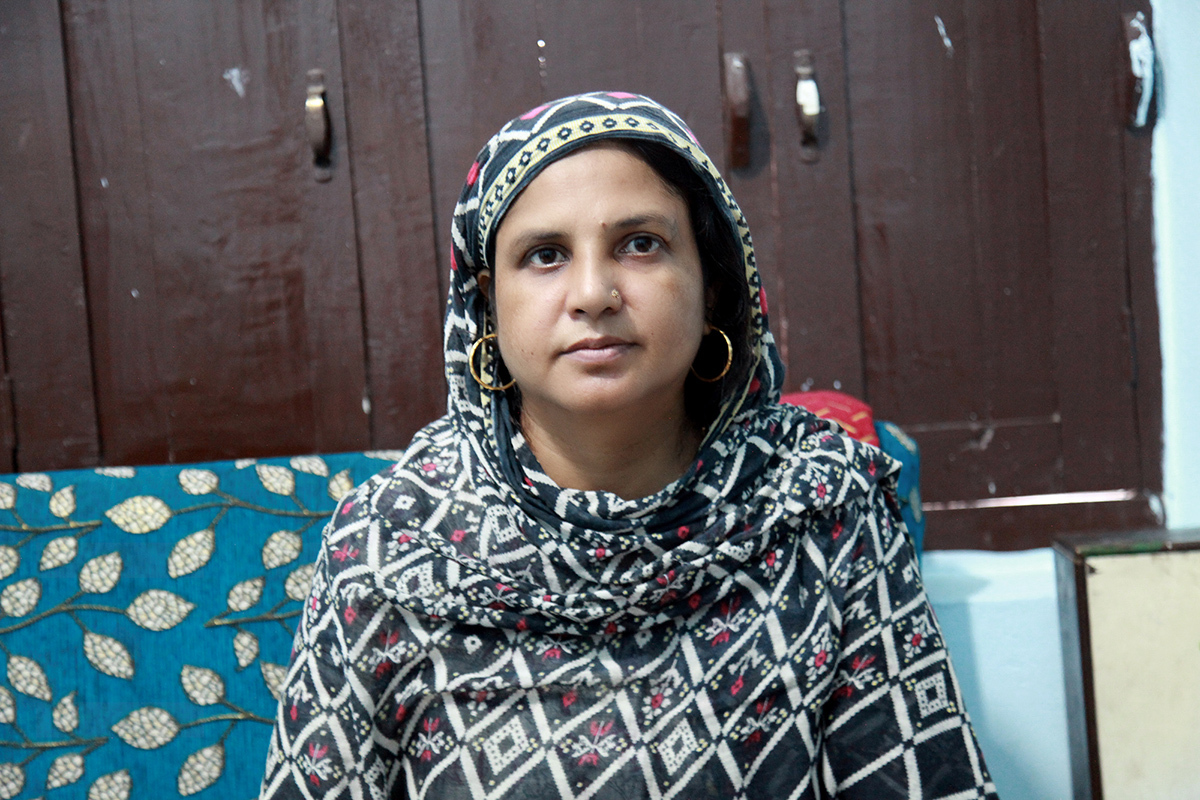
Nikhat only learned something was wrong when neighbors noticed soil being dumped on the land and made inquiries. They informed her that someone else appeared to have purchased it.
“After that, an unidentified person called my father-in-law and threatened him not to send me to Nepal to claim the land,” Nikhat says. “They even threatened to kill me if I came back.”
It was the time of the Madhesh Movement.
“Because of the unrest, my father was also in India then. We could not immediately return to Birgunj,” she says. “We simply could not believe that my land would be transferred into someone else’s name.”
More irregularities surfaced as the case unfolded.
Although documents showed that the Bara Land Revenue Office had transferred the land to Rina Devi Sah, records also showed that Rina Devi applied – more than a year later, on Poush 4, 2071 BS (December 20, 2014 – to the Parsa Land Revenue Office to update the ownership records.
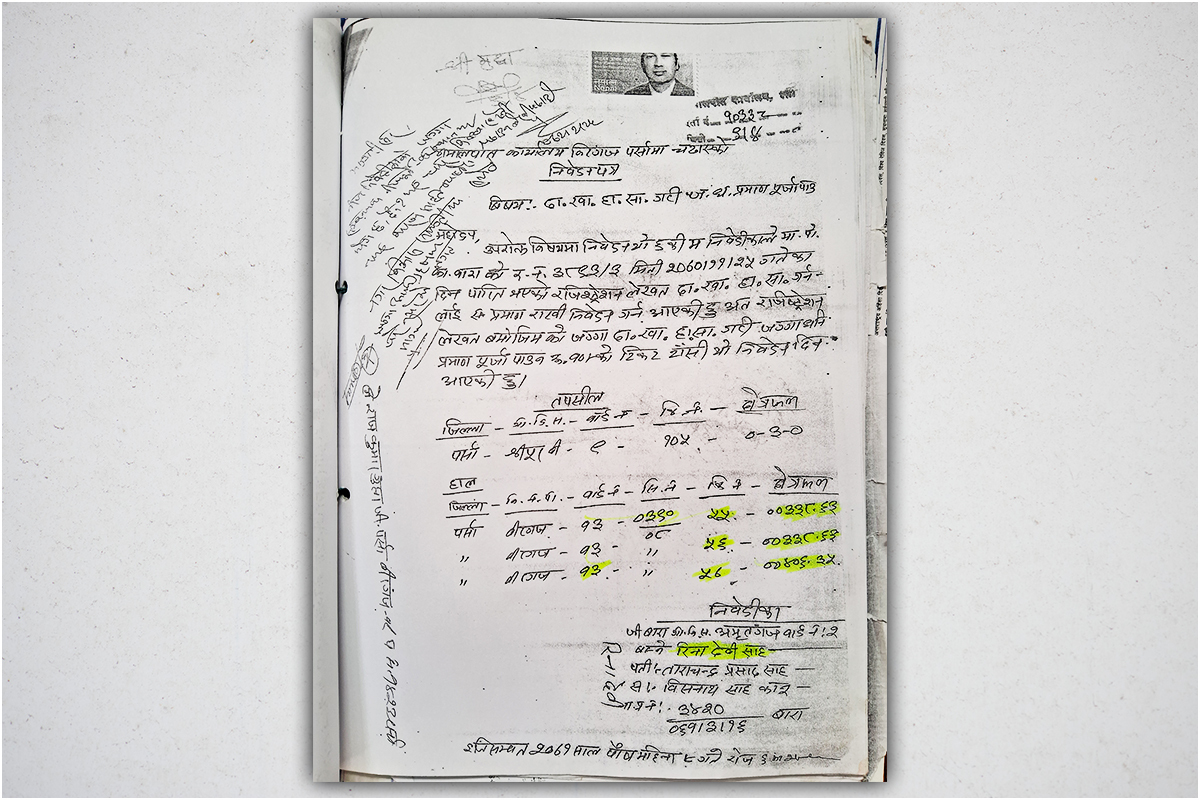
The Parsa office, noting the delay, ordered that the seller, Nikhat Parveen Ansari, be produced in person for verification.
Suspiciously, Rina Devi then went silent.
At that point, Madan Prasad Satyal, who had just been transferred as acting chief of the Land Revenue Office, Parsa, proceeded with Rina Devi’s application without requiring Nikhat’s presence.
He stated that under the updated cadastral map, the original Parcel 105 had already been converted into Parcels 54, 55, 56, and 57, and that these had already undergone mutation into the names of other individuals. Accordingly, Rina Devi’s application was placed on hold, pending a court decision establishing ownership.
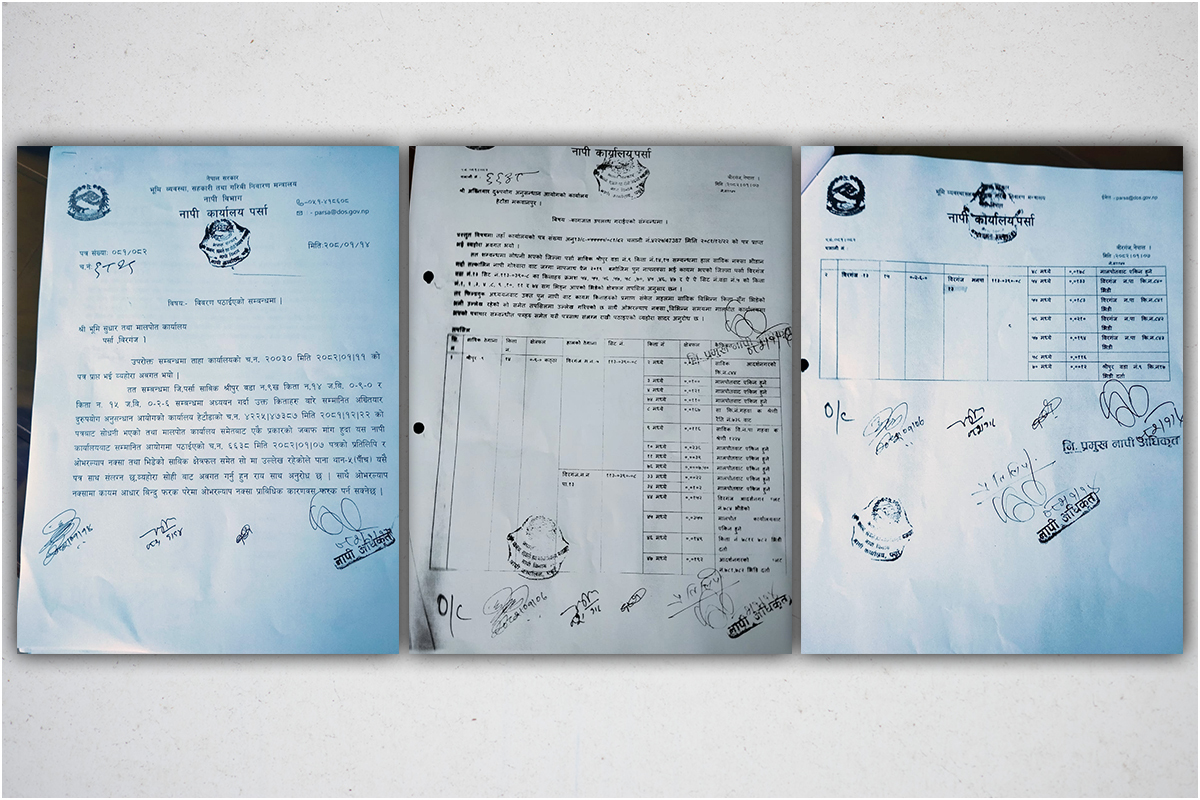
Of these four, Parcel 54 was registered in the name of Mahabir Prasad Agrawal, father of former Birgunj Chamber of Commerce president Anil Patwari (Agrawal); Parcel 55 in the name of Rina Kumari Sah; Parcel 56 in the name of Umesh Chandra Nepal; and Parcel 57 in the name of Sumeshwar Prasad Kalwar. Notably, the cadastral field book listed Naresh Bahadur Shah as the owner of Parcel 57, yet it was registered in Kalwar’s name.
Naresh Bahadur had already sold this land in 2056 BS.
Under the new survey, each of these parcels measured 1 kattha. Although survey records showed mutation into these four names, the original ownership ledger (sresta) based on the 2023 BS survey still listed the land under Nikhat’s name. The Parsa Land Revenue Office also continued to reflect her ownership.
This confirms that while survey records were altered through forgery or manipulation, the legal title never legitimately left Nikhat’s possession.
On what basis, then, did the Survey Office assign these parcels to four different individuals?
Records obtained from the Survey Office in Birgunj, the Parsa Land Revenue Office, and the erstwhile survey unit reveal no legal basis or supporting documentation.
Metropolitan City Colludes with Land Revenue, and Survey Offices
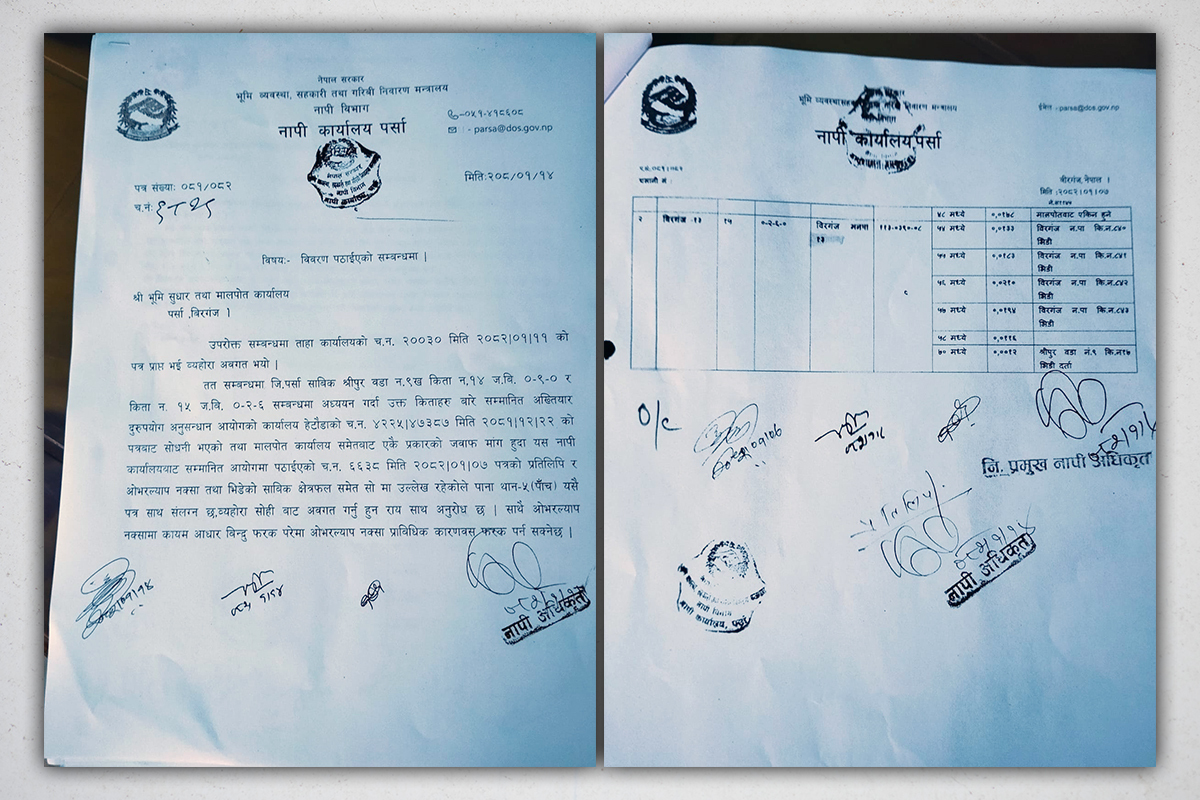
On Asar 10, 2072 BS (June 25, 2015), the Parsa Land Revenue Office wrote to the then Birgunj Sub-Metropolitan City seeking clarification.
The letter stated that parcels numbered 840, 841, 842, and 843 in Adarshanagar – originally sold by the Pashupati Adarshanagar Development Committee – had, under the new cadastral survey, been registered as Sheet No. 0390–08 in Birgunj-13, and ownership certificates issued in the names of respective claimants as Parcels 54, 55, 56, and 57.
It further noted that when the Survey Office Parsa was asked to reconcile the 3 kattha area of original Parcel 105 in Shreepur (B)-9, it had responded on Poush 16, 2071 BS (31 December, 2014) that the land corresponded to Parcels 54, 55, 56 and 57.
The Land Revenue Office posed a direct question: “Do Parcels 54, 55, 56, and 57 correspond to the earlier parcels 840, 841, 842 and 843 of Adarshanagar, or to Parcel 105 of Shreepur (B)-9? Where is this land currently located? … As per the order dated 2072-03-09 (June 24, 2015), kindly verify and clarify the status of said land.”
A copy of the letter was sent to the Survey Office, Parsa.
On Shrawan 8, 2072 BS, the then Birgunj Sub-Metropolitan City sent a reply to the Land Revenue Office, Parsa. The letter stated that the area of original Parcel 105 of Shreepur (B)-9 was not included in the land tenure records (bitouri), nor did it fall within the acquisition notice published by His Majesty’s Government for the construction of Adarshanagar in Birgunj, in the Nepal Gazette Part 3 – published on Ashwin 2, 2029 BS (September 18, 1972) – under the authority of Section 7(1) of the Land Acquisition Act 2018.
“As it was already informed on 2072-03-07 (June 22, 2015) that the mentioned parcel does not appear in this office’s tenure records (bitouri), or in the registers of the Pashupati Adarshanagar Development Committee, the same is hereby reiterated,” the letter stated.
This exchange sits against an intriguing background.
During government surveys conducted in 2054–2055 BS, a committee formed by the Ministry of Land Reform found instances where land belonging to one individual had been registered under another’s name. Based on this, the Department of Survey, on Ashoj 8, 2058 BS, instructed the Parsa Land Revenue Office to correct such registrations under Section 7(3) of the Land Revenue Act, 2034. It also ordered a freeze on the sale or transfer of any irregularly registered government, public, or private land until the registration cancellation proceedings were finalized.
Consequently, such transfers were annulled, and the then Chief of the Survey Office, Hriday Narayan Mishra, was suspended.
By that precedent, the registrations of Parcels 54, 55, 56, and 57, held in the names of four individuals, should have been annulled. But they were not. Instead, acting on Rina Devi Sah’s application, the Parsa Land Revenue Office chief Madan Prasad Satyal issued a letter on Falgun 11, 2072 BS (February 23, 2016), stating that since ownership of Parcels 54, 55, 56, and 57 had already been established and mutation completed in the names of four individuals, any dispute should be taken to court.
Rina Devi resurfaced about a year later seeking registration transfer and mutation (dakha haal-sabik). What followed remains unclear, but a letter she produced claimed that the land revenue office had already subdivided the land and mutated Parcels 54, 55, 56, and 57 into the names of four individuals through the survey unit.
The memorandum order from the Land Revenue Office, however, provides no legal basis for this action, suggesting that the document may have been fabricated to support a plan to secure ownership through the courts.
After discovering documents showing her land in someone else’s name, Nikhat reached out to relatives and acquaintances in Birgunj for help. During this time, Tabarak Ali Miya from Feta Rural Municipality-6 in Bara, where Nikhat had spent her childhood, came to meet her. He offered to restore the land in her name and process the mutation. He took her citizenship certificate and land ownership documents.
A few days later, he returned claiming that “both the land revenue and survey offices refused to register the land in Nikhat’s name” and advised filing a case in the High Court.
Acting as her legal representative, Tabarak filed a writ petition at the Birgunj bench of the Janakpur High Court. On Asar 11, 2075 BS (June 25, 2018), the court issued a writ of mandamus (paramadesh) directing the heads of the land revenue and survey offices in Parsa to carry out mutation (haal-sabik) in Nikhat’s name.
But the two offices did not proceed with updating the ownership records for Parcel 105. Instead, they spent five years claiming they were “searching for the original case file” that Nikhat had submitted earlier.
Meanwhile, nearly three years later – based on her earlier letter dated Falgun 11, 2072 BS (February 23, 2016) claiming ownership over land Parcel 105 – Rina Devi filed a case in the Parsa District Court on Magh 28, 2075 BS (February 11, 2019), naming the owners Parcels 54, 55, 56, and 57 as defendants. In the lawsuit, she sought annulment of the mutation, claiming the defendants had “seized her land through forgery and fraud”.
Had the lawsuit been genuine, Rina Devi should have named the decision-making authority – the Land Revenue Office Parsa – and the original owner, Nikhat, defendants. But she did not.
According to the case file, Parcel 54 had already been sold by Mahabir Prasad Agrawal to Nilam Agrawal, who then sold it to Skyline Infra Pvt. Ltd. It also appeared that Parcel 55, owned by Rina Kumari Sah, had been used as collateral for a loan from Citizens Bank. That loan was later settled by Tahir Hussein, who then sold the land to Skyline as well.
Parcel 56 remains in the name of Umesh Chandra Nepal. As for Parcel 57, while the field book from the new cadastral survey showed the land was surveyed under the name of Naresh Bahadur Shah, it had already been registered to Sumeshwar Prasad Kalwar.
How Naresh Bahadur’s land ended up being registered under Kalwar’s name is not explained in land revenue office records. The ownership has since been transferred from Sumeshwar to Sunil Kumar Gupta. There is no evidence in the survey office records to show what proof was used to update the land in Sumeshwar’s name.
In the same case file, a registration document was found showing that Mahabir Prasad had purchased Parcel 54 from the Pashupati Adarshanagar Development Committee. However, the handwritten document does not identify the official who authorized or validated it.
In the same case file, a registration document was found showing that Mahabir Prasad had purchased Parcel 54 from the Pashupati Adarshanagar Development Committee. However, the handwritten document does not identify the official who authorized or validated it.
The Entry of Pradeep Yadav
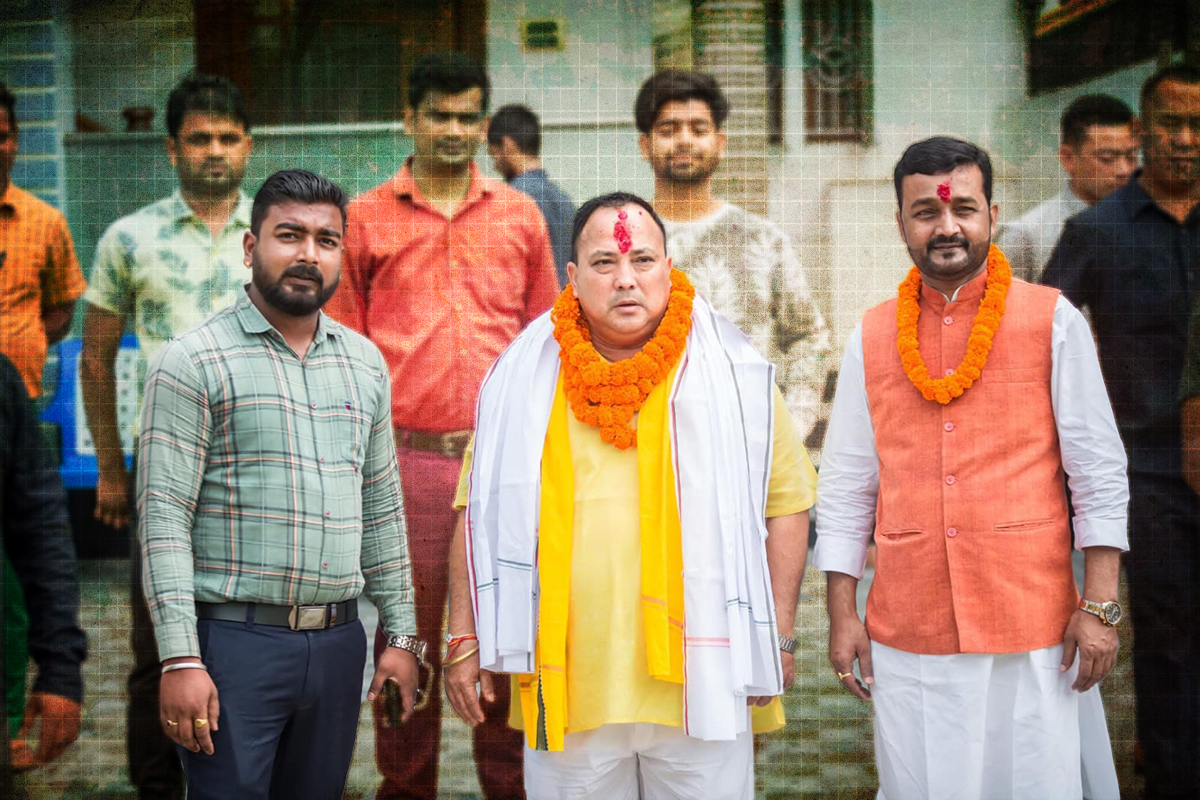
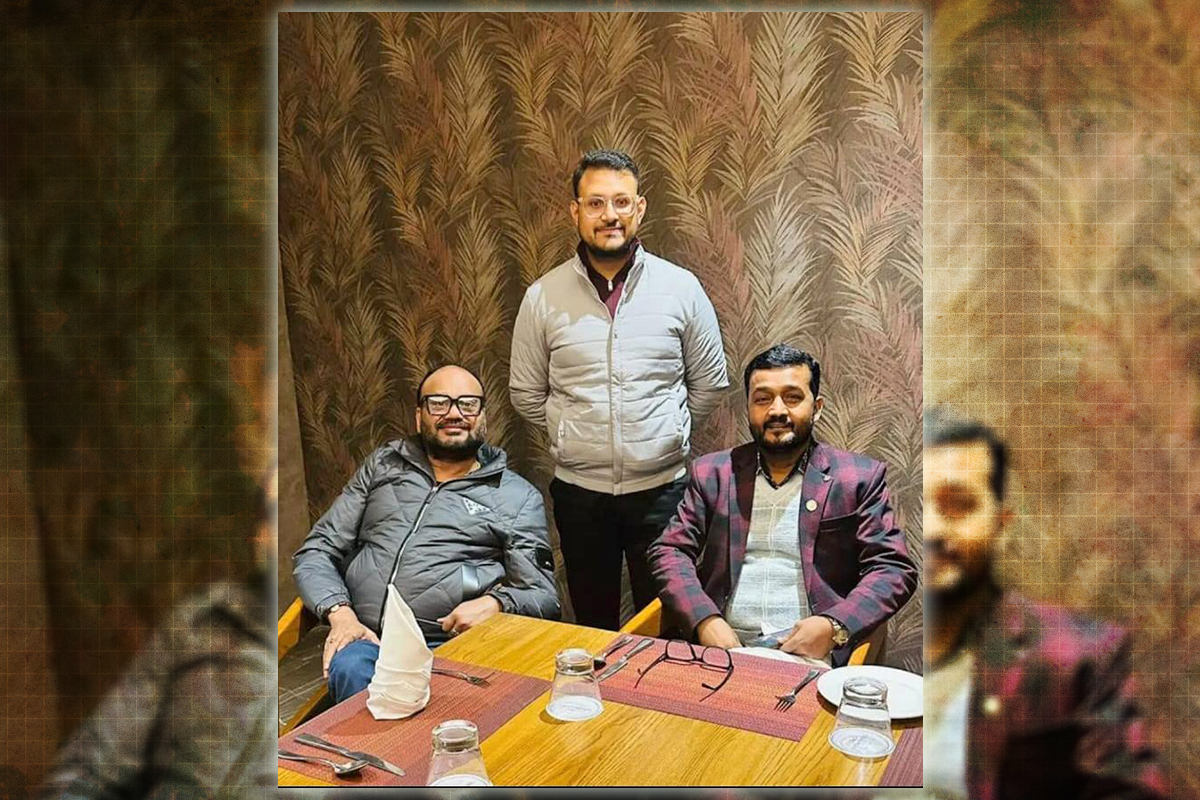
After the case was filed in the district court, documents emerged showing a compromise agreement that Rina Devi initiated, requesting that ownership of Parcels 54 and 55 remain in the name of Skyline Infra Pvt. Ltd., the developer of a mall. The agreement, dated Ashoj 12, 2077 BS (September 28, 2020), was signed on behalf of Skyline by Nikhil Barnwal. Barnwal later served as the personal secretary to Pradeep Yadav, who was elected to the House of Representatives from Parsa-1 in 2079 BS and subsequently became Minister for Drinking Water.
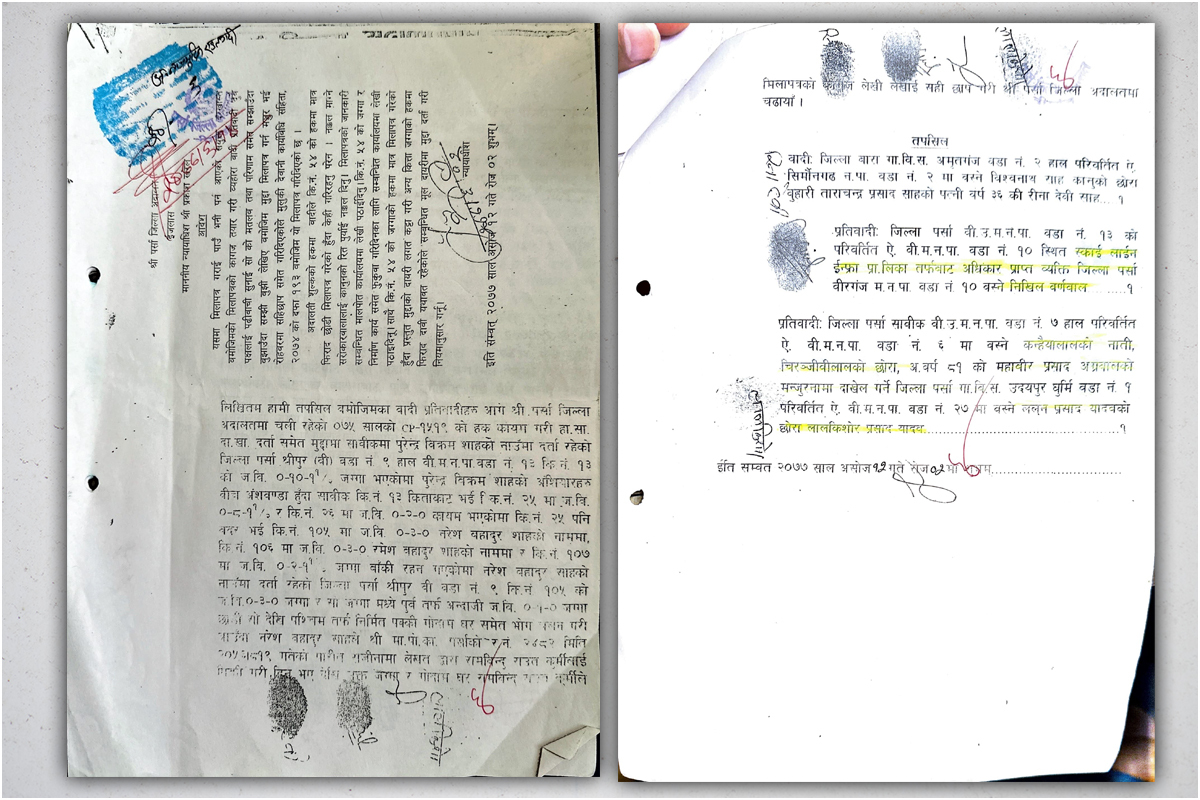
Sources familiar with the case claim Yadav himself assigned Barnwal to facilitate the settlement. They allege that Rina Devi was propped up as a dummy landowner as part of a coordinated design orchestrated by Barnwal and Akriti Agrawal, daughter of Rajesh Agrawal of the Jagdamba Group, and an operator of Skyline. This fraudulent compromise agreement has reportedly not been submitted to the Land Revenue Office to date.
Another anomaly emerges in the court’s handling of the case filed by Rina Devi. The Parsa District Court ruled that Parcel 57, which Sumeshwar Prasad Kalwar had sold to Sunil Kumar Gupta, would remain with Sunil. However, the court recognized Rina Devi’s claim over a small portion of 4 dhur (67.8 square meters) of that land. She lost her claim over Parcel 56 entirely.
This raises the most critical question in the case. How did Rina Devi so easily relinquish her claim over such high-value land located in Adarshanagar, at the heart of Birgunj Metropolitan City?
The explanation lies in another layer of irregularity. The very document that supposedly showed Rina Devi purchasing the land through the Bara Land Revenue Office appears to be forged. While a deed (likhat) exists in Bara records, there is no corresponding ownership ledger (sresta) or official register (moth). Meanwhile, Parcel 105 continues to be recorded in Nikhat’s name at the Parsa Land Revenue Office. The current Chief Land Revenue Officer in Parsa, Khemraj Khati, also confirmed that the title remains with Nikhat.
Once it became clear that the land legally remained under Nikhat’s ownership, a new phase of maneuvering began.
When Nikhat again sought mutation in line with the High Court’s mandamus (paramadesh) order, officials claimed the original case file could not be located and asked her to submit a fresh application. On Baisakh 3, 2081 BS (April 16, 2024), she filed a new application. Four days later, on Baisakh 7 (April 20, 2024), the Parsa Land Revenue Office requested details from the Survey Office. Despite the fact that the then Birgunj Sub-Metropolitan City had already clarified the status of the land through letters dated Asar 7 and Shrawan 8, 2072 BS (June 21 and July 24, 2015), the Land Revenue Office again wrote to Birgunj Metropolitan City on Asar 6, 2081 BS (June 20, 2024), seeking further clarification on ownership.
In response, on Shrawan 1, 2081 BS (July 16, 2024), the Metropolitan City sent a letter stating that the land fell under the acquisition of the Pashupati Adarshanagar Development Committee. The letter claimed that, based on a government decision at the time, the committee had acquired and surveyed the land in 2029 BS, assigned parcel numbers based on boundaries, and sold it accordingly.
The Metropolitan City further argued that Parcels 840, 841, 842, and 843, originally prepared by the committee, had been sold to various individuals, who were in possession of the land. Following the new urban cadastral survey, these were recorded under their names as Parcels 54, 55, 56, and 57. “The lands under Parcels 54, 55, 56, and 57 fall within the cadastral map prepared by the Pashupati Adarshanagar Development Committee and correspond to Parcels 840, 841, 842, and 843,” the letter stated.
But this directly contradicts earlier records. In 2072 BS, the then Birgunj Sub-Metropolitan City had twice stated that the land was not part of any acquisition. How, then, did the same land come to be declared in 2081 BS as falling within the Adarshanagar acquisition map? A high-level source within the Metropolitan City said, “It appears that then Minister and Member of Parliament Pradeep Yadav directed Mayor Rajeshman Singh, who belongs to the same party, to issue such a letter without any factual basis.”
Following this correspondence, the Parsa Land Revenue Office issued a 21-day notice asking current landholders to present proof of ownership. In response, they submitted minutes dated Asar 1, 2029 BS (June 15, 1972), of the Pashupati Adarshanagar Development Committee as supporting evidence. The Land Revenue Office then wrote to the Metropolitan City and the Birgunj Town Development Committee on Ashoj 9, 2082 BS (September 25, 2025) (dispatch number 2478), seeking verification of the authenticity of those minutes. On Ashoj 23, 2082 BS (October 9, 2025), the Town Development Committee responded (dispatch number 7), stating that since the committee itself had only been formed on Mangsir 2, 2033 BS (November 17, 1976), the minutes from Asar 1, 2029 BS (June 15, 1972) could not be related to its office.
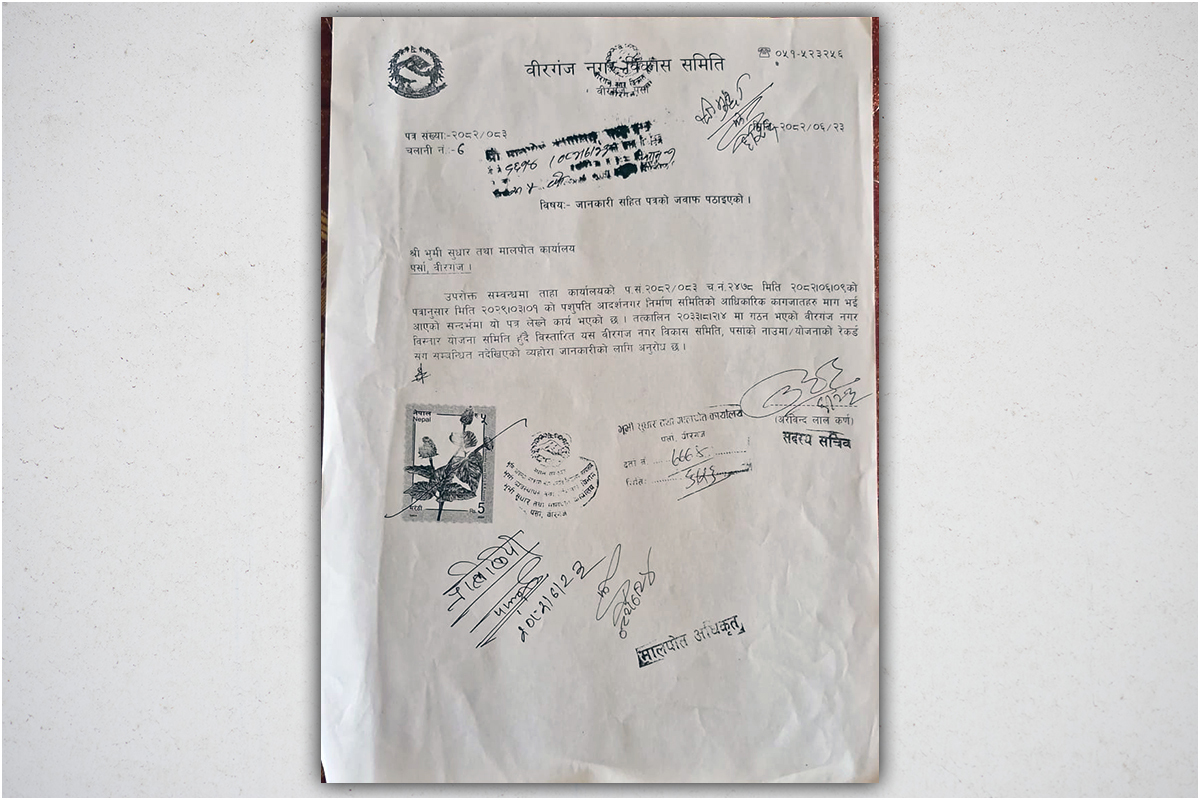
After the Land Revenue Office again sought clarification from the Metropolitan City on Ashoj 9, 2082 BS (September 25, 2025), the city responded on Kartik 23, 2082 BS, with supporting documents. In the same letter, it instructed that the matter be treated as a “closed case” or “final disposal,” and that no further correspondence or disputes be entertained.
This was highly irregular. While legal provisions dictate that appeals against decisions by a quasi-judicial body like the Land Revenue Office can only be made at the district court, an employee of the Metropolitan City, without clarity on decision-making authority, was effectively directing closure of records and final settlement of the dispute.
The connections here point back to former minister Pradeep Yadav and the Mayor of Birgunj Metropolitan City. While serving as minister, during an interaction held on Shrawan 8, 2082 BS under the Asian Development Bank-supported Sirsiya River pollution control project, Yadav reportedly issued a verbal directive to “annul ownership ledgers (sresta).”
Speaking in the presence of Mayor Rajesh Man Singh, he warned: “If we are not vigilant, even Shankaracharya Gate, a major landmark hub in Birgunj, could be registered in someone else’s name by the Land Revenue Office. It is the local government that must protect all this. I request the mayor to control such mafias. As a minister, I say this, you have the backing of the Government of Nepal.”
Not long after, on Kartik 23, 2082 BS (November 9, 2025), the Metropolitan City formally issued a letter calling for annulment of the records. Subsequently, on Mangsir 17, 2082 BS (December 3, 2025) (dispatch number 6032), the Land Revenue Office wrote back requesting supporting evidence for the annulment process.
The letter noted that a review of certified copies of five meetings of the 2029 BS Pashupati Adarshanagar land distribution subcommittee showed that “decisions had been made even before the Government of Nepal had officially published a notice in the Gazette on Ashoj 2, 2029 BS (September 18, 1972) to acquire land for the Adarshanagar project.” It also noted that a later Gazette notice dated 2034/04/24 BS (08-08-1977) had formally constituted a seven-member Birgunj Town Expansion Planning Committee under the Narayani Zonal Commissioner, along with a three-member board.
When the Metropolitan City failed to respond, the Land Revenue Office sent a follow-up letter on Magh 6, 2082 BS (January 19, 2026). There was still no response. The matter was eventually taken to the District Administration Office. Even after joint discussions involving the Land Revenue Office, Survey Office, and the Metropolitan City, no clear answer emerged. A source within the Metropolitan City summed it up bluntly: “When you yourself are involved in forged actions from the start, what answer can you possibly give?”
While acting as her legal representative in the case against the land revenue and survey offices, Tabarak Ali Miya launched a surprising legal action against Nikhat herself. On Mangsir 23, 2075 BS (December 9, 2018), Tabarak filed a debt recovery lawsuit against Nikhat in the Parsa District Court.
He claimed that on Falgun 2, 2068 (February 14, 2012) BS, Nikhat had borrowed Rs. 2.6 million from him under a promissory note (tamasuk). He further alleged that she had taken Rs. 2.5 million from his wife, Sabarun Khatun, and Rs. 5.5 million from his brother, Basarat Ali Miya. Altogether, he argued that a total of Rs. 10.6 million had been transacted, with no repayment of either principal or interest.
However, the documentation submitted to the court appeared highly suspect. One of the promissory notes in Tabarak’s name lists a scribe identified only as “Suresh Prasad” with certificate number 716, but no corresponding address. A review of licensed legal scribes at the Parsa District Court suggests this may refer to Suresh Prasad Gupta. Another note, dated Bhadra 5, 2068 BS and issued in the name of his brother Basarat, lists a scribe named Chaturi Mahato Dhanuk with certificate number 420, yet no address is provided. Records from the Bara chapter of the Nepal Association of Legal Scribes show Chaturi Mahato Dhanuk registered under number 179, while certificate number 420 belongs to someone else. The promissory note in the name of Tabarak’s wife again lists Suresh Prasad as the scribe.
Despite these discrepancies, on Ashadh 30, 2076 BS (July 15, 1019), the court ordered Nikhat to repay the claimed amount, including principal and interest.
During enforcement of the judgment related to Sabarun’s claim, the payable amount was calculated at Rs. 8.79 million. Records show that, with the alleged collusion of Survey Officer Deepak Kumar Singh, Sabarun herself “purchased” 1 kattha 3 dhur (389.4 square meters) from Parcels 56 and 57 (derived from Nikhat’s original Parcel 105).
Following the court’s order, the Land Revenue Office, Parsa, instructed the Survey Office on Asar 25, 2078 BS to subdivide land from Parcel 105, effectively carving out the portion for Sabrun.
Once the 1 kattha 3 dhur (389.4 square meters) was registered in Sabrun’s name, the land was transferred to Skyline Infra Pvt. Ltd. (Skyline Mall). Following this, the remaining 1 kattha 17 dhur (626.4 square meters) of land was also transferred – via auction proceedings – first into the name of Basarat Ali Miya and eventually into the ownership of Skyline Infra Pvt. Ltd. The timeline suggests that once the initial plan using Rina Devi failed, this elaborate “debt and auction” scheme was engineered as a backup to secure the land.
Meanwhile, after Nikhat filed a fresh application on Baisakh 3, 2081 BS (April 16, 2024) seeking enforcement of the High Court’s mandamus order, the Land Revenue Office wrote to the Survey Office on Baisakh 7 requesting verification for mutation. In response, Survey Officer Deepak Kumar Singh, surveyor Sanjay Kumar Jha, and office chief Rakesh Kumar Jha informed the Land Revenue Office that Parcel 105 fell within the jurisdiction of the Pashupati Adarshanagar Development Committee. This contradicted earlier findings. The then Birgunj Sub-Metropolitan City had already clarified that the land did not fall under the committee. Yet, following the Land Revenue Office’s renewed correspondence, the Metropolitan City’s map section chief Gaurav Kumar Jha issued a reply on Shrawan 1, 2081 BS stating that the land did fall within the committee’s cadastral map.
In response, Nikhat submitted an application to Birgunj Metropolitan City seeking official records and clarification. She asked whether her land – original Parcel 13 and current Parcel 105 – had ever been acquired, and if so, under what decision, on what date, and at what administrative level. She also requested details on when such a notice was published in the Gazette, to whom the land was sold thereafter, how much revenue the government collected from such transactions, and which level of authority had approved registration at the Land Revenue Office.
The Metropolitan City refused even to register her application. When she later sent formal requests via the District Post Office to Mayor Rajesh Man Singh, the then Chief Administrative Officer Matrika Bhattarai, and map section chief Jha, she still received no response.
Frustrated, Nikhat escalated the matter, filing complaints with institutions including the parliamentary State Affairs and Good Governance Committee Chair Ram Hari Khatiwada and the National Vigilance Center. “I will fight this to the very end and reclaim my land,” she said. She has also filed a criminal case of forgery and fraud at the District Court. In that case, the court scheduled witness examination for Chait 8, 2082 BS (March 21, 2026).
Rs. 1.25 Billion Loan Against Disputed Land
Skyline Infra Pvt. Ltd. sits at the center of this case. Registered on Kartik 25, 2073 BS (November 10, 2016) (registration no. 151774) at the Office of the Company Registrar, the company has taken loans exceeding Rs. 1.25 billion from two banks. Records from the Land Revenue Office, Parsa, show that by Shrawan 22, 2078 BS, Skyline had acquired a total of 5 kattha 6 dhur (1794.6 square meters) of land in Birgunj Metropolitan City–13, including Parcels 70, 58, 54, and 55. Using this land as collateral, the company secured loans worth Rs. 1.13 billion from Nepal SBI Bank and Kumari Bank Limited.
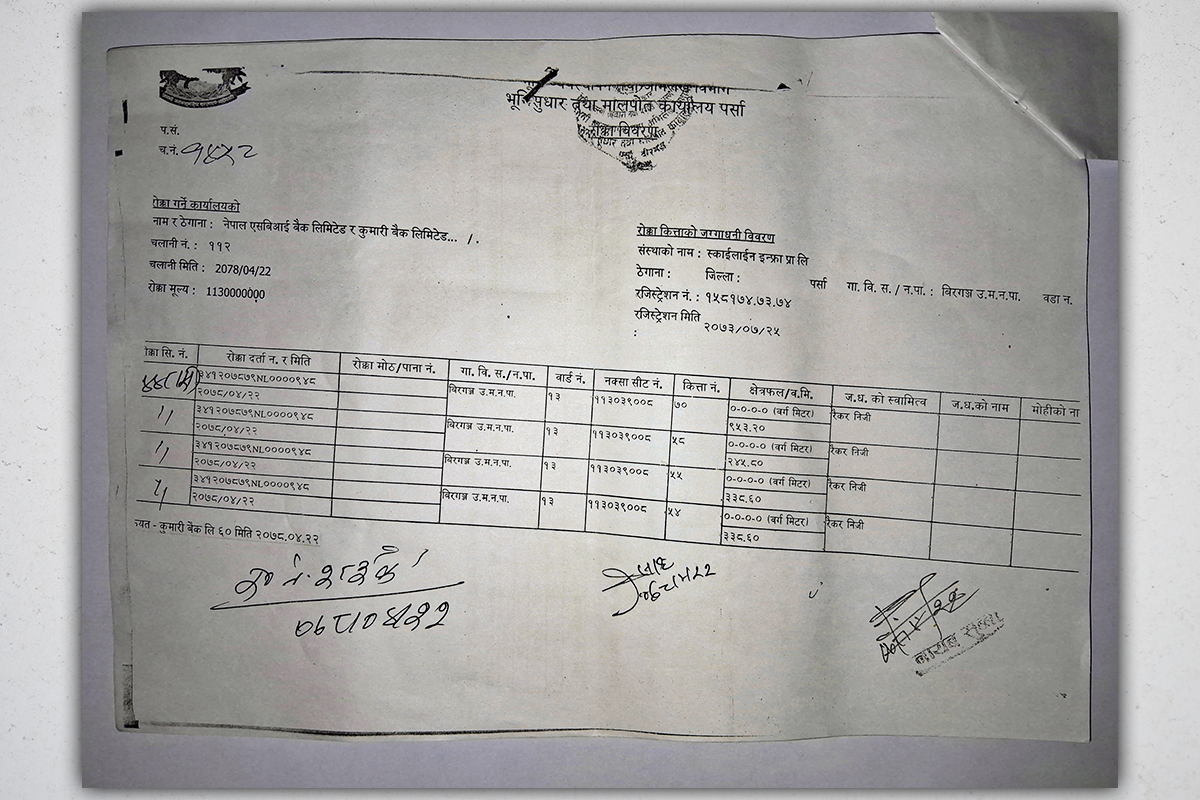
Parcels 70 and 58 were initially purchased by Nilam Agrawal from Shambhu Kalwar and later sold to Skyline. Parcel 54 was transferred by Mahabir Agrawal to Nilam Agrawal through a deed of gift before being sold to Skyline. Parcel 55, meanwhile, had been mortgaged by Rina Kumari Sah to Citizens Bank. After she defaulted, Tahir Hussein acquired it through auction and subsequently sold it to Skyline.
Skyline initially took Rs. 800 million from Nepal SBI Bank and Rs. 330 million from Kumari Bank. Loan documents show that the collateral included not just the land but also all present and future assets on it – buildings, industrial structures, residential units, office spaces, plant and machinery, furniture, and fixtures – under a joint claim arrangement by the banks.
Crucially, the banks appear to have extended these loans without verifying the original cadastral map of 2023 BS. Instead, they relied on land ownership certificates in Skyline’s name, which are now under serious question for being forged.
Including an additional loan of Rs. 125 million extended by Nepal SBI Bank on Magh 24, 2079 BS (February 7, 2023) Skyline’s total borrowing reaches Rs. 1.255 billion. How were such large loans approved so easily?
Bom Bahadur Baniya, manager of Nepal SBI Bank’s Birgunj–Adarshanagar branch, said in conversation that the loans were issued based on documents provided by the borrower, including land ownership certificates and blueprints. He added that if those documents are later found to be forged, action would be taken accordingly.
When asked whether it was appropriate to issue such large loans without verifying the original cadastral records of 2023 BS, he responded, “I cannot speak much on this matter. All legal documents provided by the borrower have already been forwarded to the head office.”
Multiple efforts to contact Amit Sarraf, manager of Kumari Bank’s Adarshanagar branch, were unsuccessful.

Initially registered with one chairperson and 12 directors, Skyline was later converted into a private limited company (Pvt. Ltd.) on Magh 6, 2079 BS (January 20, 2023), according to records at the Office of the Company Registrar. The current register lists Pratik Agrawal of Birgunj–6 as chairperson, with other directors including Aakriti Agrawal of Birgunj–10, Ankur Bhagar Agrawal of Birgunj–5, and Anuj Kayal of Birgunj–13. The company’s shareholders include Pratik, Aakriti, Ankur, and Anuj, along with Anjali Sarawgi, Anshuman Kumar Agrawal, Keshav Sarawgi, Suresh Kayal, Rajesh Hardwares, and Gopal Agrawal.
Despite such large lending, the value of the mortgaged land, even at a prevailing rate of Rs. 5 million per dhur, would amount to a maximum of around Rs. 530 million for 5 kattha 6 dhur. Of this, 3 kattha had been seized from Nikhat, while the remaining 2 kattha 6 dhur belonged to Rukmini Devi Kedia and had similarly been appropriated.
The land belonging to Kedia – originally Parcel 15 in former Shreepur–9, measuring around 2 kattha – had been subdivided into Parcels 70 and 58. Claims similar to Nikhat’s have been raised over this land as well, with former Birgunj Chamber of Commerce president Pradeep Kumar Kedia (Rukmini Devi’s grandson) filing applications with both the Land Revenue Office and the Metropolitan City, seeking mutation (update of ownership records) based on original records.
Claiming that loans had been issued against land fraudulently seized from her, Nikhat Parveen filed complaints on Asar 19, 2081 BS (July 3, 2024) with Nepal SBI Bank and Kumari Bank branches, as well as their central offices and Nepal Rastra Bank, demanding action. No action followed. Nepal Rastra Bank spokesperson Guru Prasad Paudel stated that the matter falls under the supervision department and could only be commented on after review.
Sources familiar with how land was funneled into Skyline Infra claim that the process was enabled by the influence of former minister Pradeep Yadav and businessman Rajesh Agrawal of the Jagdamba Group. They allege that the company was structured under their design to secure bank financing, resulting in a “conspiracy of silence.” Agrawal’s daughter Aakriti is an investor in the company. While Yadav may not be directly linked to the company, the involvement of his personal secretary and his public statements point to deeper ties.
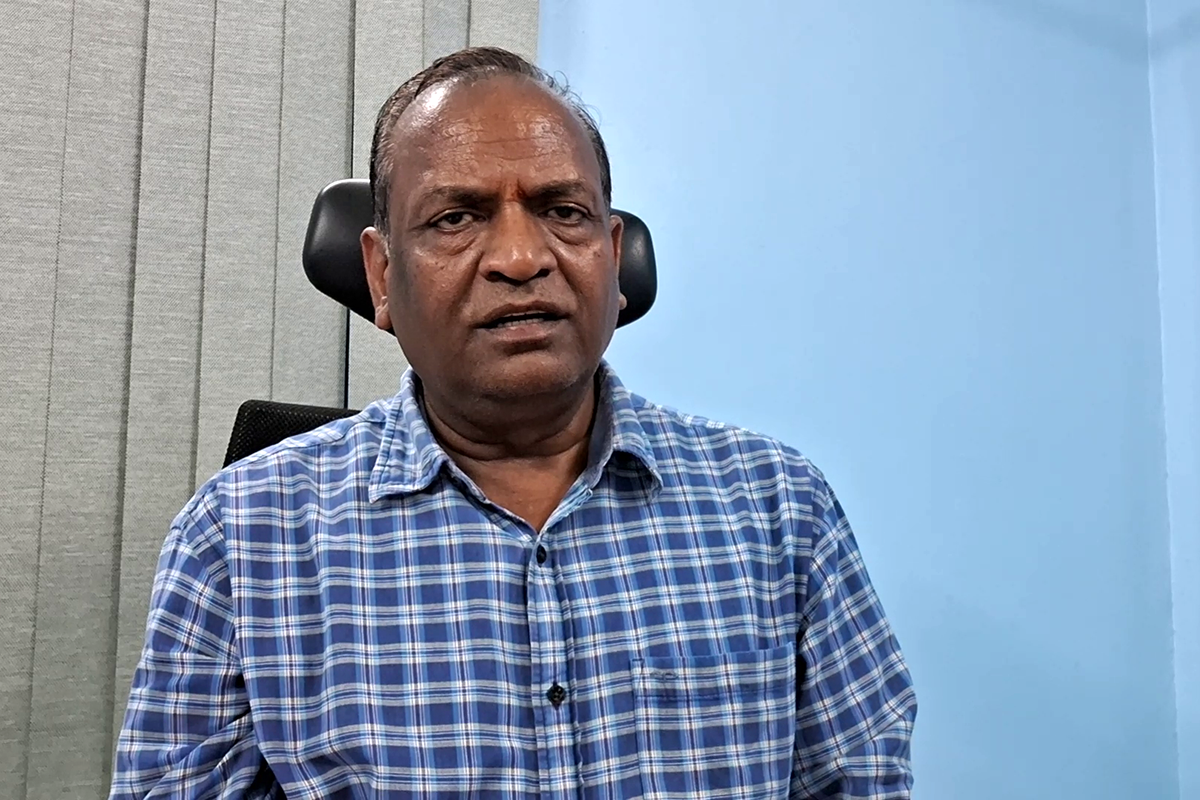
While serving as Minister for Drinking Water, Yadav, during an interaction on the Sirsiya River pollution control project on Shrawan 8, 2082 BS (late July 2025), made remarks about “land mafias” in Birgunj, explicitly naming Nikhat. “Sometimes Nikhat Parveen, sometimes another Parveen, sometimes a Kedia – people keep appearing to grab land,” he said. “It is the responsibility of Birgunj Metropolitan City to prevent land grabbing. Immediate action is needed.”
Speaking for nearly two minutes about the lands of Nikhat Parveen and Pradeep Kedia, he added, “Such mafias have emerged that they could register all land in Birgunj Metropolitan City in someone else’s name. Who knows when even Ghantaghar will be transferred?”
Landowner Nikhat and Pradeep Kedia, representing Rukmini Devi Kedia’s heirs, reject such rhetoric. “Land seized through forged documents does not become legitimate just because influential leaders make speeches,” Kedia said. “Transferring land from Parsa through fake registration in Bara, falsely claiming acquisition, and then legitimizing it through power does not make it legal.”
During his tenure, Yadav also allegedly exerted undue pressure to allow a casino to operate inside Skyline Mall. Despite regulations prohibiting casino operations within five kilometers of an international border, permission was granted by the District Administration Office under his influence, even though the site lies within three kilometers.
A casino is now operational there under Majong Holdings Pvt. Ltd. Repeated attempts to contact former minister Pradeep Yadav and Birgunj Mayor Rajesh Man Singh for comment were unsuccessful.
Land worth Rs. 1.43 billion
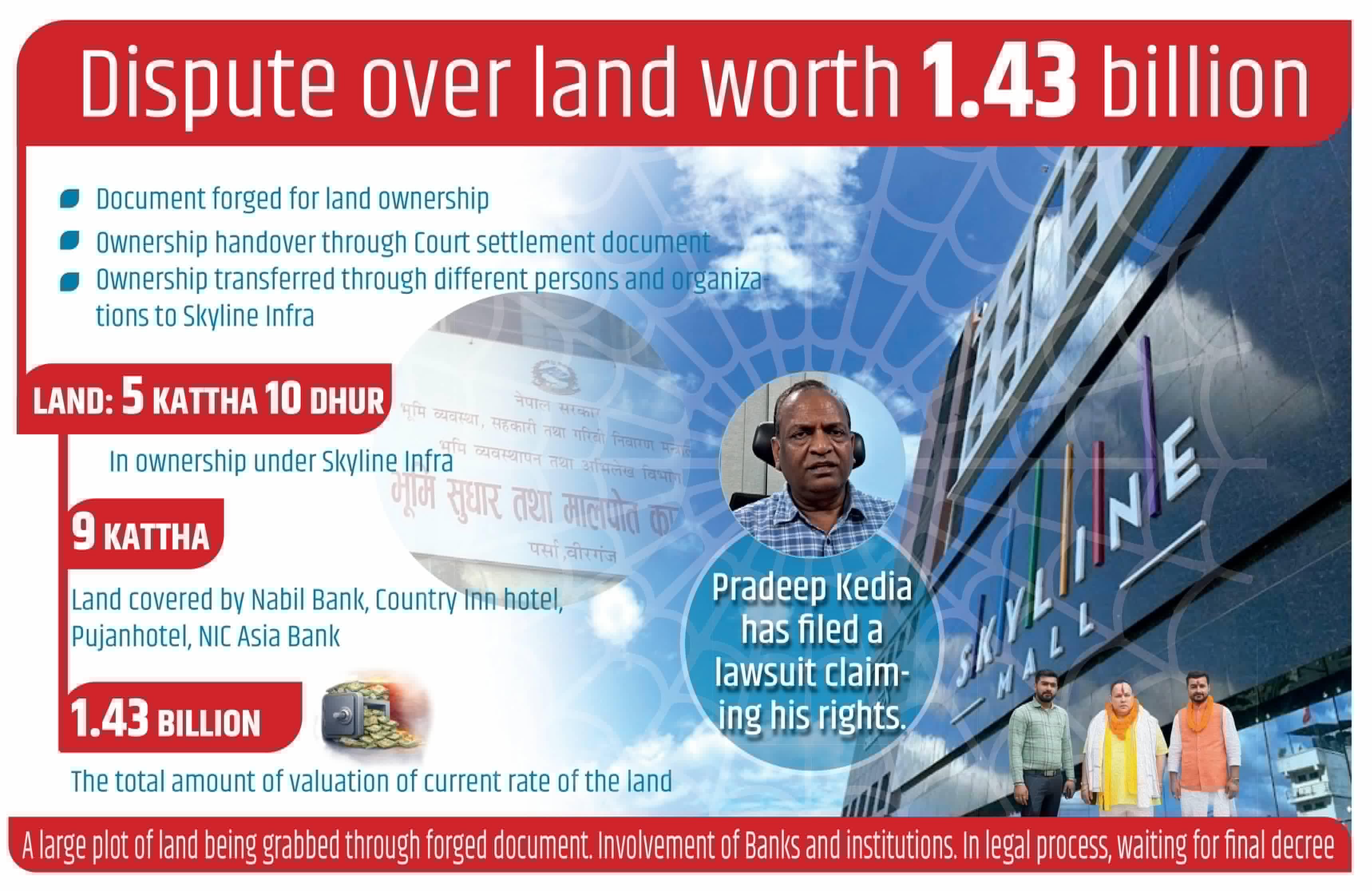
CIJ’s examination of events, facts, and documents indicates that Skyline Infra acquired 1 kattha each from Parcels 54 and 55 through court-mediated settlement based on forged documentation. Similarly, 14 dhur from Parcel 58 and 2 kattha 6 dhur from Parcel 70 were transferred through fraudulent mutation from Shambhu Kalwar to Nilam Agrawal and eventually to Skyline.
In total, 5 kattha 10 dhur of land appears to have come under the company’s control through such means.
After Pradeep Kedia initiated legal proceedings claiming ownership over this land, the Land Revenue Office issued a 21-day notice to the banks, institutions, and individuals occupying it, and sought clarification from Birgunj Metropolitan City regarding whether the land had ever been acquired. The metropolitan office had yet to respond. Even after multiple discussions at the District Administration Office, the city had repeatedly asked for more time.
This includes 2 kattha 6 dhur from Rukmini Devi Kedia’s original Parcel 15 in Shreepur VDC–9 (B). An additional 9 kattha from her Parcel 14 is currently occupied by institutions such as Nabil Bank, Country Inn Hotel, Pujan Hotel, and NIC Asia Bank.
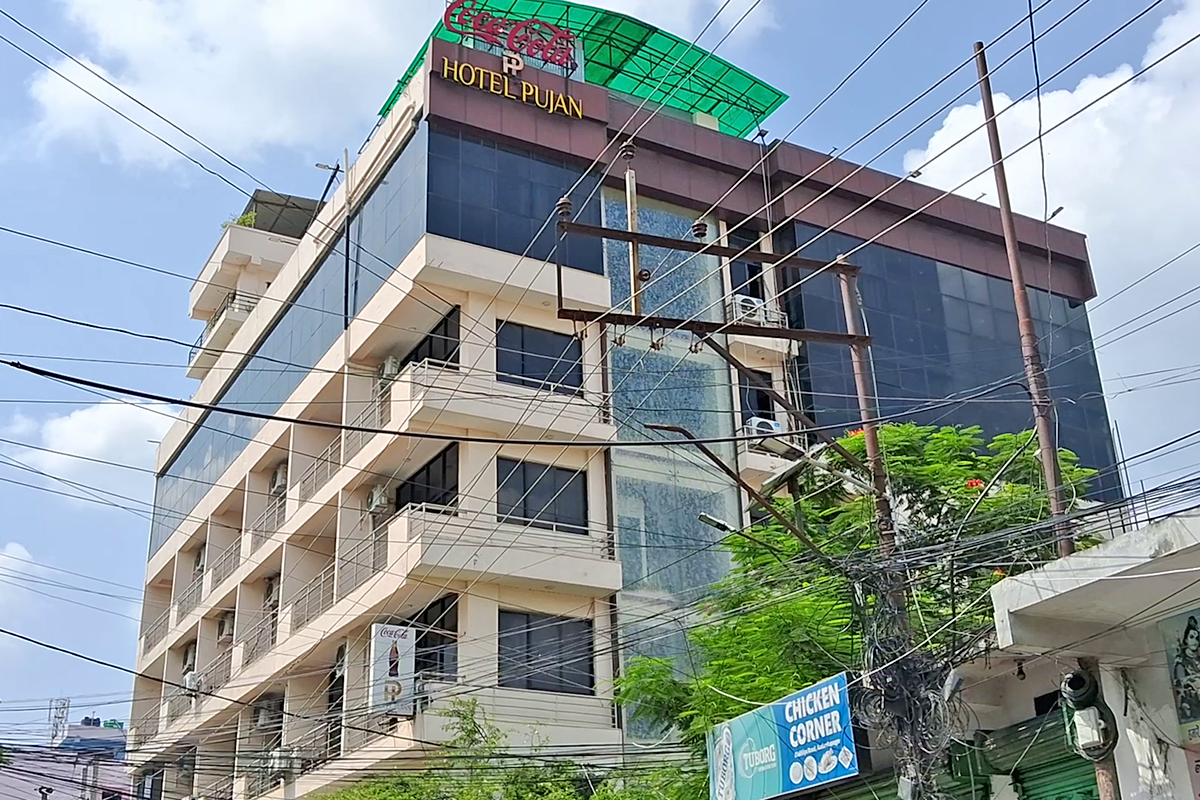
The prevailing market value of the total 14 kattha 6 dhur land – 5 kattha 6 dhur held by Skyline, and 9 kattha held by other entities – stands at no less than Rs. 5 million per dhur. By this calculation, Skyline’s share of 106 dhur alone amounts to approximately Rs. 530 million. Including the remaining area, the total value of allegedly seized land reaches Rs. 1.43 billion.
The official government valuation, however, is Rs. 22.5 million per kattha.
Parsa’s Chief Land Revenue Officer Khemraj Khatri confirmed that the land originally appears to belong to Nikhat Parveen and Rukmini Devi Kedia, but now hosts a large commercial mall. “Had their ownership ledger (sresta) been legally annulled, the mall developers would have gained rightful ownership,” he said. “We asked for the minutes, proof of revenue payment, but even in meetings held in the presence of the Chief District Officer, the metropolitan office has only engaged in stalling tactics.” Khatri added that while claims over Kedia’s land lack sufficient supporting evidence, Nikhat’s case is complicated by the loan dispute currently before the court, and can only be resolved after that is settled.
It appears the land mafias struck when they realized Nikhat’s land was poorly guarded. The Kedia family only discovered their land had been seized when Nikhat’s representative contacted Pradeep Kedia to sign a document regarding adjoining parcels.
Pradeep Kedia said his family owns land across the country, and while they were aware of the Adarshanagar property in Birgunj, they had been misled into believing it had been acquired by the state. “Land mafias tried to seize it. With power, anything seems possible in this country,” he said. “Even now, when the District Administration tries to resolve the dispute, the Metropolitan City Office continues to resist. Instead of supporting rightful owners, it harasses them for impossible proof while enabling land grabbers. That is what hurts the most.”
More Investigative Stories
Who Does The Annapurna Belong To?
In fiscal year 2082/83 BS, the Annapurna Conservation Area Project (ACAP) received 508,000 visitors and collected more than NPR 1.77...
Politicized Budget Distribution in Madhesh is Contrary to the Spirit of Federalism
From small projects that local governments can implement themselves to the selection of projects based on political connections, the pattern...
Comment Here