Investigative Stories
Afforestation in Sudurpaschim: Millions Planted, Almost None Protected
Despite spending tens of millions of rupees to plant millions of saplings, forest cover in Sudurpaschim continues to decline. With no data on how many saplings actually survive, the very premise of afforestation campaigns is now being called into question.

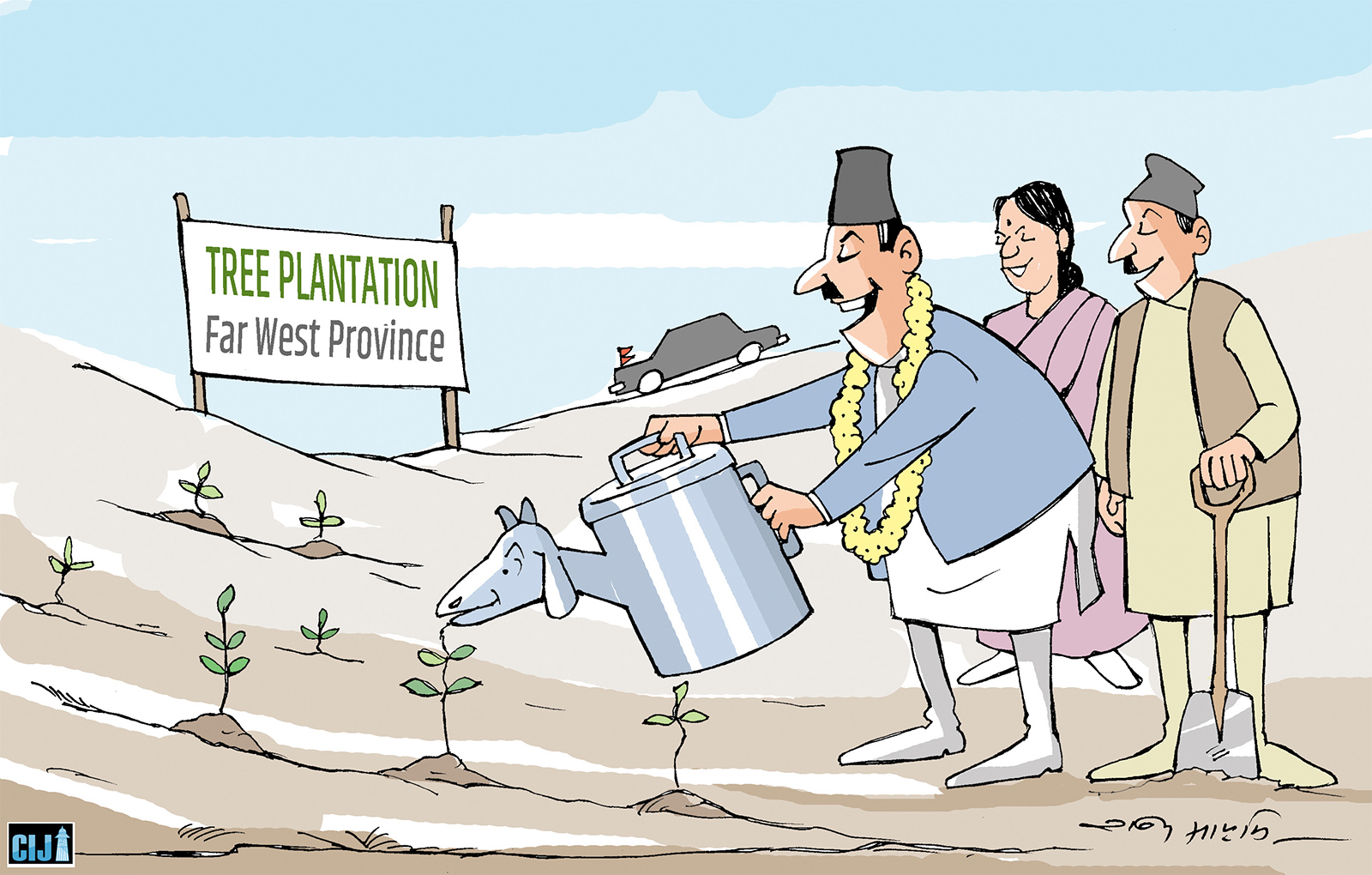
On paper, Sudurpaschim Province appears to be moving towards greater greenery. Over the past seven years alone, government records show that nearly 14.2 million saplings have been planted across thousands of hectares. But the reality is quite the opposite. Instead of expanding, forest cover is shrinking, and most saplings perish before they can take root.
This raises a fundamental question. Have afforestation programs become merely a means of spending budgets?
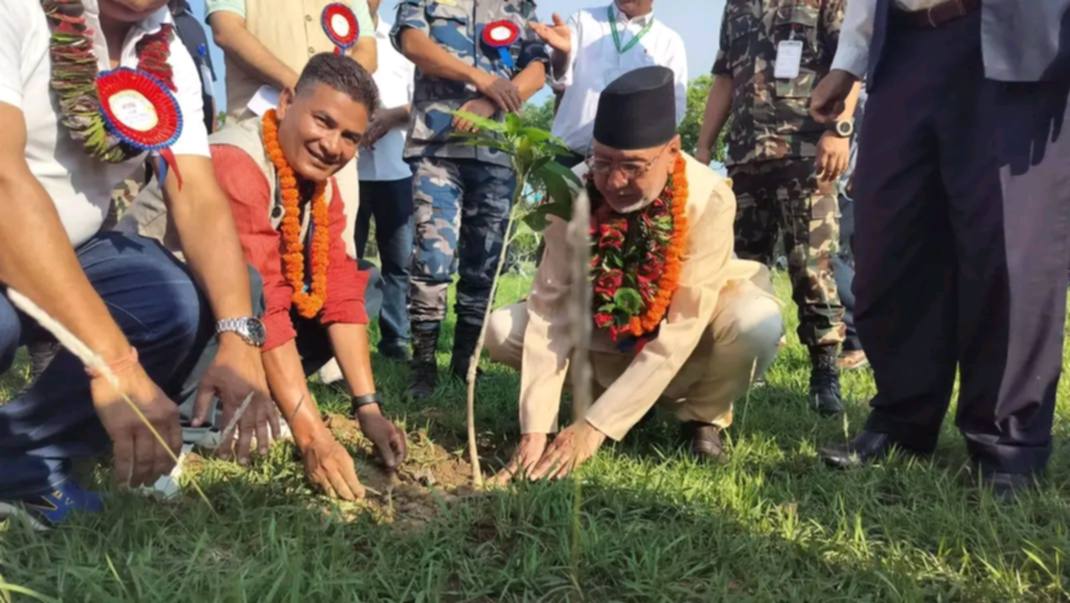
With the onset of the monsoon, plantation drives have become routine across public land and community forests. These programs are typically inaugurated by ministers, ministry officials, or local leaders. Yet once the ceremonial planting is done, no institution or individual is held responsible for nurturing the saplings.
Green on Paper, Barren on the Ground
According to the provincial Ministry of Industry, Tourism, Forest and Environment, more than 7.785 million saplings were planted across 1,030 hectares between fiscal years 2074/75 and 2077/78 BS, at a cost of Rs. 77.857 million. The campaign has only expanded since then.
In 2078/79 BS, 2.273 million saplings were planted across 247.16 hectares. In 2079/80 BS, 2.205 million saplings were planted across 109 hectares, and in 2080/81 BS, 1.908 million saplings were planted across 159.67 hectares. In total, Rs. 141.7 million has been spent over seven years to carry out plantation across 1,545.83 hectares.
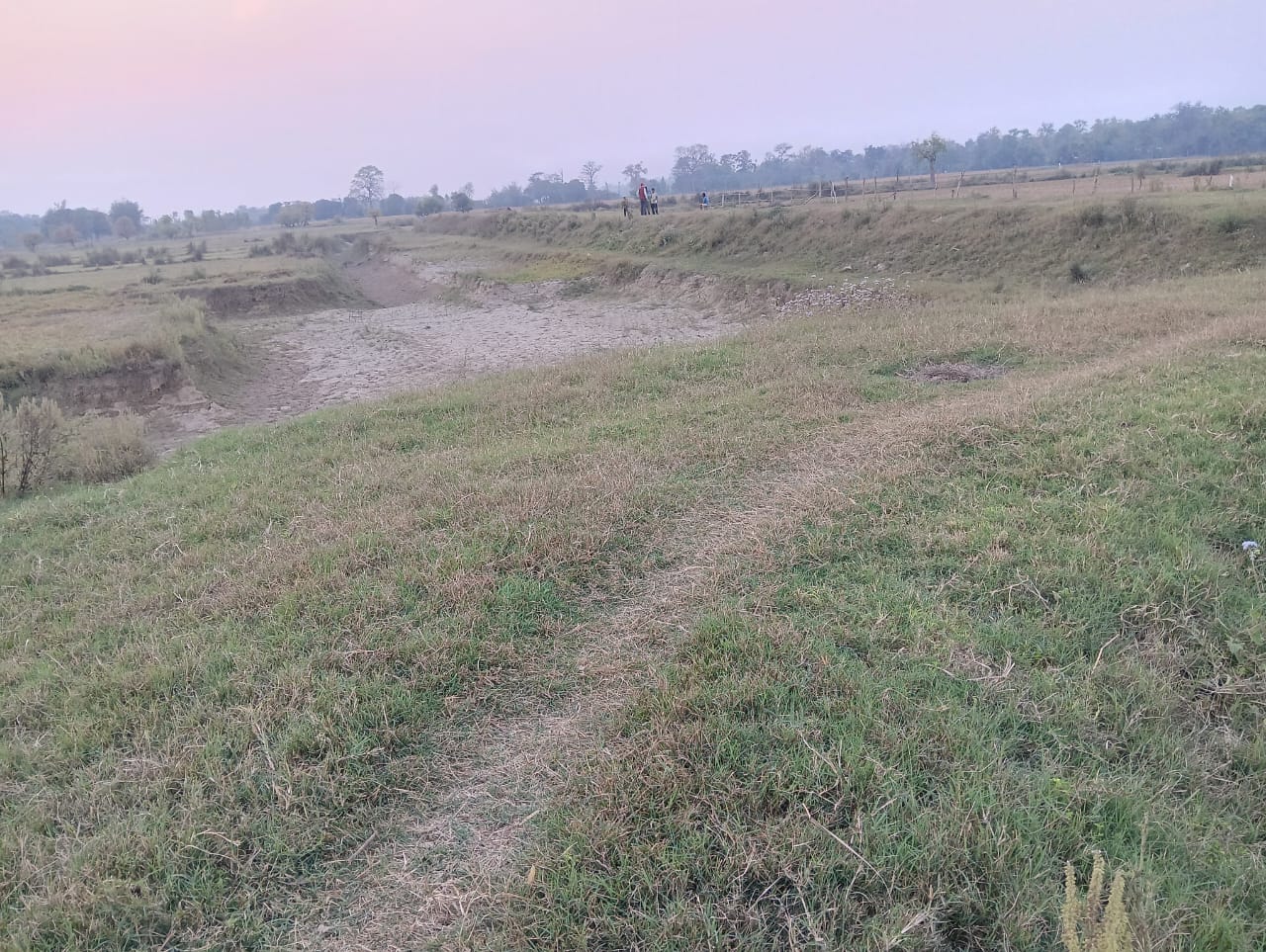
Yet forest cover has not expanded. On the contrary, since 2074 BS, nearly 28,000 hectares of forest land have been encroached upon, with Kailali and Kanchanpur districts leading the trend.
Forest conservationist Yadav Bhandari says, “If we add up the government’s annual plantation figures, it would appear that more trees have been planted than the total forest area of Sudurpaschim. But this is not reflected on the ground.”
Stakeholders point to a core flaw. Saplings are planted and then abandoned. Sarita Gautam of Dhangadhi-3 says, “Every year, there is a program, photos are taken, speeches are made. But no one is concerned about who will look after or nurture those saplings.” According to her, plantation drives have largely become a means of producing progress reports and exhausting budgets.
Forest conservation activist Dandee Raj Subedi echoes this concern. “Thousands of saplings are planted in a single day at a single location. By the very next day, livestock have already eaten them,” he says. The lack of planning – planting “whatever is available, wherever there is space” – has weakened the campaign.
Lack of Technical Knowledge and Planning
For afforestation to succeed, factors such as location, soil, climate, and species selection are critical. In practice, these are often ignored.
Purushottam Wagle, information officer at Shuklaphanta National Park, says, “If saplings are planted without considering soil type, water availability, and species suitability, they simply do not survive.”
Subash Kunwar, information officer at the Division Forest Office Kanchanpur, identifies another major issue: lack of post-plantation care. “There is no irrigation, no fencing, no monitoring. In such conditions, how can saplings survive?” he asks.
According to Kunwar, the tendency to prioritize fast-growing species has also undermined long-term forest development. Every year, millions of saplings are planted across forest areas, private land, and barren land. Yet forest density and coverage have failed to increase.
In Ashadh of 2082 alone, 450,000 saplings were produced and distributed in Kanchanpur alone. Every year, millions of rupees are spent on sapling production and plantation, yet most saplings perish before they can establish roots.
Showpiece Programs at the Local Level
Thousands of saplings are planted every year across Kailali and Kanchanpur, with strong public participation in areas such as Lamkichuha, Belauri, Kailari, and Godawari. But most of these saplings disappear within months.
Both natural and human factors contribute to this. Forest fires, open grazing, encroachment, and human negligence prevent saplings from surviving.
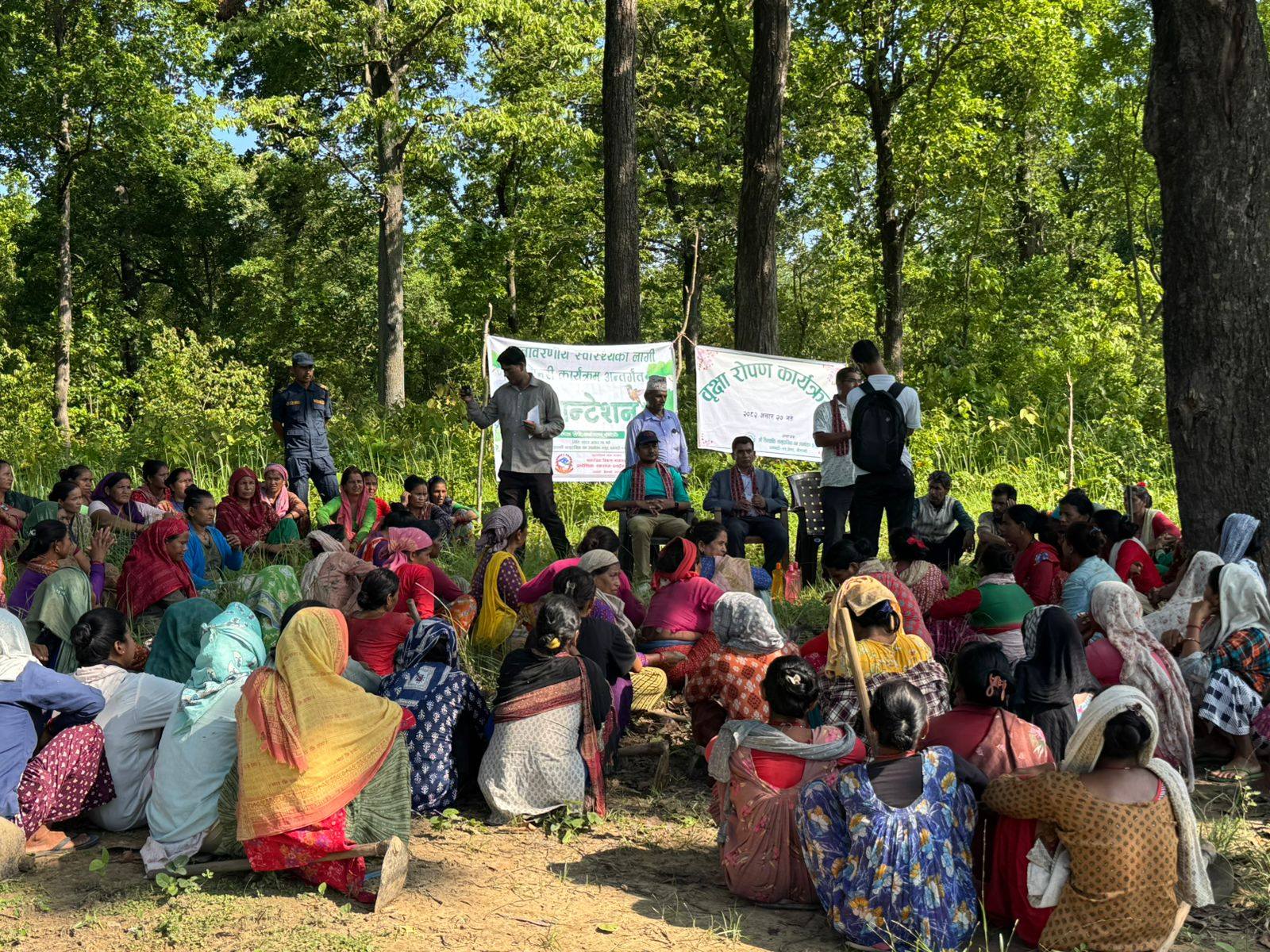
In Ashadh 2082, around 2,000 saplings were planted in the Mukta Kamaiya Community Forest in Lamkichuha-3, Kailali, in the presence of Chief Minister Kamal Bahadur Shah and other stakeholders. Similarly, more than 2,000 saplings were planted in Belauri-7, Kanchanpur under the campaign “Greenery for Future Generations.” Yet the long-term impact of such programs remains weak.
In Kailari Rural Municipality’s Koseli Community Forest, 3,000 saplings disappeared within a short period. In Pavera Community Forest, 18,000 saplings were lost; in Dilasaini Community Forest of Dhangadhi-3, 32,000; in Shivashakti Community Forest of Dhangadhi-11, 4,000; and in Chetana Community Forest of Godawari, 12,000 saplings failed to survive due to lack of protection. These areas now lie barren.
Even 500 bamboo and cane saplings planted around Puraina Lake in Bhajani-7 were destroyed due to lack of care. Local residents cite stray cattle and absence of protection as key reasons.
In some cases, saplings have been uprooted the very next day. In Dhangadhi-19, a plantation program for Mohana River control failed on the second day due to local disputes.
Kunwar says that without protection, plantation objectives cannot be achieved. “If forests are protected from encroachment and interference, natural regeneration alone can support forest development,” he says, adding that plantation in barren riverbeds and open land can still be beneficial.
Bhandari adds that this problem is not limited to Sudurpaschim but exists nationwide. “Instead of planting new saplings, it is often more effective to conserve and regenerate existing natural forests,” he says.
Krishna Singh Air, chairperson of the Dilasaini Community Forest, says protecting saplings from forest fires remains a major challenge.
Data Exists, Monitoring Does Not
According to the Division Forest Office Kailali, more than 8.2 million saplings were planted between 2068/69 and 2080/81 BS, with over Rs. 82.8 million spent. But the most critical question remains – how many survived? There is no answer.
Most offices do not maintain any data on sapling survival rates.
Provincial Forest Director Hemraj Bista is not ready to call the program a complete failure. “It may not have been as successful as expected, but it is not entirely unsuccessful,” he says. According to him, plantation on private land has had some positive impact by reducing dependency on forests.
Ministry spokesperson Bhojraj Pathak says a new model will be adopted, with plans to partner with community forests and distribute responsibility more clearly.
“Not Just Planting, But Protecting”
Experts argue that a shift in approach is essential. The current practice of planting and abandoning saplings cannot yield meaningful results.
Subedi says, “Afforestation must be treated not as a campaign, but as a responsibility. It is not enough to plant saplings; a system must be in place to protect them.”
Purushottam Wagle, information officer at Shuklaphanta National Park, also points to weak technical foundations as a key issue. “Saplings do not survive if species are selected without considering location, soil, and water conditions,” he says. “Scientific planning must come first.”
Kunwar emphasizes that post-plantation care is even more critical. “Planting alone is not sufficient,” he says. “Without irrigation, fencing, and regular monitoring, afforestation cannot succeed.”
Subedi adds that local governments and communities must play a central role. “Saplings will not survive unless local communities are meaningfully engaged with responsibility. It must be clear who is accountable not just for planting, but for protection.”
Provincial Forest Director Hemraj Bista Hemraj agrees that without long-term planning and monitoring, afforestation campaigns cannot succeed. “Saplings must be cared for like children. Planting alone does not create forests,” he says, stressing that protection is the decisive factor.
Krishna Singh Air, chairperson of the Dilasaini Community Forest, adds that unless unless the provincial government implements clear policies, procedures, and monitoring systems, plantation programs will remain symbolic. “In the current state, it may create some employment and commission opportunities for a few individuals, but it does not contribute to forest conservation or expansion,” he says.
More Investigative Stories

Who Does The Annapurna Belong To?
In fiscal year 2082/83 BS, the Annapurna Conservation Area Project (ACAP) received 508,000 visitors and collected more than NPR 1.77...
Politicized Budget Distribution in Madhesh is Contrary to the Spirit of Federalism
From small projects that local governments can implement themselves to the selection of projects based on political connections, the pattern...
Comment Here