Investigative Stories
The Silent Crisis of Internal Trafficking
Data reveal that the trafficking of women and girls within Nepal has escalated into a silent crisis. Yet efforts by the state, from local to federal levels, remain feeble against such a grave crime.


On 14 March 2025, Nepal Police rescued five underage girls from the temple shelters inside the Pashupatinath premises. They were taken to Maiti Nepal, still visibly under the influence of drugs. Among them was Sajina.
Enticed by promises of “earning money”, Sajina had been brought from Sunsari by a relative. With her stepfather in prison and her mother gravely ill, she dropped out of school in Grade 5 and began working in a flower shop and later a bag factory. It was there that friends first introduced her to cigarettes and alcohol, and eventually to narcotic pills.
Rani, 20, arrived in Kathmandu in search of a better life. After finding work at a small clothing shop, she met Samikshya, who lured her with the prospect of “quick and easy money.” When Rani’s mother suddenly fell ill, the urgent need for treatment costs pushed her into contact with a man named Akash – who coerced her into prostitution.
Seventeen-year-old Seema took a job as a waitress at a dance bar in Thamel. The owner, Dipak Tumsing Magar, promised her a monthly salary of NPR 15,000 for night shifts, along with meals and tips. But within a week of starting in March–April 2025, she was pressured to sleep with customers at a nearby guesthouse. When she refused, she was beaten and burned on the hand with a cigarette. In April–May 2025, police raided the club and arrested Magar and one of his employees, Ishwar Century.
Rescued girls and adolescents often lack immediate family support. Many do not possess citizenship documents. Without these, they have no legal basis to file complaints. Brokers exploit precisely this vulnerability to ensnare them.
‘Let’s Clean Our Own Yard First’
The trafficking of women and girls within Nepal is no longer an isolated crime. It has grown into a social crisis, spreading unchecked as state monitoring and enforcement remain weak. Recent data show that human trafficking inside the country has taken on increasingly organized forms.
According to the Human Trafficking Investigation Bureau of Nepal Police, 1,679 survivors – both internal and cross-border were rescued between 2019 and 2026 January. Of them, 1,078 were women. Bureau spokesperson Superintendent of Police Bishwaraj Khadka reported that in the current fiscal year alone, 50 people were rescued through 19 joint operations nationwide, including 40 girls.
Between 2019 and mid-January 2026, the bureau registered 435 cases involving 657 survivors, 249 of whom were girls. In last fiscal year alone, 61 cases were filed, with 42 girl survivors. Over the past seven years, 887 accused were named, but only 671 were arrested. Even in a crime as grave as human trafficking, many perpetrators remain beyond the reach of the law.
Data from non-governmental organizations, including Maiti Nepal, suggest the number of children affected by internal trafficking is even higher. Maiti Nepal reports that girls have been rescued almost daily over the past two and a half years from hotels, restaurants, spas, and guesthouses in Kathmandu and other major cities. Yet not all of those rescued enter the formal complaint process.
In 2025 alone, Maiti Nepal rescued 337 people from the Kathmandu Valley. Of them, 56 percent were adults and 44 percent minors. In 2024, the number was 278. Maiti Nepal chairperson Anuradha Koirala remarked: “For many years, we spoke about trafficking abroad. But when girls are being pushed into the sex trade within the country itself, the state does not appear serious.”
Indra Raj Bhattarai, global coordinator of KIN INDIA, an organization working against trafficking, exploitation, and gender-based violence, says internal trafficking has spread across major cities including Kathmandu, Pokhara, Chitwan, Butwal, Dharan, and Biratnagar.
“They bring adolescent girls from villages, promising jobs in hotels, spas, dance bars, and restaurants. There is no fixed salary, no defined working hours. Gradually, they fall into exploitation,” Bhattarai explained. He warned that the trend is growing at an alarming pace and that Nepal’s entertainment sector can no longer remain unregulated. “The exploitation of young women and girls is not limited to restaurants or spas. Increasingly, customers are being called directly to rooms, with girls supplied there. Many of those found are under 18.”
In coordination with the Ministry of Women, Children and Senior Citizens, rehabilitation centers are operating in Jhapa, Morang, Chitwan, Makwanpur, Parsa, Kathmandu, Surkhet, and Kailali. Other non-governmental organizations are also engaged in rescue and rehabilitation. Pushpa Rai, an official at the ministry’s Human Trafficking Control Section, notes that the number of women and children entering these centers is steadily rising.
In fiscal year 2022/23, 798 survivors were housed in 10 institutions. By 2024/25, that number had grown to 4,200 nationwide. These centers provide shelter to survivors of smuggling, trafficking, and domestic violence.
Rai says the greatest challenge in rehabilitation is rejection by families. “Families do not accept them. Legal aid, psychosocial counselling, food, and accommodation all must be arranged,” she explained. In some cases, because families have already broken apart, survivors remain in rehabilitation centers for extended periods.
According to Bishwo Khadka, spokesperson for Maiti Nepal, the situation of internal trafficking of women and girls is alarming. He says the highest number of rescues so far have come from hotels, restaurants, spas, and eateries in areas such as the Kathmandu bus park, Koteshwor, and Jadibuti.
Khadka adds that the government has failed to regulate hotels, restaurants, and spas operating outside established standards. Since Covid-19, he notes, economic hardship and the lack of viable livelihoods have pushed more young women seeking work in the entertainment sector into exploitative situations. Girls between the ages of 13 and 18 remain at particularly substantial risk.
How Are Girls Drawn In?
According to data from the Human Trafficking Investigation Bureau, 86 cases were registered in the Kathmandu Valley between the year 2019 and 2026 January. Outside the Valley, 31 cases were recorded in Banke, 28 in Kaski, 17 in Kailali, 19 in Sunsari, and 18 in Chitwan.
“Poverty, family breakdown, and the misuse of social media and mobile phones are putting children at greater risk,” said Bishwaraj Khadka, spokesperson for the bureau and Superintendent of Police. “Those between the ages of 14 and 22 are the most vulnerable. Victims above 22 are often reluctant to file complaints with the police.”
The bureau notes a growing pattern: “friends pull in friends.” In several cases, girls were told, I’m earning well, you should come too. “The network has become so complex that in some instances, victims themselves, under pressure or dependency, end up recruiting new victims,” SP Khadka explained. “Lack of awareness and economic hardship are the main drivers.”
Charimaya Tamang, chairperson of Shakti Samuha, says girls from economically vulnerable households, those without parental supervision, and those raised in fragile family environments are easily lured and exploited.
Benu Maya Gurung, executive director of the Alliance Against Trafficking in Women and Children (AATWIN), emphasized that sexual and labor exploitation of children is especially prevalent in the entertainment sector. “Girls and young women who come to cities from villages for work or education often cannot cover their expenses. They end up in this sector, forced to work for extremely low wages. That creates pressure to earn extra money by pleasing customers,” she said.
According to Uma Tamang, a lawyer affiliated with Maiti Nepal, adolescent girls often become trapped in drug dependency alongside sexual exploitation, leaving them even more vulnerable to further abuse.
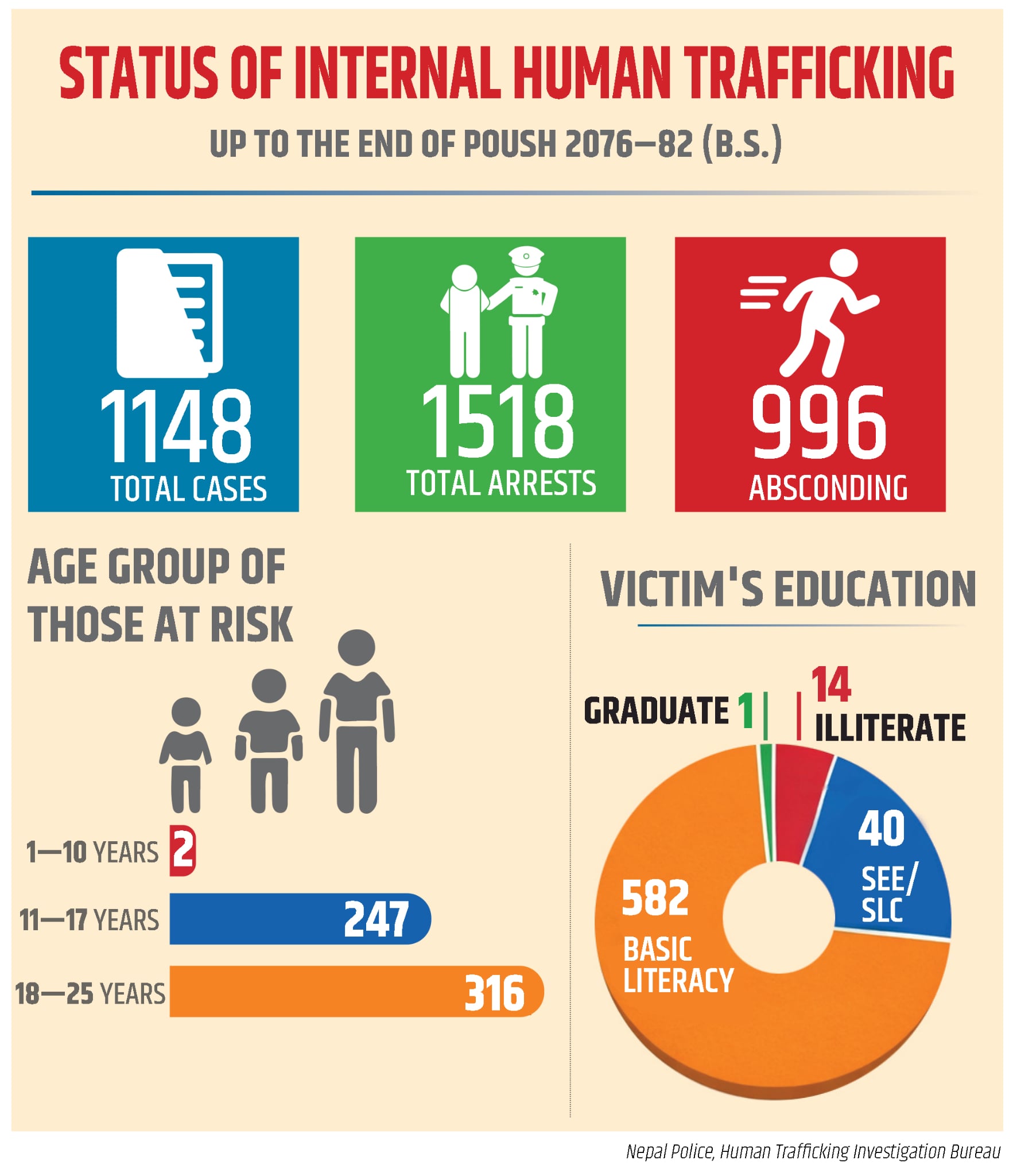
A closer look at survivors’ educational backgrounds shows that lack of schooling remains a major pathway into exploitation. Of 637 survivors, 582 had only basic literacy, while 14 were illiterate. Just 40 had studied up to the School Leaving Certificate or Secondary Education Examination level, and only one had reached the bachelor’s level.
The nature of trafficking-related offences also reveals a clear pattern: sexual exploitation lies at the core of this crime. Bureau data show that of 1,148 total cases recorded between 2019/20 and 2025/26, 404 were linked to sexual offences. These include 116 cases registered under sex trade and sexual exploitation, and 101 under trafficking and sexual exploitation. Taken together with other sexual offence categories, they account for nearly half of all cases, underscoring that internal trafficking in Nepal is primarily driven by sexual exploitation.
A particularly troubling trend is the rise in prostitution and human trafficking-related cases in official records. In fiscal year 2024/25, five such cases were registered; by 2025/26, the number had jumped to 27. This suggests attempts to normalize sexual exploitation as a “service” through hotels, spas, and the wider entertainment sector. At the same time, labor exploitation remains significant, with 98 cases registered under trafficking for labor exploitation and 379 under transportation for labor exploitation.
Basanta Panthi, head of the Human Trafficking and Transportation Control Section at the Ministry of Women, Children and Senior Citizens, says the drivers of internal trafficking are multidimensional: poverty, unemployment, lack of education and information, family and social pressure, the absence of safe employment opportunities, and the active role of brokers and organized networks. “At times, the lure of quick money also draws people toward risky proposals,” he noted.
No Integrated Record
The age profile of survivors of internal trafficking shows that minors are the primary targets. Bureau data show that 247 of those rescued over the past six years were between the age of 11 and 17. Another 316 survivors were aged 18–25, suggesting that exploitation often begins in adolescence and continues into young adulthood. Two children aged 10 or younger were also identified.
In terms of caste and ethnicity, 310 survivors were from Adivasi-Janajati communities and 123 from Dalit communities. Together, these two groups account for nearly two-thirds of all survivors. Others were recorded from Brahmin (30), Chhetri (121), Madhesi (44), and Muslim (7) communities.
The data also highlight a deeper problem: government agencies lack consistency in how they study, record, and classify trafficking.
For example, the Nepal Police Human Trafficking Investigation Bureau reports that 1,518 defendants were arrested and 996 remained at large in connection with 1,148 cases registered since 2019. By contrast, the Human Trafficking Control Section under the Ministry of Women, Children and Senior Citizens notes that the number of people sheltered in rehabilitation centers alone had reached 4,200 by fiscal year 2024/25.
While the ministry’s data show a rising overall number of survivors, they do not distinguish between internal and cross-border trafficking. Police data, meanwhile, separate cases and defendants but categorize offences differently – under prostitution, sexual exploitation, trafficking, and labor exploitation – making direct comparison difficult.
Incomplete Efforts at the Local Level
Kathmandu Metropolitan City introduced the Human Trafficking and Transportation Control Procedure in 2021, creating a separate legal and institutional framework to address human trafficking. The city’s Law and Human Rights Department, along with ward committees, works to raise awareness and support survivor rehabilitation. Yet the most alarming picture of trafficking and transportation is visible within Kathmandu itself.
Local governments have the authority to formulate laws on the issue. Each year, the ministry awards municipalities that perform well in anti-trafficking efforts on the national day against human trafficking. In 2024, Siddharthanagar Municipality in Rupandehi received the award, followed by Krishnanagar Municipality in Kapilvastu in 2025.
According to Kaushalya Chaudhary, Assistant Women Development Officer at Siddharthanagar Municipality, the municipality has adopted a trafficking control procedure and formed committees at both ward and municipal levels. “We have rescued individuals believed to be at risk or in suspicious circumstances. We have also addressed trafficking in our policy, program, and budget,” she said. Thuma Devi Upadhyay, Women Development Inspector at Krishnanagar Municipality, added that the municipality has been running awareness programs to help prevent trafficking. “We are also working in coordination with four organizations: Aafanta Nepal, Shantipurna Punarsthapana Griha, Sano Haathharu Nepal, and Economic Social Service Nepal,” she said.
But the three tiers of government still lack a sufficiently coordinated response to stop the trafficking of women and girls, which has spread as a broader social and humanitarian crisis. According to Bhattarai, global coordinator of KIN INDIA, the problem can only be brought under control through an integrated effort involving society as a whole, from ward-level bodies to federal agencies.
More Investigative Stories
Who Does The Annapurna Belong To?
In fiscal year 2082/83 BS, the Annapurna Conservation Area Project (ACAP) received 508,000 visitors and collected more than NPR 1.77...
Politicized Budget Distribution in Madhesh is Contrary to the Spirit of Federalism
From small projects that local governments can implement themselves to the selection of projects based on political connections, the pattern...
Comment Here