Investigative Stories
Lele Stripped Bare: Springs Drying Up, Villages Emptying Out
Years of unchecked extraction in the Lele-Mahadev Khola area of Lalitpur have ravaged forests and the environment. Local residents have been forced to abandon their homes and leave.

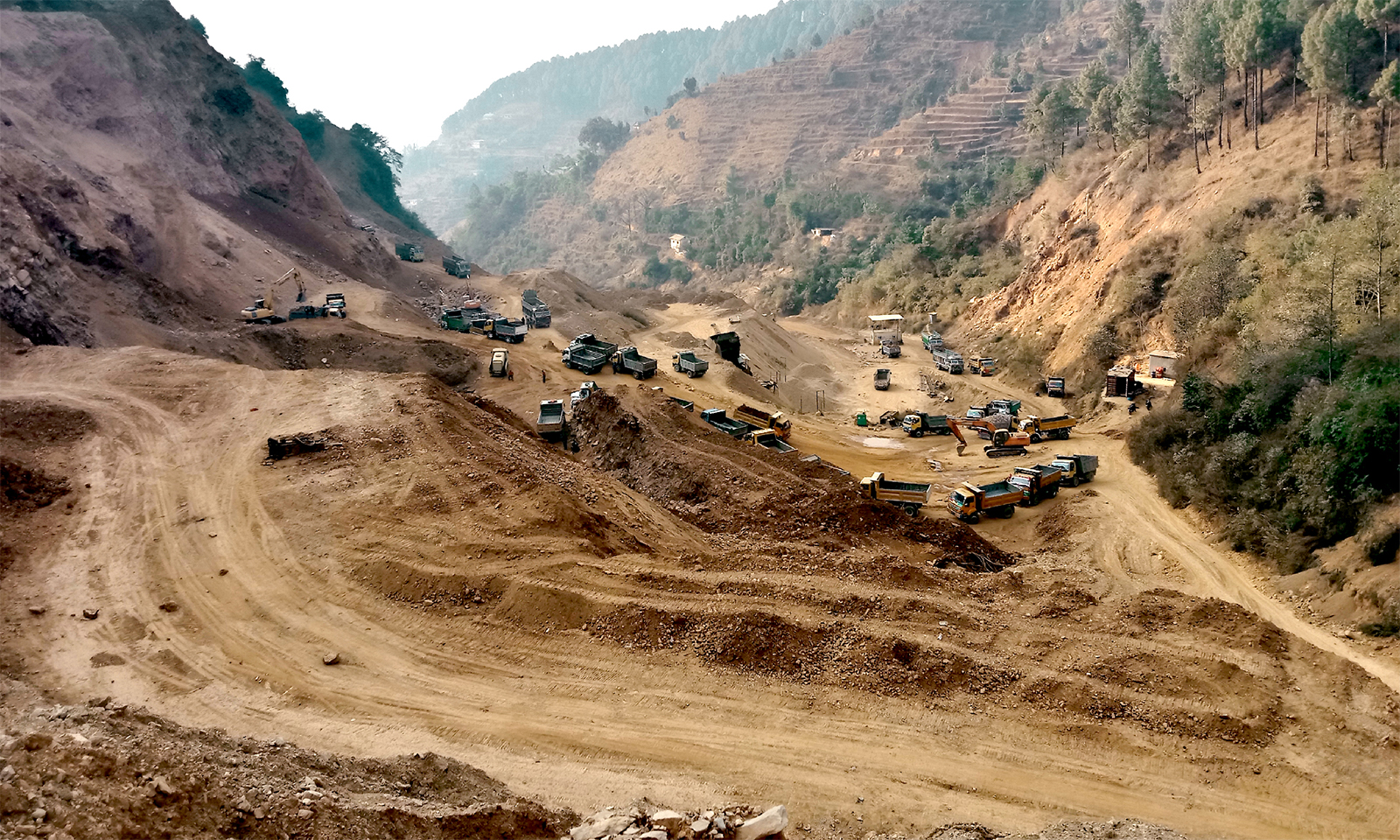
Although the Department of Mines and Geology has revoked excavation permits for mines and crusher plants linked to cement factories in the Lele area of Godawari Municipality, Lalitpur, they continue to operate freely with the collusion of the local administration. The consequences are stark. Drinking water sources have dried up. Air and noise pollution, along with landscape degradation, are severe. People have been displaced.
According to records from Godawari Municipality, 21 companies are involved in hill-cutting for stone and sand extraction and in stone-crushing operations in the area (see infographic). Records from the Department of Mines and Geology, Godawari Municipality and the District Administration Office show that most of these companies have excavated in government forests and settlements, failed to pay taxes, encroached on public land, and operated in violation of regulations.
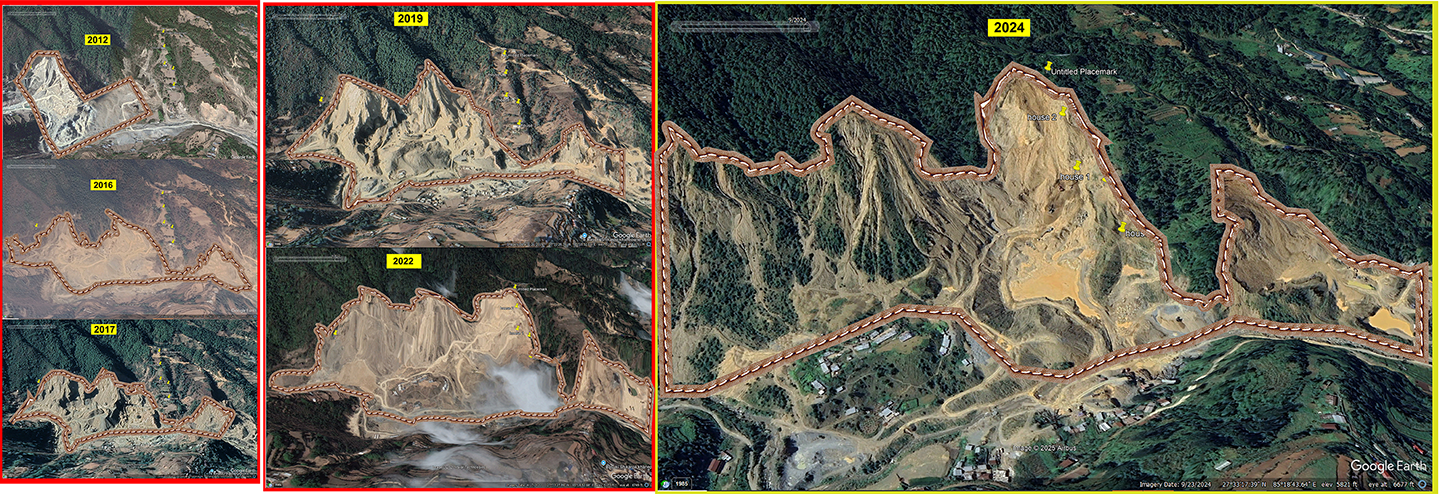
Google Earth Pro imagery from 26 January 2010 shows that excavation and hill-cutting in Lele, including in forest and river areas, had already spread across 12.3 hectares. At the time, around five households still lived there. Fourteen years later, the excavation footprint had doubled to 24.6 hectares. The homes are gone.
Living Under Constant Threat
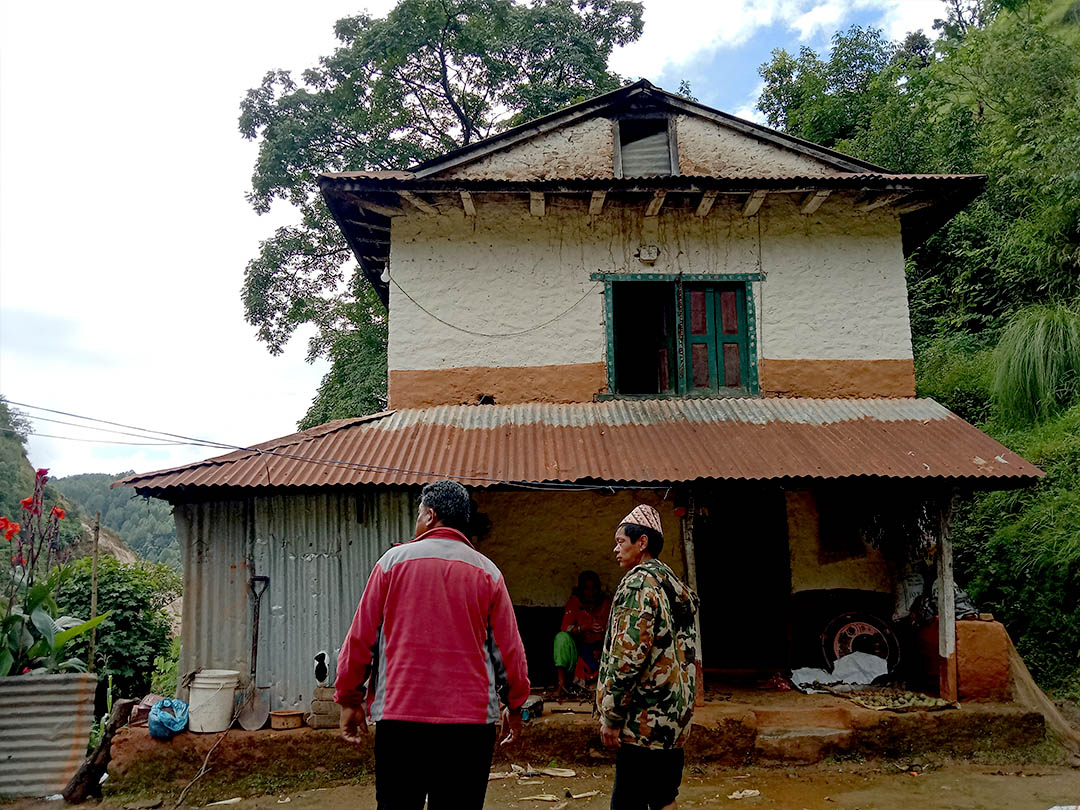
On 28 September 2024, flooding in the Nallu Khola swept away the home of 65-year-old Sanumaya Nagarkoti of Godawari-5. Crusher plants had been extracting stone and sand for years right next to her house. Waste rock from the mines had not been properly managed.
“Even the floods of 1981 couldn’t damage our home. But last year, a flood carrying gravel washed it away,” said Sanumaya. The flood also swept away 10 other houses in her neighborhood.
Sanumaya and her husband repeatedly petitioned the ward office, the municipality and the forest office to stop the haphazard extraction. No one listened.
Up on the ridge above the Nallu Khola lives the family of 70-year-old Chakana Nagarkoti. Dust from the mines and crusher plants, along with pollution from the tipper trucks, has made life inside their home unlivable.
“Even the food we serve has to be eaten with dust on it,” Nagarkoti said. “And the fear of landslides is always there.”
The heavy machinery used at the mines and crusher plants has shaken the ground hard enough to crack homes in Lele. A CIJ investigation six years ago also found cracks in houses near quarry and crusher sites.
In 2025, Godawari Municipality ordered the closure of mines and crusher plants that had not renewed their licenses and had failed to pay revenue. But they are still operating.
Because trucks using the old route had to pay taxes to the municipality, companies changed the route two years ago. Since then, tipper trucks hauling stone and sand have been passing right beside the Nagarkotis’ home.
Vinayak Multipurpose transports crushed stone and rock to the United Cement Industries factory. Its patron is Milan Silwal, who is also the elected ward chair of Godawari-5. According to local residents, whenever disputes arise, Silwal shows up to speak in support of the company.
Settlements Displaced
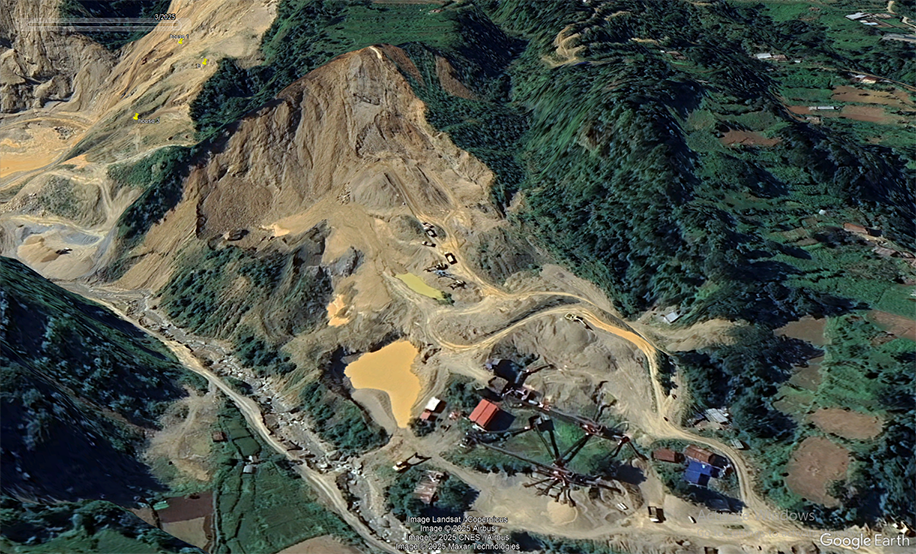
Another hill, near Mahadev Khola and 4.6 kilometers east of Lele Danda as the crow flies, is being carved up in much the same way. This ridge in Godawari-5 is being quarried by three cement companies (see infographic). The main one is United Cement, part of the KL Dugar Group.
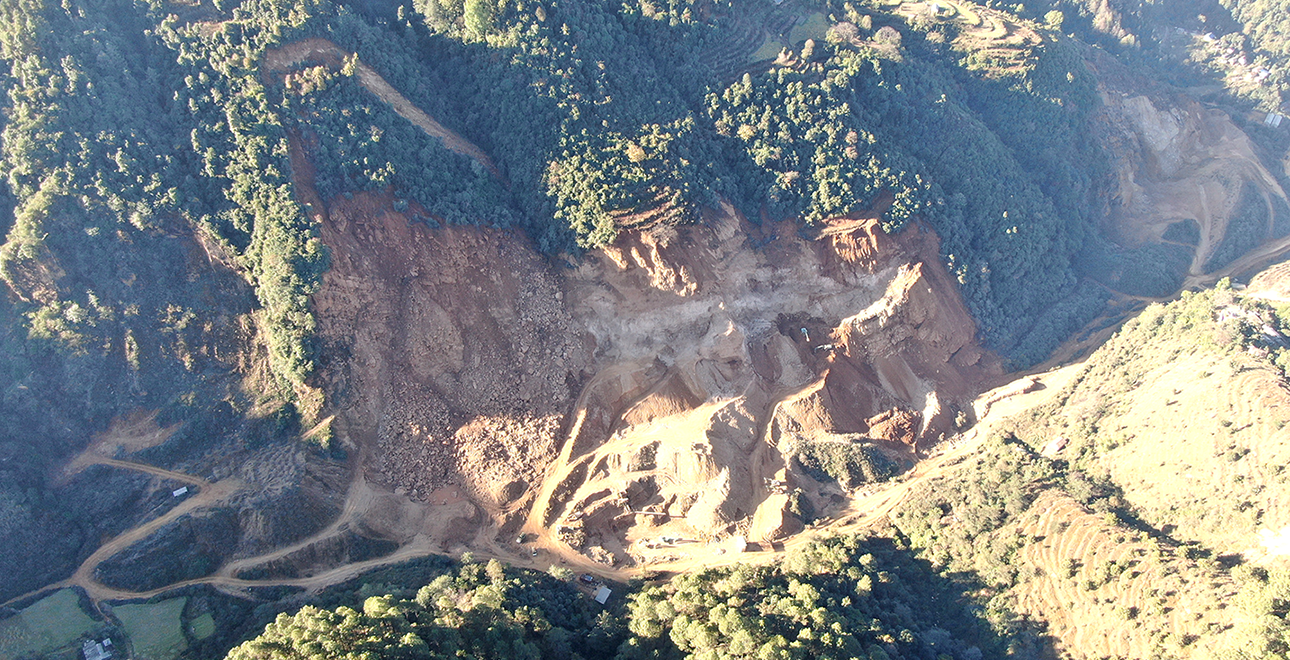
An analysis of satellite imagery shows that United Cement began excavation there in 2010, initially covering around 1.15 hectares. Over the next 15 years, the excavated area grew fivefold to 5.70 hectares (see map).
Another hill right next to it, directly in front of United Cement’s office, has also been cut into. Excavation began there in 2014, and 4.40 hectares have since been stripped.
On the adjacent Bhumishwori Mahadev Danda stands the lone house of 55-year-old Sabina Tamang. She lives there with her husband and daughter. But the noise from the stone breakers is so loud they struggle to hear one another. Until a few years ago, five Tamang family homes stood in a row here. They were forced to leave because the noise and dust had made the area unlivable.
She says all of her neighbors have left because of the factory. “Last year, a landslide destroyed our cowshed and toilet,” she said. “Now I’m afraid the house itself will be swept away.”
About 10 years ago, five families still lived in the upper Lame Danda area, where United Cement first began excavation. They have since moved about 200 meters away to Chautara Danda. According to local resident Chandra Tamang, excavation in Lele began as far back as 1981.
The extent of the damage became painfully clear during the floods that hit the area in late September 2024. Two people were killed in the Lele–Nallu–Tikabhairab belt alone. Across Lalitpur, 43 people died. Another 2,700 were displaced. The floods destroyed homes and swept away drinking water sources.
According to Deepak Ghimire, a resident of Ward 7, haphazard excavation has also worsened water scarcity in Lele. “Devichaur was already a steep and landslide-prone area. Since United Cement started extracting stone there too, the fear of landslides has only grown,” he said.
Dry Springs, Murky River
The main drinking water sources for the Lele area of Godawari are the Panighatta, Bagkhor and Khokkarbot springs. Water flow from all three has now declined. At Panighatta, located around 300 meters from the site where United Cement is excavating, only a small amount of muddy water now trickles out.
“That’s the water we’re drinking,” said local resident Rajesh Shrestha. “Not only is there less of it, it’s also murky and reddish.” Shrestha says the problem worsened after the cement factory began mixing material from the mine into the water.
Ishworman Dangol, an elected member from Ward 5, also says the mines and crusher plants have dried up and polluted local water sources. Prakash Silwal, a teacher at the local Saraswati Secondary School, said, “If this continues, people here will soon have no drinking water at all.”
Ek Bahadur Mahat, a technician who worked on the Lele drinking water project completed in 1983, also says water levels in the area have dropped sharply. According to Mahat, as the springs have dried up, a system that once served 800 households now supplies only 500.
Local residents, burdened by pollution, floods and landslides, water shortages, and damage to farming caused by illegal extraction, took to the streets in protest in December 2023 (see photo). But their demand that the unchecked exploitation of natural resources be stopped went unheard.
Nikesh Shrestha, who has campaigned against illegal extraction, says a parliamentary committee ordered the excavation there to be halted 15 years ago. It has continued uninterrupted.
Hari Upreti, general manager of United Cement’s mining division, claims the company is excavating in full compliance with all regulations on 300 ropani (15.26 hectares) of its own land and 83 ropani (4.2 hectares) of government land.
“We have permits from the Department of Mines and Geology valid until 2035. We extract 1,600 tons of limestone a day, all within the prescribed limits,” Upreti said. “We bought nearby homes and land that could be affected by the mine, with the owners’ consent. If there is a problem with the drinking water source, it is not because of us.”
Environmental expert Uttam Babu Shrestha says excessive extraction without regard for environmental impacts has led, in many places, to floods and landslides, the destruction of aquatic habitats, declining water quality, and drying springs.
“There are places where extraction is necessary, but none is taking place. And there are places where it should not happen, but extraction is excessive,” he said. “Only a proper study can determine where, how much and how extraction should take place. If the EIA (Environment Impact Assessment) sets a limit on how much can be extracted, then only that amount should be taken.”
Sanctioned by the Mines Department, Shielded by Forest and Local Authorities
A review of complaints related to crusher plants and mining operations in the Godawari area of Lalitpur, along with correspondence from the Department of Mines and Geology and decisions made by the district administration and local government, raises serious questions about United Cement’s limestone extraction and the administrative handling surrounding it.
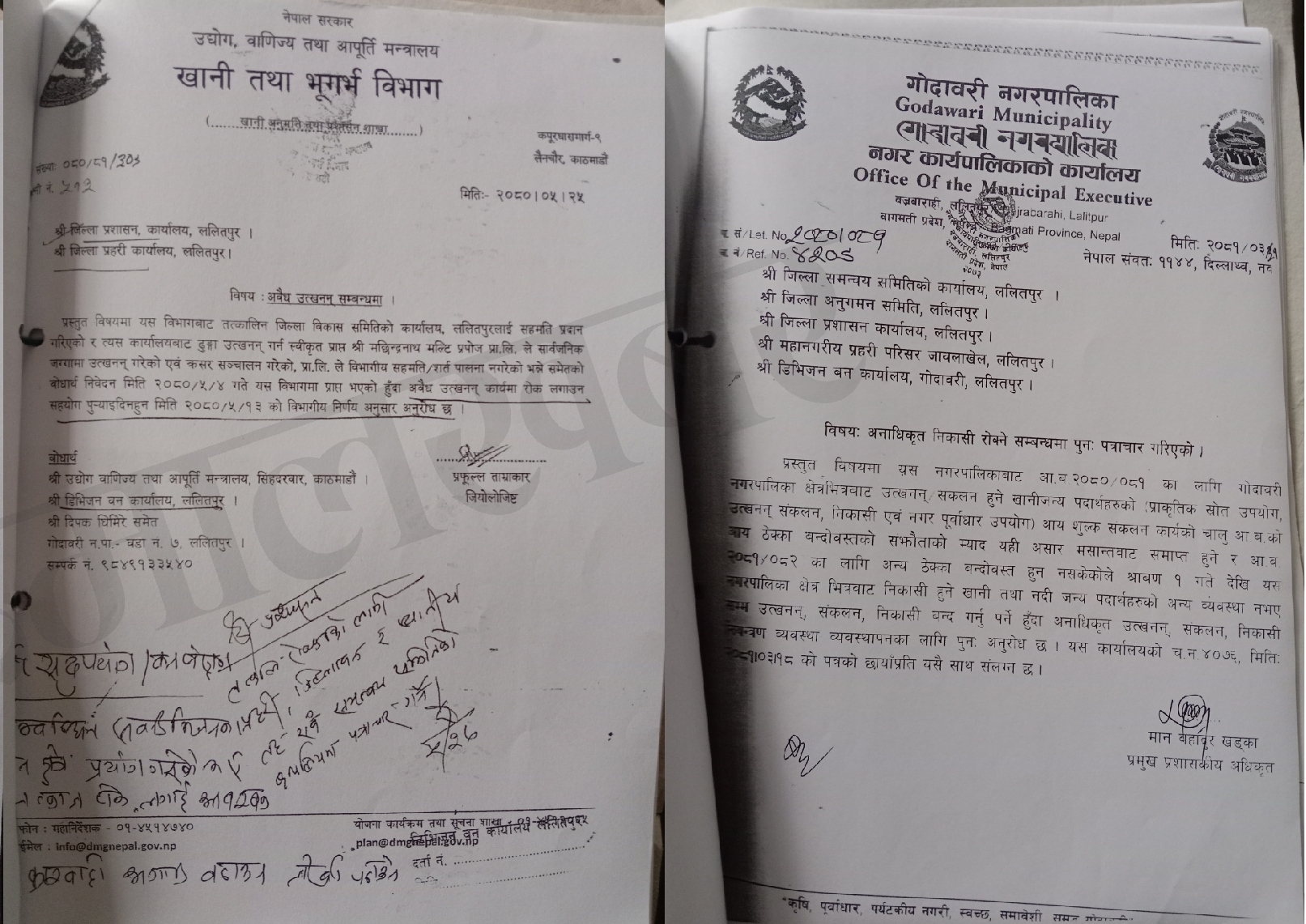
In a letter dated 7 August 2023, the Department of Mines and Geology informed United Cement that its limestone mining permit had been revoked and removed from the official record. The department also directed the company to restore the mined area. Previously, the company had been granted permission to excavate across 0.672 square kilometers in what was then Lalitpur Municipality.
Despite the department’s action, the Bajrabarahi Sub-Division Forest Office, in a letter sent on 6 February 2024 to the Division Forest Office in Godawari, effectively cleared United Cement. Citing a field inspection, it stated that the company’s limestone mine was operating legally within the boundaries of forest land over which it had government-granted usage rights.
Then, on 15 September 2025, a meeting led by the Chief District Officer decided to facilitate the transport of mined materials used by United Cement from its site in Godawari-5. The meeting agreed to ensure that transport along the Champeshwari–Lele road section would proceed in accordance with guidelines and without obstruction.
The meeting was attended by the mayor, district police officials and representatives of United Cement. It also reached an understanding that United Cement would deposit money with the municipality under its corporate social responsibility obligations, and help make arrangements for settlement development and city planning in Wards 5 and 6.
A monitoring report prepared by the Lalitpur District Monitoring Committee in February-March 2024 also noted that all mining and crusher operations in the district were connected to national forest land, scrub forest and public wasteland.
Even so, it remains inexplicable why the District Administration Office, the municipality and the forest office have continued to facilitate excavation despite the mining department having already revoked permits and taken action.
Abiral Crusher and Birendra Roda-Dhunga Udyog, both operating in the Nallu Khola area, also have investment from Bishnuman Maharjan, the ward chair of Godawari-6. Documents obtained from the municipality show that Maharjan has also invested in Sagarmatha Stone Crusher and Mankamana Aggregate Industries.
Ward chair Maharjan acknowledges that he has investments in stone and aggregate businesses there. He claims, however, that while company documents list him as an operator, he is not actively involved. He also said that, apart from Birendra Roda-Dhunga Udyog, the other crusher plants and mines have now shut down. Other companies in which he is listed as an operator have been blacklisted.
The Municipality’s Focus Is on the Money
On 5 June 2024, Godawari Municipality issued a notice instructing crusher operators to prepare Initial Environmental Examination (IEE) and Environmental Impact Assessment (EIA) reports, and to submit their permits, along with details of the equipment and workforce being used, within 15 days.
On 15 July 2024, the municipality directed Machhindranath Multipurpose Pvt Ltd to pay its local development fee, and ordered all other industries operating within the municipality to deposit outstanding revenue by mid-August 2024.
In a letter dated 29 August 2024, the municipality informed the Department of Mines and Geology that, of the 27 mines and crusher plants operating within its jurisdiction, only five had obtained excavation permits from the municipality. The letter also stated that the municipality had no registration records for the crusher plants.
Earlier, on 11 September 2023, the Department of Mines and Geology wrote to the District Administration Office and the District Police Office, instructing them to halt illegal extraction. A copy of the letter was also sent to the Division Forest Office in Lalitpur.
Following that letter, on 17 September 2023, the Lalitpur District Administration Office wrote to the Lalitpur police, stating that Machhindranath Multipurpose Pvt Ltd was operating a crusher plant on public land and had failed to comply with conditions set by the mining department. It instructed police to stop the illegal extraction and shut down the industry and crusher plant. The extraction did not stop.
Godawari Municipality’s notices and letters regarding action against mining and crusher industries appear to have had one central purpose: to pressure these companies to pay the fees they owed the municipality under various headings.
For instance, the municipality pressed Nirakar Dhunga-Roda Udyog Pvt Ltd, Birendra Maharjan Dhunga Udyog Pvt Ltd, and Machhindranath Multipurpose Pvt Ltd to clear outstanding royalty payments, export levies and local development fees. According to the municipality’s accounts, these companies owe tens of millions of rupees.
Nirakar, for example, was told to pay NPR 51 million. Machhindranath was asked to pay NPR 104 million. The companies, however, wrote back asking the municipality to reconsider the charges. They disputed both the basis for the taxes and fees and the way they had been calculated.
Taken together, the record suggests that the municipality’s greater concern is revenue collection, not the environmental damage or the harm already being done to people’s lives.
Factories Shut Down, Then Running Again
It has been 10 years since young activists like Rajesh Shrestha and Nikesh Shrestha began raising their voices against the environmental destruction in Lele. At times they stage sit-ins on the road. At other times, they gather outside the District Administration Office to protest.
On 26 January 2024, in the presence of ward representatives from Godawari-5, local residents, mine operators and transport entrepreneurs hauling stone and aggregate reached an agreement. The document stated that stone quarries would be allowed to operate only until 12 April 2025, after which they would be permanently shut down.
The agreement also required operators to build check dams to manage soil and debris from the quarries, carry out benchmark assessments to restore damaged structures to their original condition, plant trees at extraction sites, protect drinking water sources, and refrain from adding new excavation machinery.
But the quarries are still operating even after the April 2025 deadline. Every day, around 500 tipper trucks haul stone and aggregate out of the area.
Last October, local youths again staged a sit-in on the road. Two years ago, they had also demonstrated outside the District Administration Office in Lalitpur. After that protest, the mines were shut for around a month.
Shrestha says that in late October, officials from the District Administration Office, police and the local government pressured local youths into signing an agreement favorable to the businesses.
About a month later, the mines resumed operations. According to Ward 5 member Ishworman Dangol, local youths were coerced into the agreement. “They were made to sign it by force, in a way that no one would even know,” he said.
Birendra Maharjan, operator of Birendra Roda-Dhunga Udyog, claimed he runs the mine and crusher plant on his own land and in compliance with the rules.
“They filed cases against me saying I had dug areas that others excavated back in 2005–06. The mines department took action at the time. Now, because it is next to my land, they are again accusing me of excavating areas dug by others,” Maharjan said. He said he is continuing operations under a court stay order.
“If you want to extract stone, you have to dig. Development comes with some costs. Some trees are lost. There is nowhere in Nepal that is free from floods and landslides,” he said. Maharjan also claimed that the mines and crusher plants have brought economic benefits to local residents, saying many households now own tipper trucks and people have found work.
Kedar Timilsina Shashi, operator of Machhindranath Multipurpose Pvt Ltd, denied excavating on public land. He said that while any breach of regulations may not have been intentional, some requirements may have been violated.
“The land is steep, so landslides can happen. That may make it look like some standards were not followed,” he said.
Repeated attempts to contact Milan Silwal, spokesperson for Godawari Municipality, for comment on the damage caused by crusher plants and mines in the area were unsuccessful. Deputy Mayor Muna Adhikari said she would not comment on the issue.
Environmental researcher Uttam Babu Shrestha says the government has failed to enforce the regulations it created to protect nature. “We still have no information that anyone involved in excessive extraction in violation of those regulations has been held accountable. That is the biggest weakness,” he said.
More Investigative Stories

One Water Crisis, Three Governments, Three Directions
Despite the expenditure of millions of rupees on water, lake and watershed conservation in Kailali, groundwater levels are falling, lakes...
One River, Two Governments
The Local Government Operation Act gives local governments the authority to collect revenue from riverbed materials such as stone, gravel...
Comment Here