Investigative Stories
Into the Gutter: Madheshi Dalits and a Job Nobody Else Will Do
Accidents while cleaning septic tanks have claimed dozens of lives over the past decade. Yet most sanitation workers from Dalit communities in Madhesh who do this work remain without adequate safety equipment, health insurance, or clear legal protection as they clean human waste by hand.

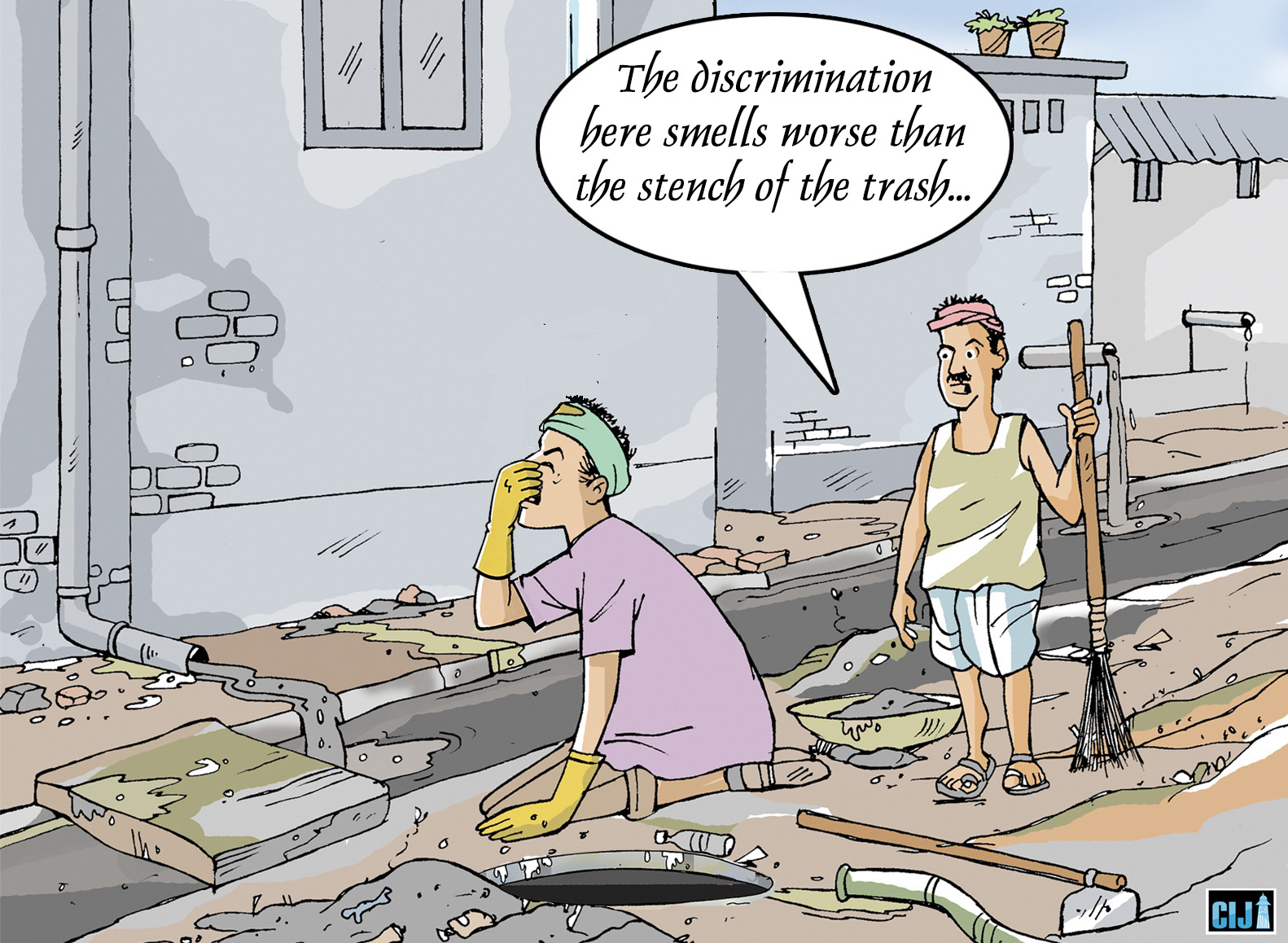
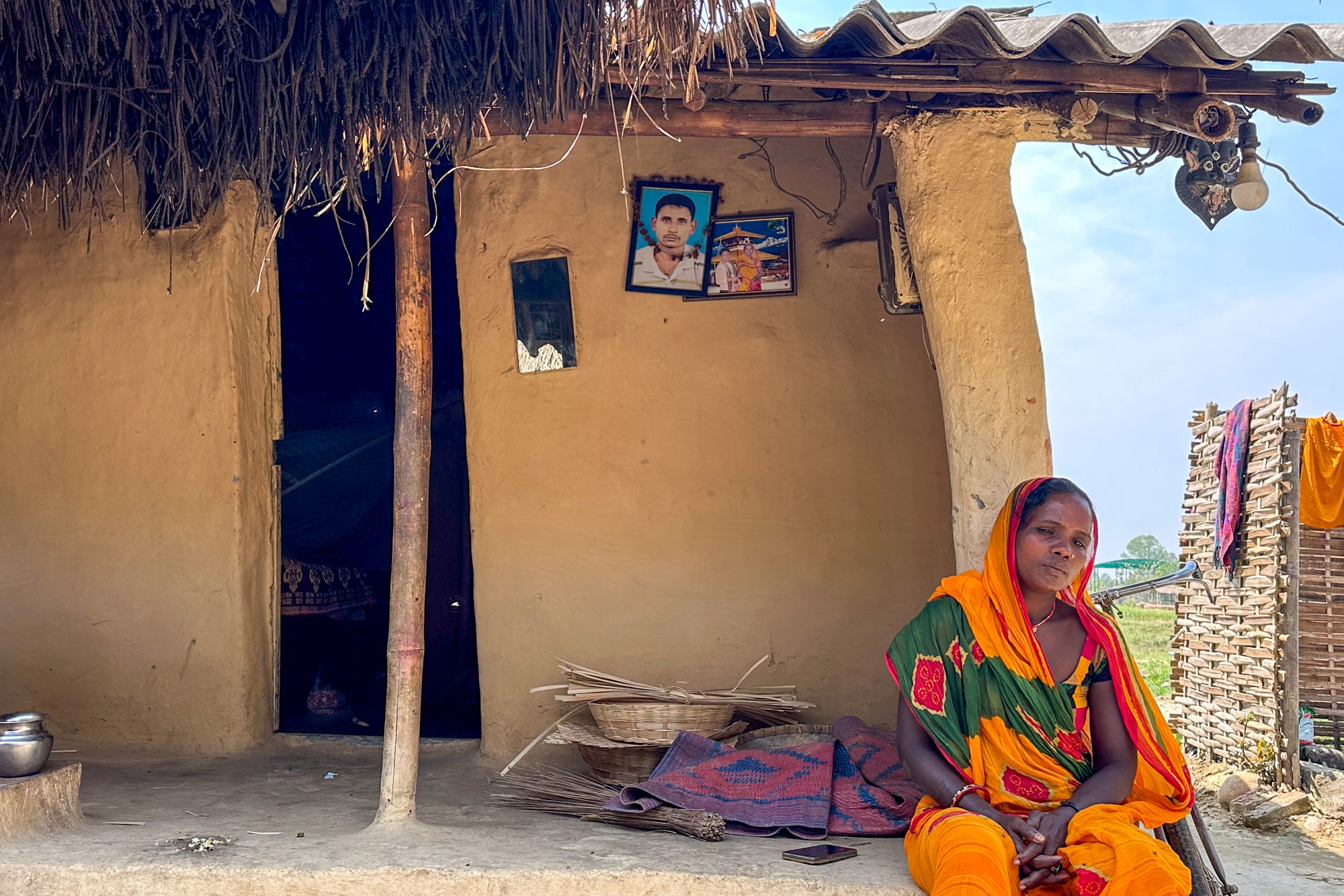
In the second week of March 2026, Vikky Mestar was cleaning a septic tank at a house in Siraha Bazaar. A suction machine had removed much of the waste, but a thick sludge of human waste remained at the bottom of the tank. Removing it by hand fell to Vikky and his two friends.
Wearing rubber gloves and ordinary face masks, they scooped the sludge from the foul-smelling tank into canisters and dumped them into a nearby pond.
"The machine pulls out what’s on top," Vikky said. "But the sludge at the bottom has to come out by hand."
The 26-year-old sanitation worker, employed by Siraha Municipality, comes from a family that has done this work for generations. He studied up to Grade 7 but returned to the occupation after failing to find other employment amid economic hardship.
Across much of Madhesh, the work of cleaning septic tanks, sewers, toilets and human waste falls primarily on men from Dalit communities such as the Mestar and Halkhor. They undertake the most hazardous sanitation work, from government offices and hospitals to private institutions and households. Yet they do so without adequate protective equipment, health insurance, social security or even basic occupational safety standards.
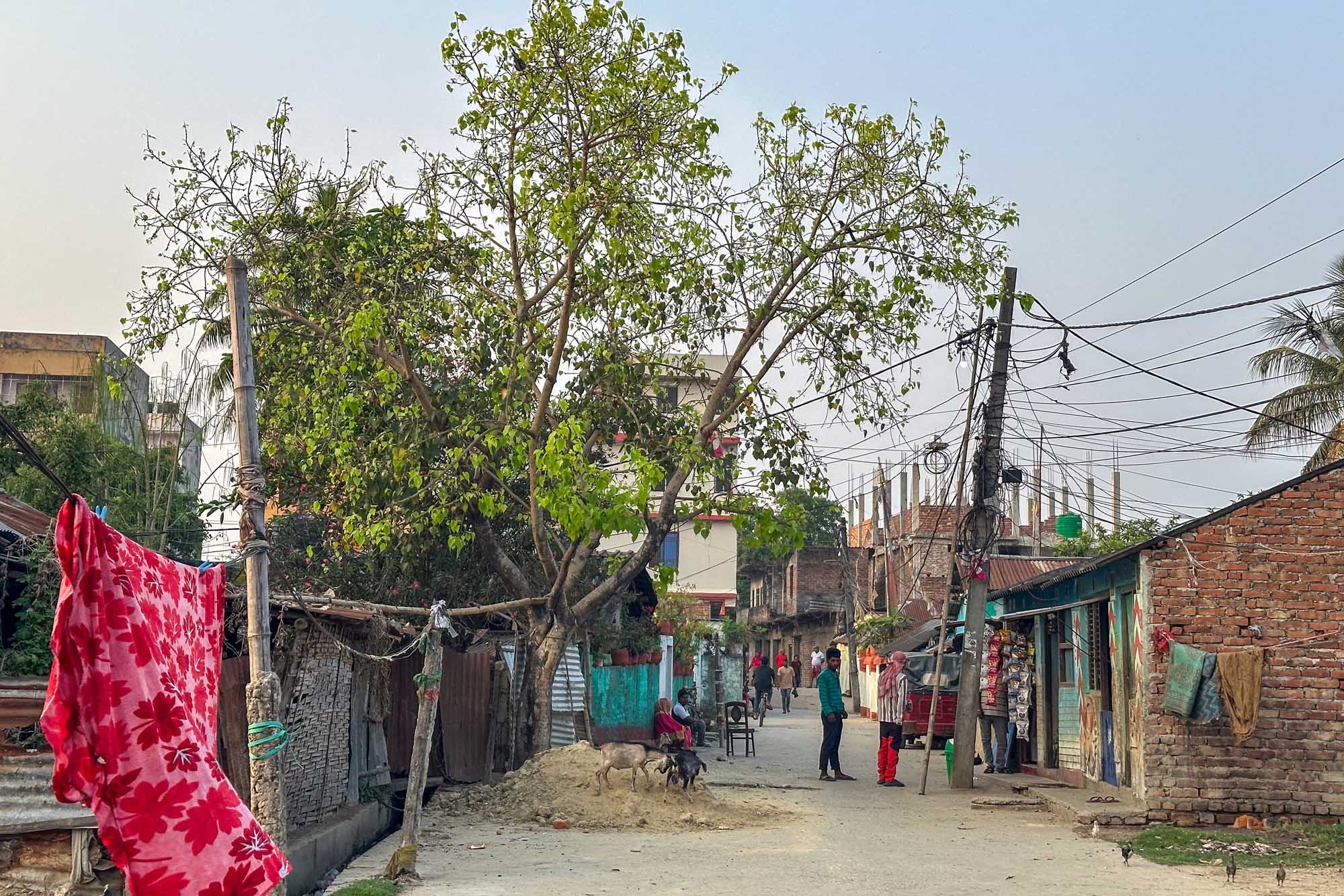
Vijay Mestar of Malangwa-4 in Sarlahi cannot remember when he first started cleaning septic tanks. "I've been going with my father since I was a child," he says. "Gradually, I learned the work myself."
His father, 60-year-old Lale Mestar, is also employed as a sanitation worker by the municipality. Having learned the trade from his own father, he passed it on to his son.
"We don't get any other kind of work," Lale says. "We have to support our families with whatever work we can find." He recalls that until about a decade ago, there were no machines for cleaning septic tanks. There were no gloves, masks or boots either. Workers had to climb into the tanks, often submerged up to their waists in human waste. "Back then, they'd make us do work worth five hundred rupees and pay us only five," he says, recalling those days.
Today, gloves, boots and masks are more widely available, but they remain inadequate. The workers typically use ordinary medical masks, which offer no protection against toxic gases.
Lale notes that younger generations now have somewhat greater access to alternative employment. Yet entrenched social non‑acceptance and the persistence of caste‑based untouchability continue to restrict opportunities for many young Madheshi Dalits.
Job Insecurity Amid Deadly Risk
Suction machines are now used to clean septic tanks in many places. But they still cannot remove all the waste. Arun Kumar Paswan, a Dalit rights activist from Siraha, experienced this firsthand when he had the septic tank at his own house cleaned.
He first hired a sewage suction truck at a cost of NPR 5,000. When thick sludge remained at the bottom, he had to pay another NPR 6,000 to have workers enter the tank and remove it manually.
Before climbing inside, the workers asked for two liters of kerosene. Paswan says they sprinkled it into the tank to reduce the stench before filling canisters with the sludge and dumping them into a nearby pond.
According to Vijay Mestar, many workers used to drink alcohol before entering septic tanks in the past years. "They used to say they couldn't tolerate the smell without drinking," he says. "It's less common now, but the practice hasn't disappeared completely."
As machines come into wider use, sanitation workers face possibility of losing what little employment they have left. "We used to do all the work ourselves," Vijay says. "Now machines have arrived, and the amount of work available to us keeps shrinking."
In the past, people often dumped waste on empty plots of land or into ponds. Many local governments have since prohibited the practice, prompting more people to use sewage suction truck services. Yet the irony remains that when machines fail to complete the job, the most dangerous part still falls to Dalit workers.
With no other earning opportunities, some young people from Dalit communities have sought employment abroad, while others now drive auto-rickshaws or tempos. But for many families without the capital to pursue other livelihoods, sanitation work remains the only means of survival.
Health Risks Ignored
For workers who come into direct contact with human waste, toxic gases and infections, sanitation work carries an inherent risk to life.
Dr. Sunil Prasad Kushwaha, Medical Superintendent at the Provincial Hospital in Siraha, says entering a septic tank without proper protective equipment is extremely dangerous.
He notes how exposure to human waste can cause diseases such as typhoid, hepatitis A and hepatitis E, as well as skin infections. Cuts on the fingers can allow parasites to reach the intestines and even the brain and can lead to other infectious diseases.
Dr. Kushwaha says gases that accumulate inside tanks left sealed for years, including methane, carbon dioxide and carbon monoxide, can cause workers to lose consciousness and may even prove fatal.
"People who are exposed to these gases over long periods can develop respiratory illnesses as well as other chronic health complications," he says.
He adds that the long-standing practice of drinking alcohol before entering septic tanks only increases the risks. Despite these dangers, he rarely sees sanitation workers arrive at the hospital in emergency situations.
"They occasionally come in with injuries such as cuts or puncture wounds," he says. "But regular health check-ups are almost unheard of."
Deaths Without Compensation
On March 31, 2023, 45-year-old Theku Mallik died while cleaning the septic tank of a public toilet in Dhanushadham-3 in Dhanusha district. After returning from working abroad, he had been working as a sanitation worker cleaning public toilet. On the day of the incident, he had gone to clean the septic tank with his wife, Kavita Mallik, and their 11-year-old son. He entered the tank, but after several minutes there was no response when Kavita called out to him.
"I went to the nearby police post three times," Kavita recalls. "But no one came to help. Later my son-in-law climbed into the tank and he also lost consciousness. A third person tied a rope around himself and managed to pull them both out, but my husband could not be saved."
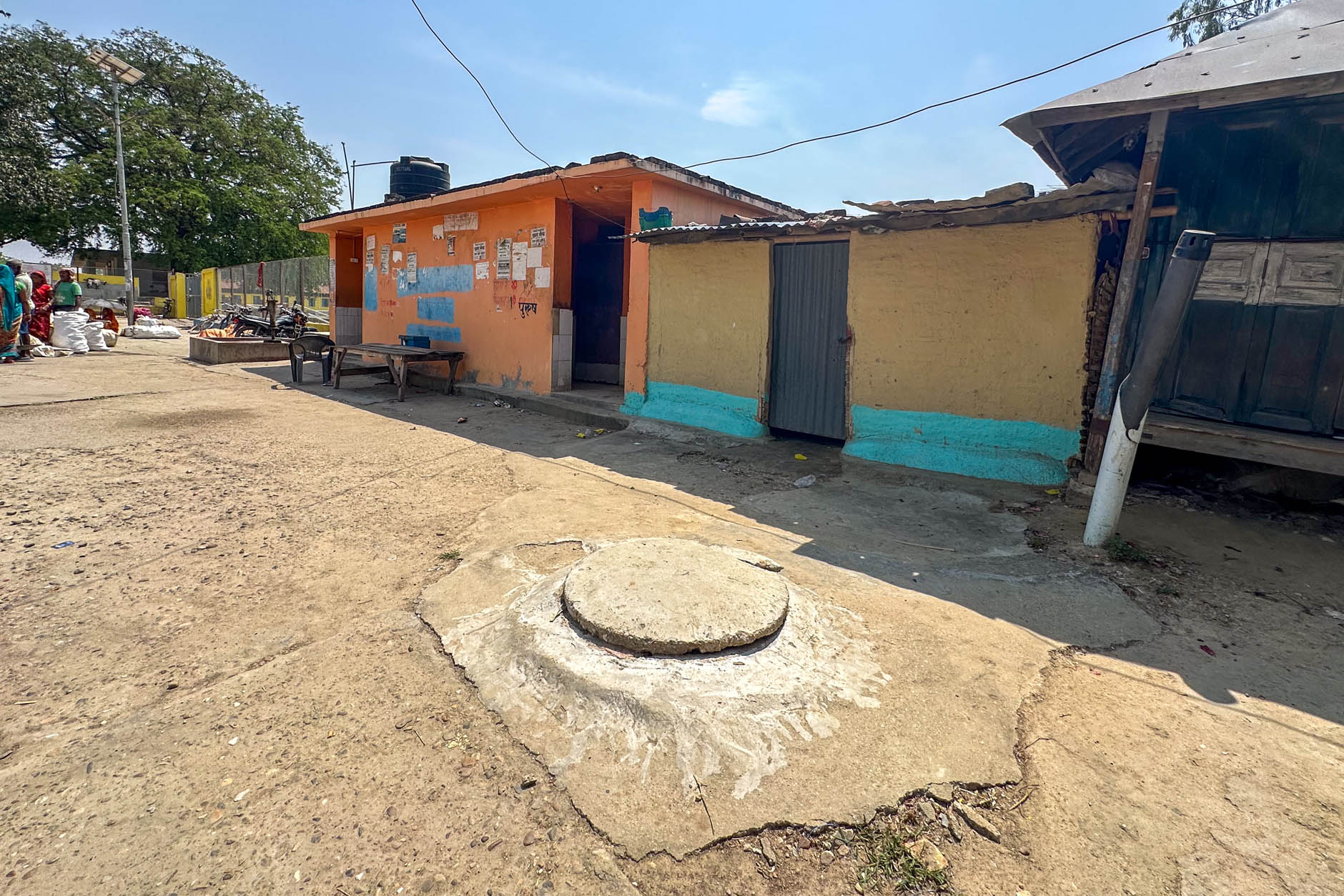
Following Theku's death, the municipality employed Kavita as a sanitation worker on a daily wage basis. Beyond that, she says, the family has received neither formal compensation nor any form of social security.
"I still have debts to repay, and I have to keep my son in school," she says. "At the time, many people told me money would be deposited into my account, but nothing has come so far."
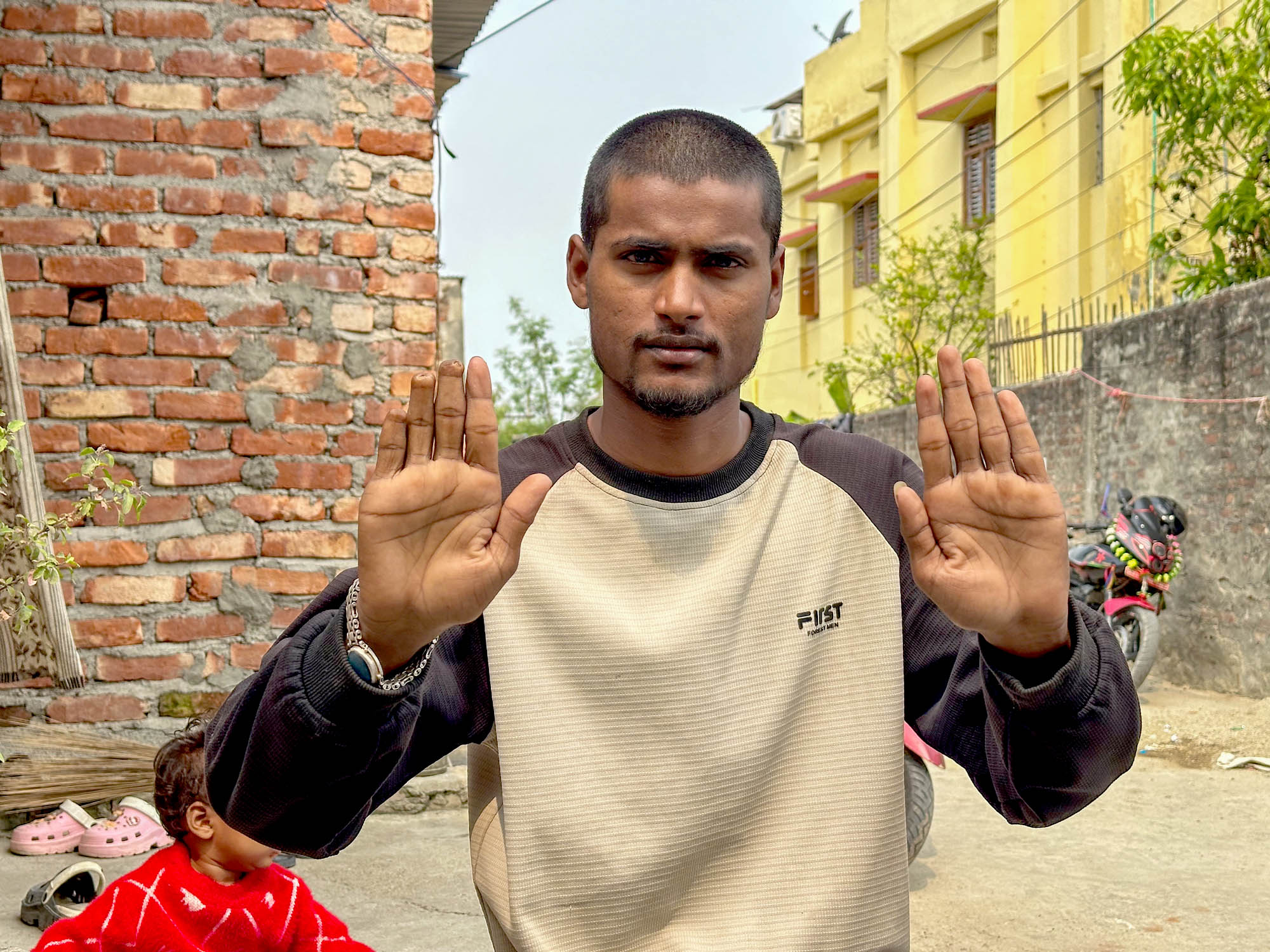
Twenty-two-year-old Rabin Mallik of Siraha also suffered a life-changing accident while doing sanitation work. Several fingers on his right hand no longer function. A year ago, while working as an assistant on a sewage suction truck, his hand was caught in the machine's moving belt as he was trying to adjust it. He says he had asked the driver to switch the machine off, but the driver did not hear him.
"When I regained consciousness, I was in the hospital," he says. "I lost my fingers, and because the nerves were damaged, my hand has withered." Rabin says he had accepted the job for NPR 2,500 but has since spent more than ten times that amount on treatment.
He had applied to join the Armed Police Force but was rejected because of his injured fingers. He also says he has not even applied for a passport after learning that all ten fingerprints are required for passport issuance.
Weak Legal Protection
Nepal has no dedicated occupational safety standards for workers engaged in hazardous jobs such as septic tank cleaning. According to Mani Nath Gop, spokesperson for the Department of Labor and Occupational Safety, the existing Labor Act covers all workers in general, but there are no specific guidelines or standards for people engaged in septic tank cleaning or the manual handling of human waste.
Although the Labor Act requires employers to provide personal protective equipment and take safety measures such as securing workers with safety ropes while performing hazardous tasks, effective implementation remains a major challenge.
Bhakti Ghimire, an advocate specializing in labor law, says these workers, despite being employed largely in the informal sector, are still entitled to the rights guaranteed under the law. "They are entitled to health insurance, compensation for workplace accidents, minimum wages and social security," she says. "The problem is that most of them do not even have written employment contracts. When accidents happen, it becomes unclear who is legally responsible."
Preeti Mittal, who works in the water, sanitation and public health sector, argues that sanitation workers must be brought into the formal labor system. "There should be clear worker classification, minimum wages, mandatory training, a licensing system, and enrolment in social security and insurance schemes," she says.
According to Sohan Kumar Sah, former vice-chair of the Madhesh Province Policy and Planning Commission, local governments could be given clear standards to make sanitation workers' safety, social security, and mechanized cleaning mandatory. He notes how India enacted legislation banning manual scavenging as early as 1993. A stronger law introduced in 2013 made the practice a punishable offence, providing for imprisonment, fines and rehabilitation of affected workers.
India's Supreme Court has also ruled that manual scavenging violates the fundamental right to live with dignity. Nepal still has no explicit legal prohibition against the practice.
Education Has Not Changed Trade, or Life
Many young people in Mestar Tole of Rajbiraj in Saptari have completed the Secondary Education Examination (SEE), and some have gone on to university. Yet education has done little to change the occupations available to them.
"Even if we study, we cannot find jobs," says a 25-year-old university student. "In the end, we return to sanitation work or pig farming."
He says discrimination doesn't begin only when people start work, but the moment people learn their surname. "Friends distance themselves from us. Even when we look for other work, people don't trust us," he says.
Mandhaniya, the daughter of Chintadevi Mestar of Malangwa in Sarlahi, studies in Grade 3 at a government school. Her mother says she has already experienced caste discrimination at school.
"The teacher poked her on the head with a pencil, asking why the daughter of a Mestar had used the toilet meant for other children," she says. She says some teachers even make her children carry water for them after using the toilet.
Babita Mestar, a 40-year-old sanitation worker employed at a private clinic in Malangwa, Sarlahi, says she too has experienced discrimination at her workplace. After stepping on a needle while cleaning, she asked for a tetanus injection. The clinic refused, forcing her to seek treatment at a government hospital instead.
"Perhaps because we are sanitation workers, nobody seems to care about our lives," she says.
The Inequality Behind the Numbers
According to Nepal's 2021 National Population Census, the country's Dalit population stands at approximately 3.88 million. Of these, around 1.39 million are Madheshi Dalits, with more than one million living in Madhesh Province alone.
Madheshi Dalits also continue to lag behind in education. Male literacy stands at 57 percent, while female literacy is only 41.4 percent. Their life expectancy is also lower than that of many other communities.
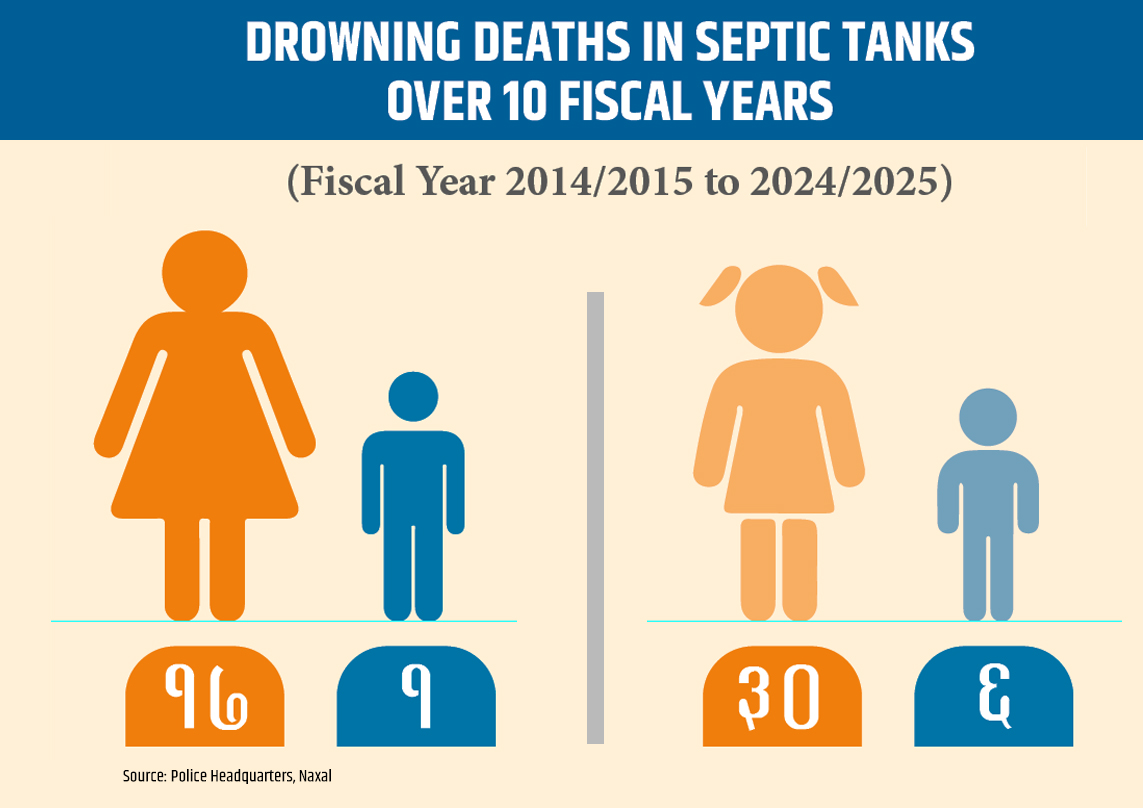
According to Nepal Police data, 54 people have died inside septic tanks over the past decade. Most of the men died from oxygen deprivation or exposure to toxic gases while cleaning tanks, whereas most women and children died in accidental incidents.
Srijana Karki, a senior officer at ENPHO, an organization that works with local governments on sanitation issues, says local authorities repeatedly report that long-serving sanitation workers tend to die earlier than retired employees in other occupations. "We urgently need more research into how constant exposure to human waste affects the health and life expectancy of sanitation workers," she says.
Across Siraha, Sarlahi, Saptari and Dhanusha, new sewage suction trucks now travel from village to town. Discussions around policy reform, mechanization and modern sanitation services are becoming more common.
Yet amid all these changes, one image remains unchanged.
A 15-year-old boy in Sarlahi has been working with a septic tank cleaning crew for the past six months. Forced to drop out of school after Grade 7 because of economic hardship, he is now planning to falsify his age to obtain citizenship documents early and go abroad for work.
"I don't see any future in this work," he says. "If I can go abroad, I feel I can support my family no matter what job I do."
His words are not just the dream of one teenager. They capture the shared reality of many Madheshi Dalit communities who, for generations, have remained trapped in hazardous work, caste discrimination, and unsafe labor.
Published in Naya Patrika on 13 July 2026
More Investigative Stories
Who Does The Annapurna Belong To?
In fiscal year 2082/83 BS, the Annapurna Conservation Area Project (ACAP) received 508,000 visitors and collected more than NPR 1.77...
Politicized Budget Distribution in Madhesh is Contrary to the Spirit of Federalism
From small projects that local governments can implement themselves to the selection of projects based on political connections, the pattern...
Comment Here