Investigative Stories
Politicized Budget Distribution in Madhesh is Contrary to the Spirit of Federalism
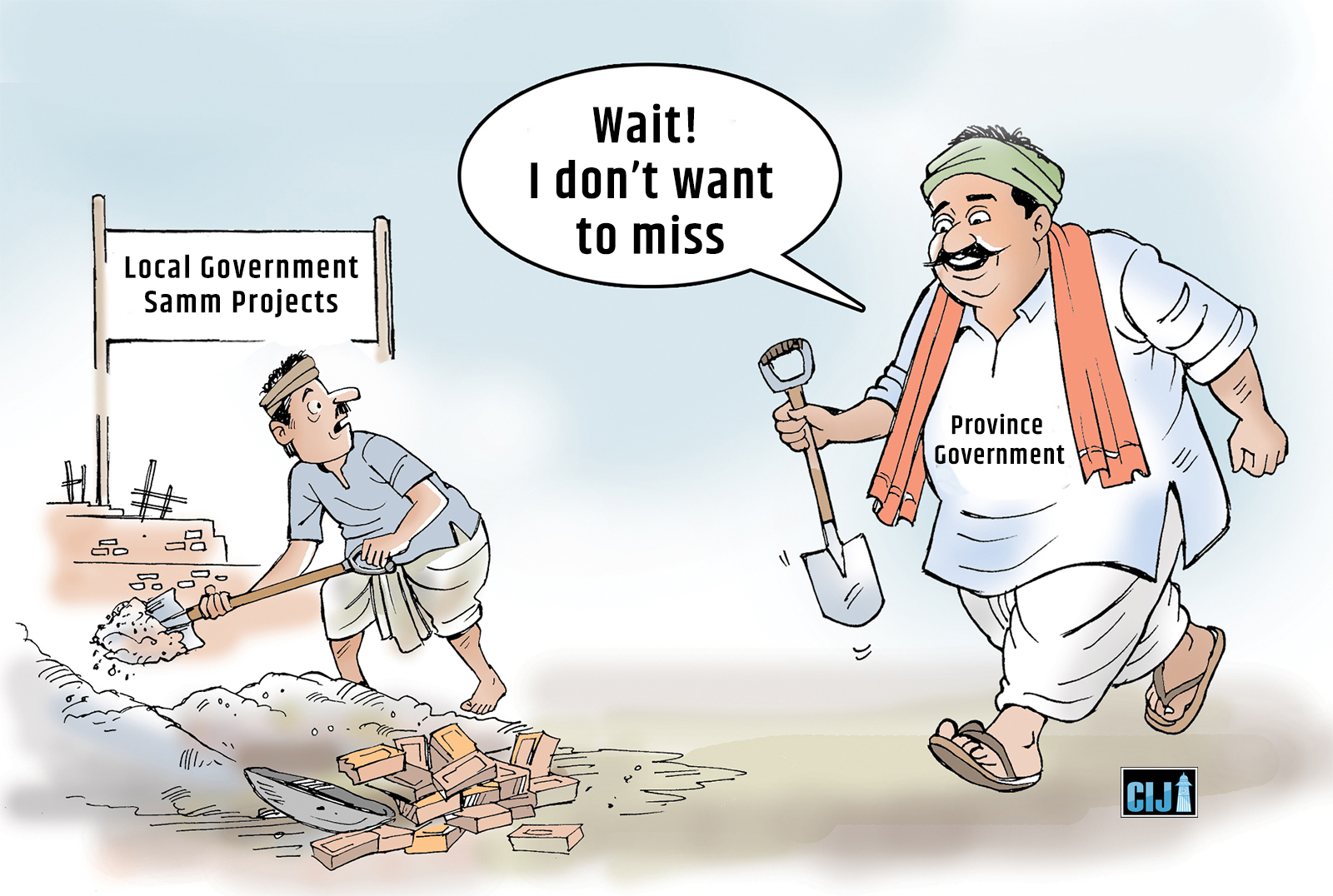
From small projects that local governments can implement themselves to the selection of projects based on political connections, the pattern in Madhesh has raised questions about the role of the provincial government.

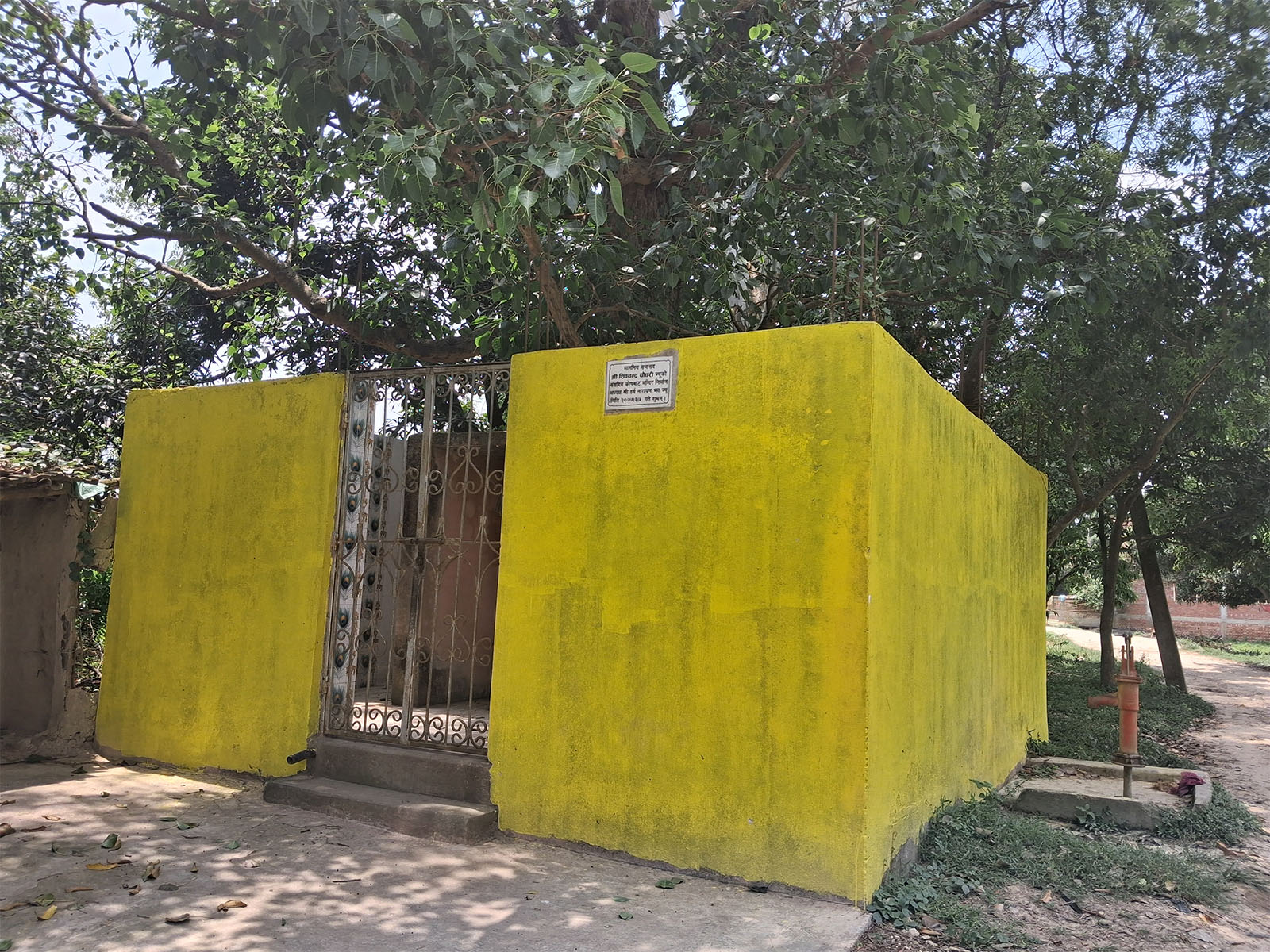
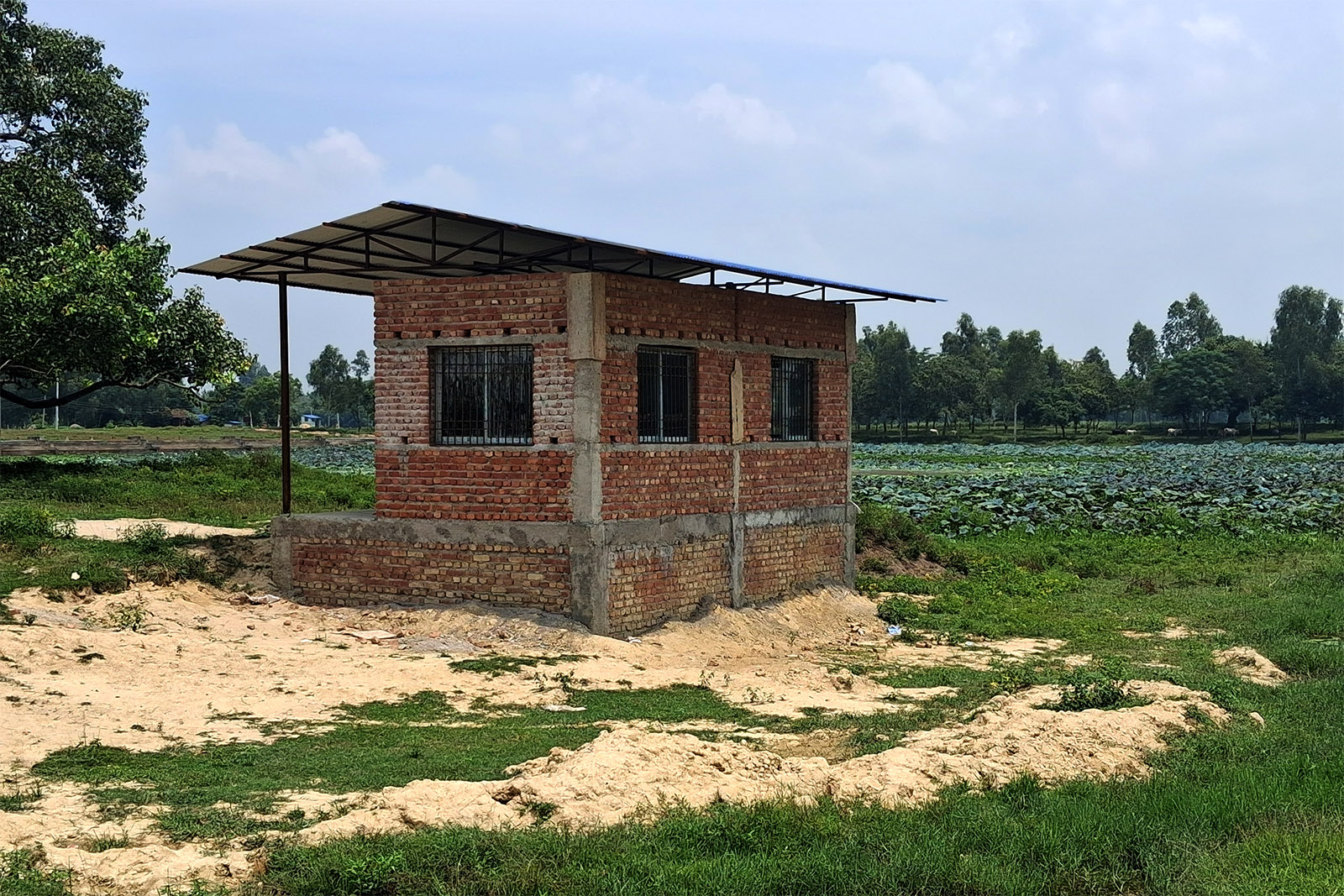
In Akaura Thakur Pokhari of Nagarain Municipality-8, Dhanusha, there is a two-room shed on the edge of the pond. It has a corrugated metal roof, aluminum windows and doors, and unplastered walls. The building looks like a temporary structure, but it has been designated as an old-age home.
“They rushed to build this shed as the fiscal year was closing in Ashadh and called it an old-age home,” said Jagdish Sah, sitting on a nearby platform. “How can elderly people live in a shed that would not even be fit for goats?”
According to Sanjay Kumar Raut, ward chair of Nagarain-8, the Madhesh provincial government allocated NPR 2 million for the construction of the unfinished structure. “This was a project of the Ministry of Social Development. I repeatedly told the concerned engineer and chief not to proceed with it because it had no practical utility, but they did not listen,” Raut said.
The structure in Nagarain is one example of the small projects proliferating across Madhesh Province. The practice of distributing budgets without a clear need or priority raises questions about the usefulness of public resources.
When Nepal adopted a federal system of government, provincial governments were assigned responsibility for advancing development projects beyond the capacity of local governments, driving regional economies and providing leadership for development.
The provincial government was envisioned as the institutional tier for long-term plans linked to infrastructure, production and employment that local governments could not undertake themselves. But as the province approaches nine years since its establishment, that expectation remains largely unfulfilled.
Annual provincial government budgets, repeated debates in the Provincial Assembly, reports of the Office of the Auditor General and findings of parliamentary investigation committees all point to the same pattern. Instead of advancing long-term development projects, budgets continue to be scattered into small schemes, projects are selected on the basis of political influence, and institutional standards governing public procurement remain weak.
Old Practices Remain Despite Claims of Reform
Madhesh Province Finance Minister Yubaraj Bhattarai presented a budget of NPR 41.13 billion for the current fiscal year 2026/27, claiming that small-scale projects had been eliminated this time. He said projects had been selected on the basis of need and priority and that no projects costing less than NPR 10 million had been included. He claimed efforts had been made to make the budget more focused on long-term, results-oriented projects.
But within days of the budget being made public, opposition lawmakers questioned the government's claim. They said multiple small projects had simply been bundled under a single heading to bring the total allocation to NPR 10 million. Although the amount under each heading had been increased, they argued, the nature of the projects had not changed.
The current fiscal year 2026/2027 budget allocated NPR 12.5 million under a single heading for projects under the Ministry of Industry, Commerce and Tourism, bringing together five separate schemes.
These included the construction of a pyramid at Om Shanti Park in Sarlahi, completion of an unfinished guesthouse at the Vedmata Gayatri Pariwar Mandal Center in Lalbandi Municipality-8, construction of Salin Gumba in Bagmati Municipality-2, construction of the Brahma Kumari Rajyoga Service Center building in Ishwarpur Municipality-12, and construction of another Brahma Kumari Rajyoga Service Center building in Hariharpur Municipality-2.
Similarly, another project heading included separate schemes for upgrading Madrasa Darul Balum Rashidiya in Jaleshwar Municipality-1, upgrading the boundary wall of Mansuri Cemetery in Kurtha Purwari Tole of Janakpurdham Sub-Metropolitan City-21, upgrading Madrasa Iqbalia in Loharpatti Municipality-5, upgrading Madrasa Jamiatul Barkat in Bardaha of Matihani Municipality-2, and constructing an Eidgah in Suga Ansari Tole of Jaleshwar Municipality-4.
The practice of using fragmented projects to sustain political cadres cannot produce quality public services. If the government does not even try to understand what people want, how can federalism be strengthened? The purpose of federalism can only be fulfilled if the provincial government focuses on long-term projects linked to production, infrastructure, industry and employment.
- Bishnu Kunwar, Political Analyst
According to Rakesh Singh, general secretary of the Dhanusha Construction Entrepreneurs Association, putting numerous small projects in different locations under a single budget heading makes implementation difficult.
“If they had brought concrete projects with more than NPR 10 million in vale, the work would have been better and management would have been easier. There are headings containing as many as six projects, spread across as many as three districts. In such circumstances, it becomes difficult to manage construction materials, mobilize workers and ensure quality work,” Singh explained.
According to opposition leader Upendra Mahato, the problem is not the size of the budget but its priorities. He says the provincial government taking on projects that are the responsibility of local governments is inconsistent with the division of jurisdictions under federalism.
Although the Constitution allows provincial governments to provide grants to local governments under various headings, Mahato argues that implementing similar projects directly through provincial ministries does not expand the province's role. It simply creates duplication.
Former Finance Minister Bharat Sah sees the roots of this pattern in the political structure itself. “Governments in Madhesh Province have generally been formed on the basis of coalitions, and there is constant pressure on such governments to accommodate the demands of every party and lawmaker in order to keep the coalition intact,” Sah says. “As a result, multi-year projects are pushed into the background while small projects focused on individual electoral constituencies take priority.”
This pattern raises another question: if every budget is to become a means of maintaining political balance, how can the provincial government implement a long-term development strategy? When will projects aimed at economic and physical transformation move forward?
No Coordination with Local Governments
The debate over Madhesh Province's budget is also a debate about its development priorities. The provincial government has repeatedly been criticized for failing to concentrate its limited resources on long-term priorities such as production, agriculture, irrigation, roads, industrial infrastructure and job creation.
According to Ramgulam Karn, acting chief administrative officer of Nagarain Municipality, the provincial government has been distributing projects without adequate coordination with local governments.
“The very spirit of federalism is that all three levels of government should identify needs and carry out development work through mutual coordination and cooperation. But projects are being included by the province without any coordination with local governments,” Karn said.
According to him, the provincial government has allocated projects in Nagarain for laying gravel on roads and beautifying temples, even though such work can be carried out by the local government using its own budget.
“If the province had coordinated with the municipality and brought major irrigation projects and other necessary schemes, it would have provided real relief to the people. But there is neither coordination nor cooperation. Projects are included on the basis of political lobbying,” he said.
Project Implementation or Project Brokering?
In Madhesh Province, alongside concerns over the selection and implementation of projects, cases have also emerged involving allegations of illegal payments to secure government projects.
On August 12, 2026, police arrested 38-year-old Rameshwar Parajuli of Pokhara Metropolitan City-5, Kaski, in Siraha. Police said he was arrested in connection with allegations that he had defrauded people by promising to secure projects from various ministries of the Madhesh provincial government, as well as in connection with a banking offence case.
Yogendra Kumar Yadav of Siraha had filed a banking offence case against Parajuli, alleging that a cheque for NPR 700,000 had bounced. Following his arrest, Parajuli reached a settlement with the complainant.
According to Kamal, Yadav's brother, Parajuli had taken NPR 700,000 on the promise of securing a provincial government project.
“My brother was asked for NPR 700,000 in advance last year as a commission to arrange a provincial government project. No project was awarded afterwards. When he still did not return the money, we filed the case,” Kamal said. “He had collected payments from many people on the promise of securing projects, claiming that he had personal contacts with politicians and ministers.”
These allegations against Parajuli, along with other incidents, have raised questions about the influence of middlemen over the provincial government's process for selecting and distributing projects.
Questions have been raised for several years over the procedures governing everything from the issuance of work orders for development projects in Madhesh Province to the formation of user committees. Debates in the Provincial Assembly, allegations and counter-allegations between ministers and lawmakers, and reports by the Office of the Auditor General have all raised concerns about the transparency of public spending.
Under the legal procedure, once a project is approved by the provincial government, a work order must be issued to the relevant implementing agency. A public notice must then be published to form a user committee or, where necessary, initiate a competitive procurement process.
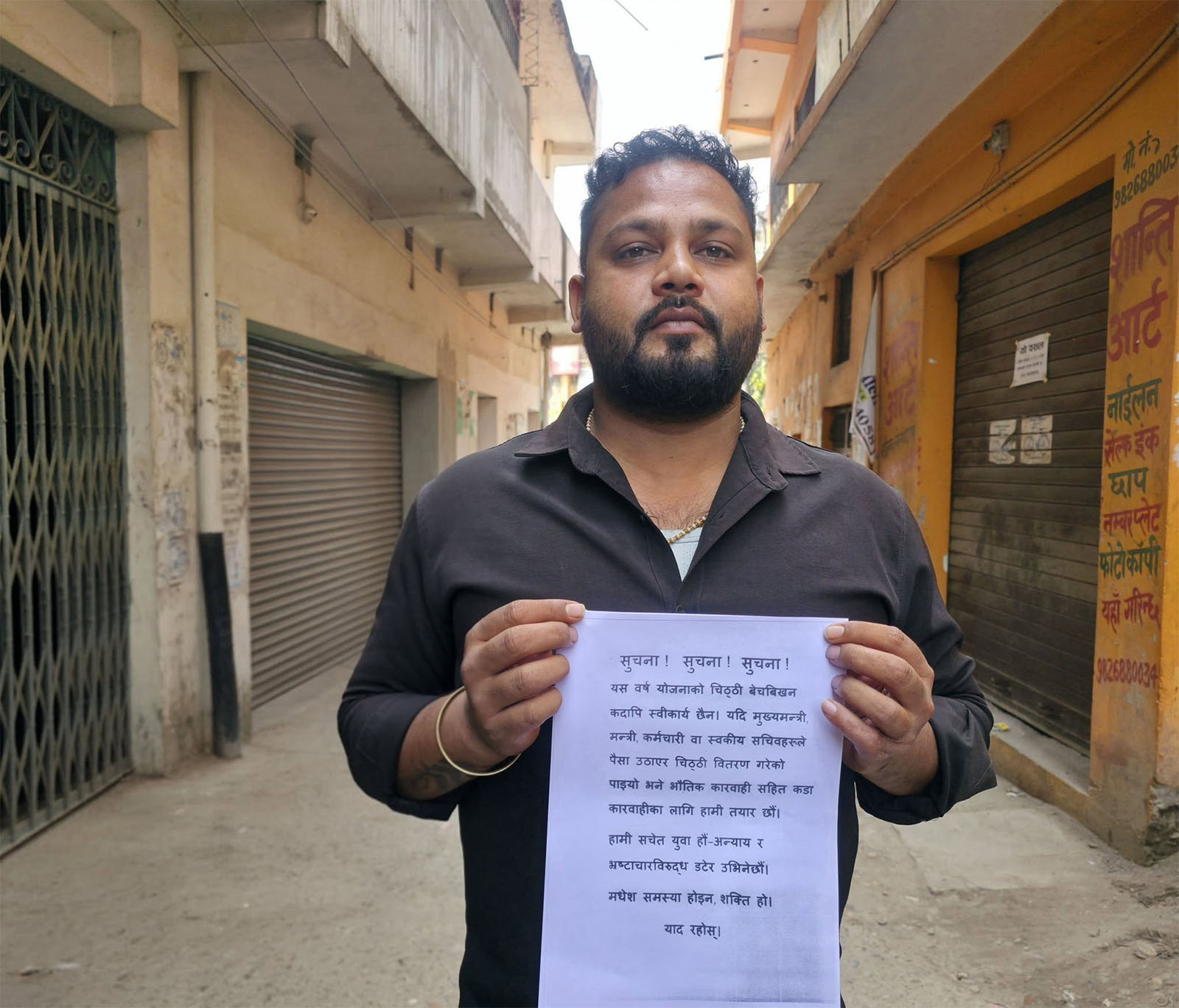
My brother was asked for NPR 700,000 in advance By Rameshwor Parajuli last year as a commission to arrange a provincial government project. No project was awarded afterwards. When he still did not return the money, we filed the case. He had collected payments from many people on the promise of securing projects, claiming that he had personal contacts with politicians and ministers.
- Kamal Yadav
But in fiscal year 2024/2025, allegations emerged that ministers and Provincial Assembly members themselves were holding on to work orders that should have been issued by development offices and handing them over to user committees in exchange for commissions.
Then-Minister for Physical Infrastructure Development Saroj Kumar Yadav alleged in the Provincial Assembly that lawmakers had secured projects worth hundreds of millions of rupees for their constituencies and had even collected the work orders themselves, effectively acting as middlemen.
He named lawmakers from various political parties and alleged that political interference was influencing the distribution of projects.
At the time, the development budget allocated to the provincial Ministry of Physical Infrastructure and Development stood at NPR 12.69 billion. Of this, approximately NPR 2.99 billion had been allocated for Provincial Assembly members. Projects worth between NPR 15 million and NPR 50 million were allocated to each lawmaker's constituency.
According to details presented by Yadav in the Provincial Assembly, then-Chief Minister Satish Kumar Singh had secured projects worth NPR 1.16 billion, while all 107 Provincial Assembly members had collected letters for 1,232 projects from the ministry.
Yadav claimed that 25 UML lawmakers had received letters for 240 projects, Congress lawmakers for 248, Janamat Party lawmakers for 163, CPN (Maoist Centre) lawmakers for 64, Loktantrik Samajwadi Party Nepal lawmakers for 94, Janata Samajwadi Party lawmakers for 174, CPN (Unified Socialist) lawmakers for 57, Nagarik Unmukti Party lawmakers for five, Rastriya Prajatantra Party lawmakers for four, and Nepal Sanghiya Samajwadi Party lawmakers for four projects.
Questions Raised by the Auditor General
The questions surrounding project selection and implementation in Madhesh Province are not new. Reports of the Office of the Auditor General from 2018 to 2026 have repeatedly instructed the provincial government to improve every stage of the process, from project selection and budgeting to implementation, supervision, monitoring and evaluation.
The Auditor General has consistently emphasized the selection of provincial flagship and first-priority projects and the concentration of capital expenditure in productive areas. Yet various provincial government offices have continued to use user committees, direct procurement and project splitting rather than competitive procedures, contrary to the spirit of the Public Procurement Act and Regulations.
Although the examples cited in the reports relate to different government offices, the underlying problems are similar. The Auditor General has identified technically complex projects being implemented through user committees, projects being split to avoid competitive bidding and, in some cases, inadequate quality testing.
The Public Procurement Regulations limit user committees to relatively simple and labour-intensive works. Yet the Auditor General's reports state that offices in Siraha, Saptari, Sarlahi and Dhanusha have implemented technically demanding and high-cost projects, including RCC buildings, embankments, river-control structures and irrigation schemes, through user committees.
The Auditor General has also drawn attention to the practice of dividing a single project into numerous smaller schemes to avoid competitive bidding. Citing examples from Bara and Dhanusha, its reports state that similar works were divided into dozens or even hundreds of separate projects, undermining the purpose of the public procurement system.
The Auditor General has further pointed to failures to use competitive procedures, inadequate documentation and a lack of clear justification for public investment in projects ranging from the procurement of medicines to building construction and tourism infrastructure.
Why Do the Same Problems Keep Recurring?
The questions surrounding budget formulation and project implementation in Madhesh Province cannot be attributed to any single government or fiscal year. The recurrence of similar problems year after year suggests that the problem lies not only in implementation but also in the fundamental process through which budgets are formulated.
According to economist Bhogendra Jha, former vice-chair of the Madhesh Province Policy and Planning Commission, budget formulation should be based on a defined methods and reliable data. The process should begin with a realistic estimate of the province's income and expenditure, followed by setting budget ceilings for ministries. Only then should projects submitted by lower levels of government be selected according to established priorities. In Madhesh Province, Jha believes, this process has been turned on its head.
Instead of projects emerging from the bottom up based on identified needs, projects are, in practice, determined by political leaders. Jha says that when ministers, governing coalitions and politically connected groups influence which projects are included, budget priorities shift away from development needs and towards political management. “That is why the pattern of fragmented projects, constituency-focused schemes and budget spreading keeps recurring,” Jha says.
If project selection itself is driven by political influence, how can the provincial government implement a long-term development strategy? When priorities are altered at the very beginning of the budget process, the effects are ultimately reflected in project selection, public procurement and, eventually, the quality of development itself.
Many Investigation Committees, But No Visible Reforms
Since the Madhesh provincial government was formed, parliamentary investigation committees and task forces have repeatedly been established to examine budgets, reallocations, grant distribution and project implementation. Some submitted detailed reports, but their findings have rarely translated into administrative reforms or legal action.
Since fiscal year 2020/21, the Provincial Assembly has formed special committees and various thematic task forces. Some concluded that irregularities and violations of law had occurred, while others became inactive without even holding committee meetings.
Available records show the following among the committees formed in recent years:
Fiscal year 2020/21: A committee was formed to investigate irregularities in grants provided to local governments, but its report was never made public.
July 11, 2023: A 10-member committee formed under the coordination of Upendra Mahato concluded that the law had been violated in the reallocation of more than NPR 3.34 billion and submitted its report on 9 Ashadh 2081. Although there were claims that the then finance and tourism ministers were held responsible, no action was taken.
May/June 2025: A committee formed to investigate the buying and selling of projects was unable to select a chair for two months and subsequently became inactive.
July 12,2026: A seven-member task force formed by the Provincial Assembly submitted 10 recommendations, including removing infrastructure projects costing less than NPR 10 million, prioritizing multi-year projects and involving experts in project selection. It remains to be seen whether these recommendations will actually be implemented.
Political analyst Bishnu Kunwar says that although political leaders portray Madhesh as the birthplace of federalism, its government has failed to function in accordance with the spirit of federalism.
“The practice of using fragmented projects to sustain political cadres cannot produce quality public services. If the government does not even try to understand what people want, how can federalism be strengthened?” Kunwar says. “The purpose of federalism can only be fulfilled if the provincial government focuses on long-term projects linked to production, infrastructure, industry and employment.”
More Investigative Stories
One Water Crisis, Three Governments, Three Directions
Despite the expenditure of millions of rupees on water, lake and watershed conservation in Kailali, groundwater levels are falling, lakes...
One River, Two Governments
The Local Government Operation Act gives local governments the authority to collect revenue from riverbed materials such as stone, gravel...
Comment Here