Investigative Stories
Hundreds of hospitals and clinics in Karnali are outside legal framework
Patients’ health and safety is at grave risk as the private health businesses without certification continue operations in Kailai.
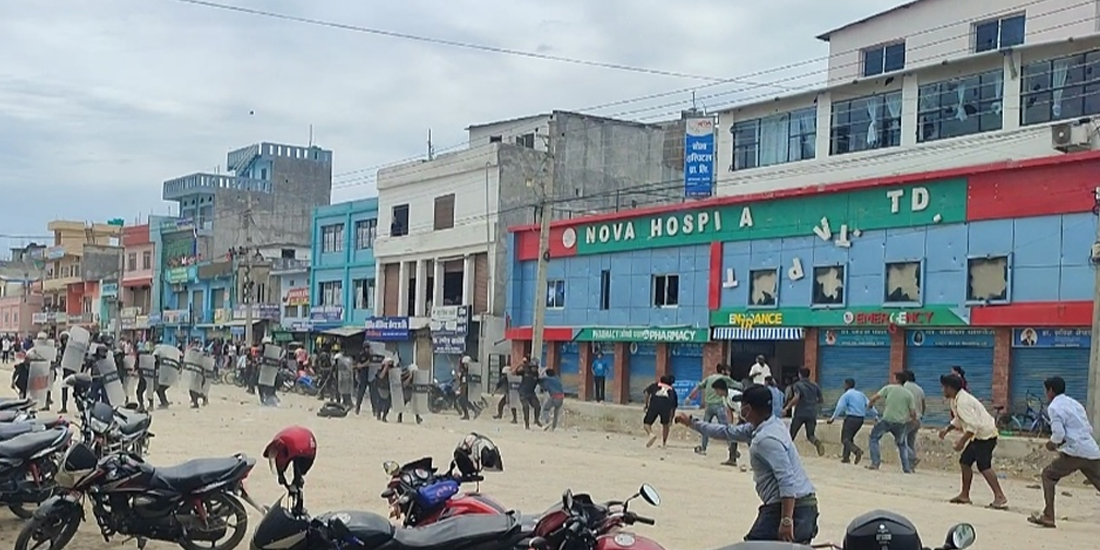
The Nova Hospital, situated alongside the Seti Provincial Hospital, has taken permission from Dhangadhi sub-metropolis to run only a 15-bed facility. But the hospital is also operating specialised ICU, orthopaedic, mental health, and cardiovascular services, among others. A permission from the local government is enough to run a 15-bed hospital. But for ICU and other specialised services, a separate approval from the Health Office is required.
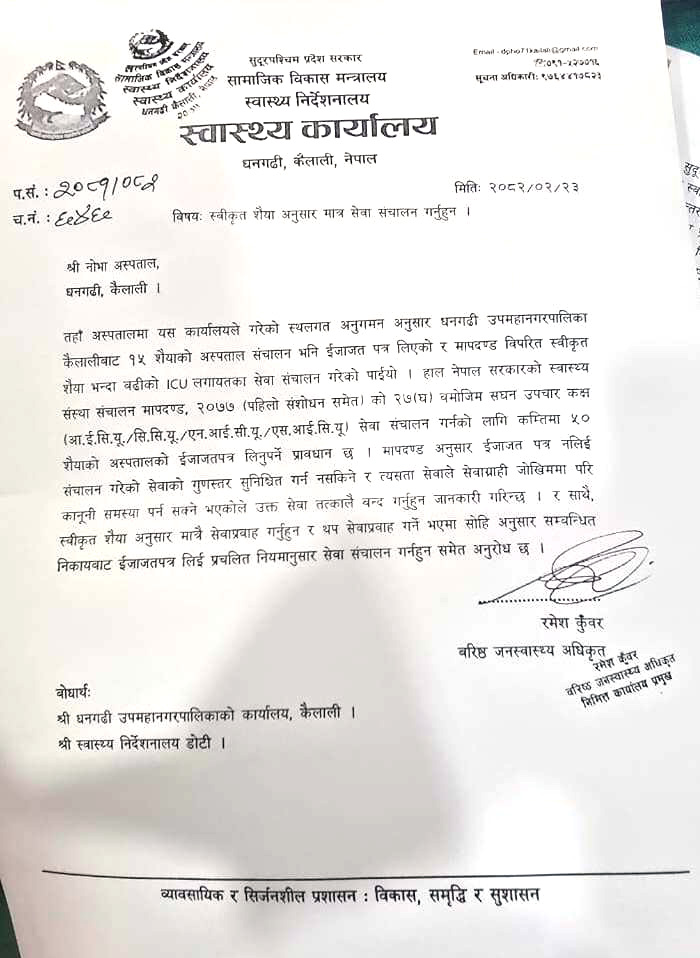
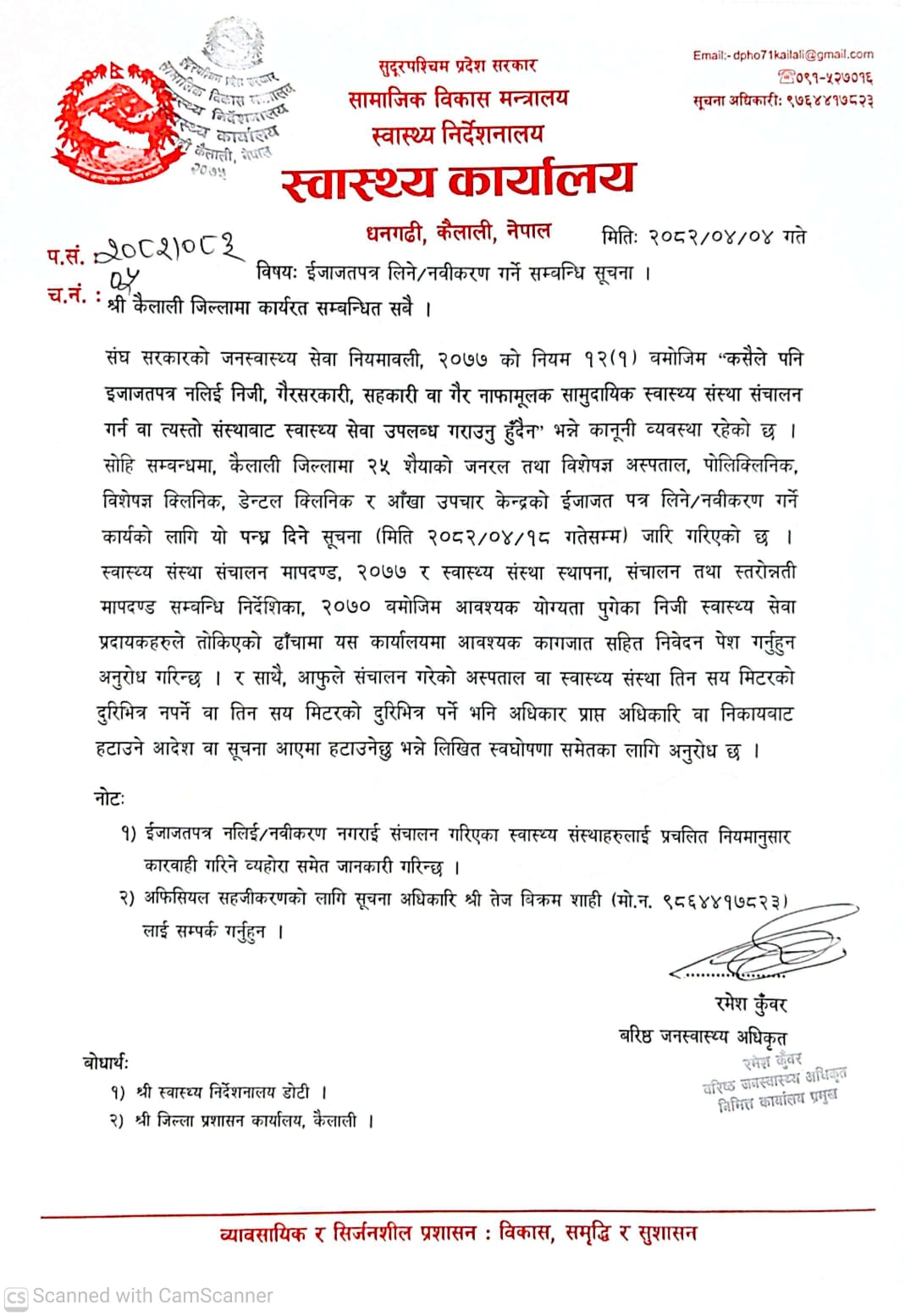
After Nova Hospital expanded its services without obtaining the required permission, the Kailali Health Office sent a letter on June 6, 2025, instructing it to immediately shut down those services. The hospital did not comply, and the Health Office recommended action against it to the District Administration Office.
Meanwhile, following the death of a patient at the hospital, angry relatives vandalised the facility. The hospital’s license to operate the 15-bed facility has now expired, but it is still continuing specialised services.
According to Ramesh Malasi, chief of the Public Health Division under the Ministry of Social Development, the hospital has initiated the process to obtain a 50-bed license but has not received approval yet.
“Since the 15-bed license has also not been renewed, the hospital is currently operating without any license,” he said.
The Private Health Institution Management Committee, formed under the Health Office to oversee and regulate private health institutions, found that other hospitals in Dhangadhi also failed to meet required standards. The committee’s inspections found that Sarathi, Sanjeevani, and KG hospitals lacked necessary infrastructure, manpower, and proper service management standards, the Health Office said.
The Health Office had warned KG Hospital to obtain a laboratory license immediately or face action. But the hospital has still not obtained even a Class C laboratory license.
On June 10, 2025, the Health Office sent a letter to Sanjeevani Hospital, which is licensed for 15 beds, instructing it to immediately shut down its ICU service—permitted only for 50-bed hospitals—and report back. The service has not been discontinued yet.
“We have instructed those hospitals to meet the required standards,” said Ramesh Kunwar, chief of the Kailali Health Office. “But after non-compliance, we have recommended action against them.”
Kunwar added that the Health Office can monitor and make recommendations but does not have the authority to take direct action. Although it has written to the District Administration Office for action, it has not received information about any action being taken, Kunwar said.
The Health Directorate grants licenses for 50- and 100-bed hospitals according to the Public Health Service Regulations 2020. Hospitals with up to 25 beds, polyclinics, specialist clinics, dental clinics, and eye treatment centres must meet required standards and obtain licenses from the District Health Office.
A Class C laboratory is required for polyclinics, and its license is issued by the Provincial Public Health Laboratory. Licenses for hospitals with up to 15 beds, health clinics staffed by MBBS doctors, and Class D and E laboratories are issued by local governments.
According to the regulations, one cannot operate a health institution without a license. Violations can result in a fine of up to Rs1 million, imprisonment of up to two years, or both.
Hundreds of clinics operating without licenses
In Kailali, hundreds of polyclinics and clinics are providing medical treatment without obtaining proper licenses.
According to the Inland Revenue Office Kailali, the number of clinics, polyclinics, hospitals, and laboratories in the district has reached 871. Among the 788 registered clinics, around 700 are operating without licenses. They have not obtained permission from the local government. Similarly, out of 37 polyclinics, even half have not secured licenses.
According to Schedule 10 of the Public Health Service Regulations 2020, to operate general, specialist, and specialised health services, the following must be submitted to the Health Office: a recommendation letter from the local government and relevant provincial authority confirming the need for a health institution in the proposed location; details of medicines and equipment; human resource details; Nepal Medical Council certification for doctors; and estimated income details.
The ‘Standards for Operation and Renewal of Specialist Clinics 2025’, prepared by the Sudurpashchim provincial government, mandates that government doctors must submit departmental approval if they intend to provide services elsewhere.
According to Surya Bista, coordinator of the Private Health Institution Monitoring and Regulation Branch, obtaining a license is not difficult if the standards are met. But many institutions are still operating outside the legal framework. “We have repeatedly called on institutions to meet the standards and apply for licenses,” Bista said. “The quality of services provided by unlicensed institutions cannot be guaranteed.”
Seti Hospital’s neighbourhood: A hotbed of illegal operations
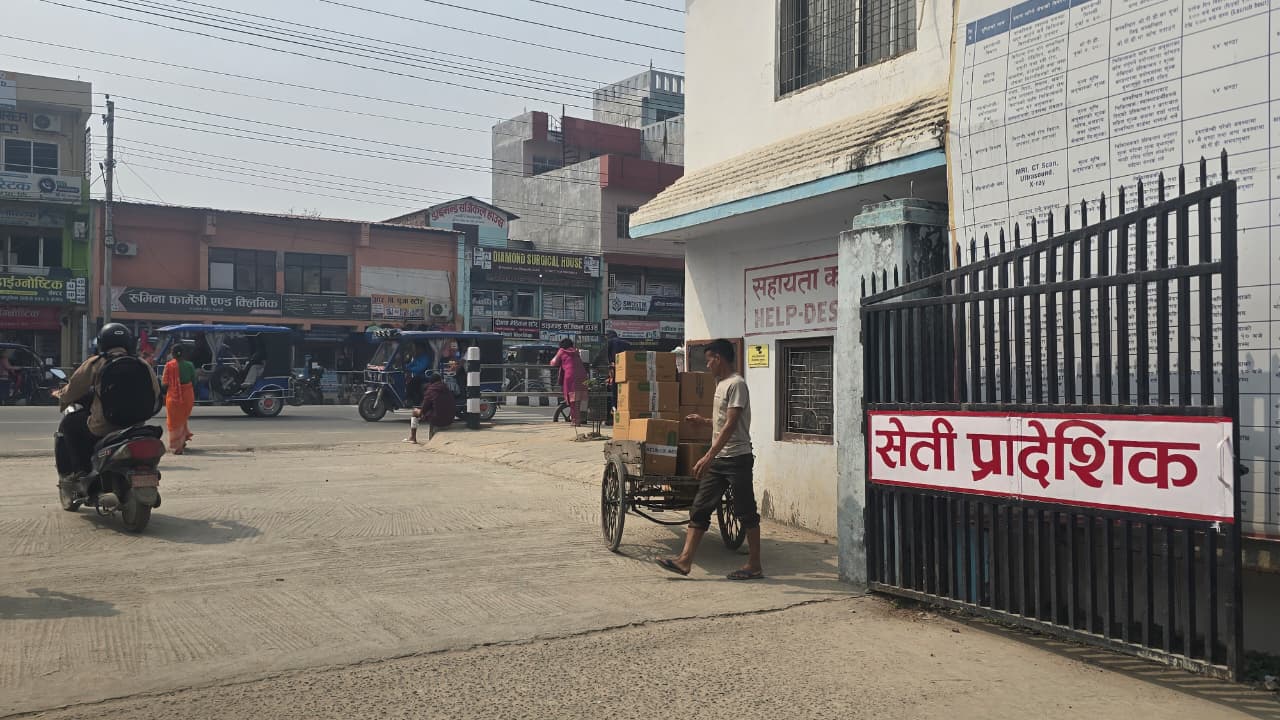
The Provincial Public Health Services Act mandates that private health services cannot be operated within at least 300 metres of a government hospital. However, many private hospitals, polyclinics, clinics, and laboratories have been established within this restricted distance around the Seti Provincial Hospital. Many of them have not even obtained operating licenses.
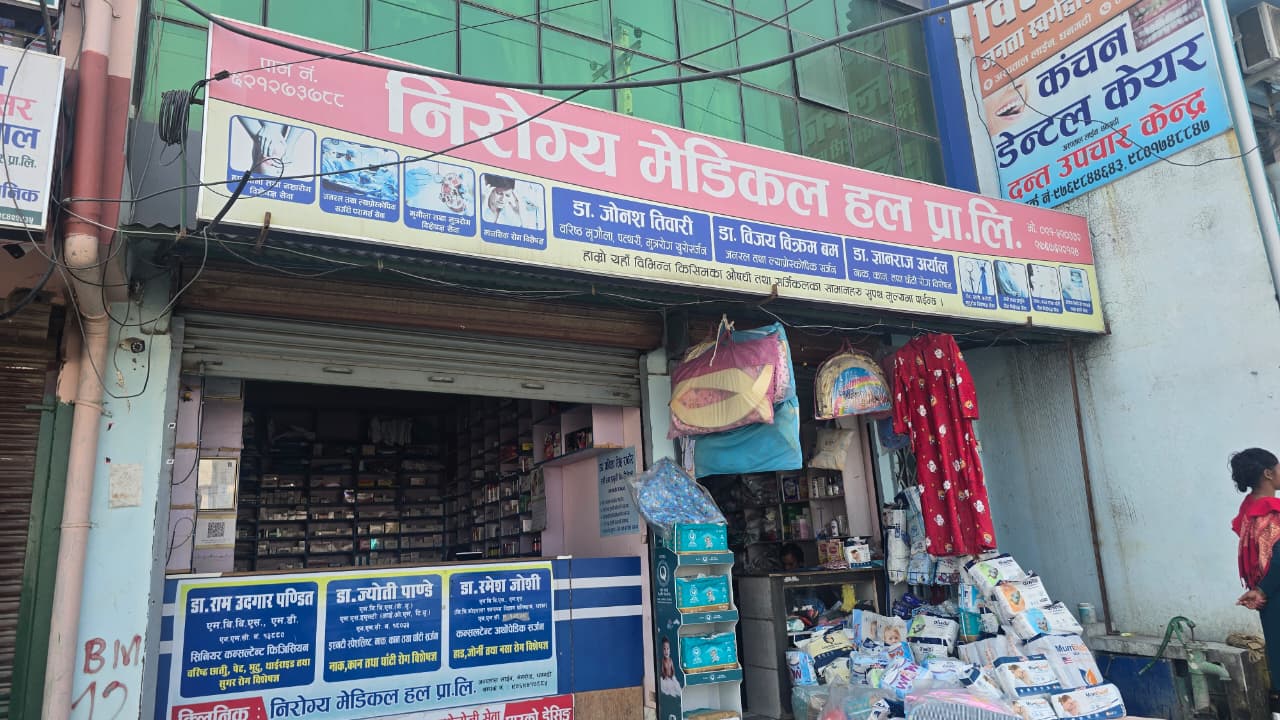
Doctors who work at the government hospital are also found working in nearby private clinics operating without licenses. Even Yug Clinic, where Dr Hemraj Pandey, the medical superintendent (MS) of Seti Provincial Hospital, sees patients, has not obtained an operating license.
Dr Hemraj Regmi, secretary of the Ministry of Social Development says the law allows government doctors to work in private health institutions outside office hours, provided it does not affect their duties at the government hospital. “However, they are not allowed to work in institutions that do not have licenses,” Regmi said. “If found doing so, action will be taken.”
Private health businesses operating near the government hospital with a high patient flow—such as Karuna Pharmacy Clinic, Samar Medical and Pharmacy, CP Clinic, Yug Specialist Clinic, Raghu Medical and Clinic, and Ugratara Medical Centre—do not have licenses but they continue to examine and treat patients.
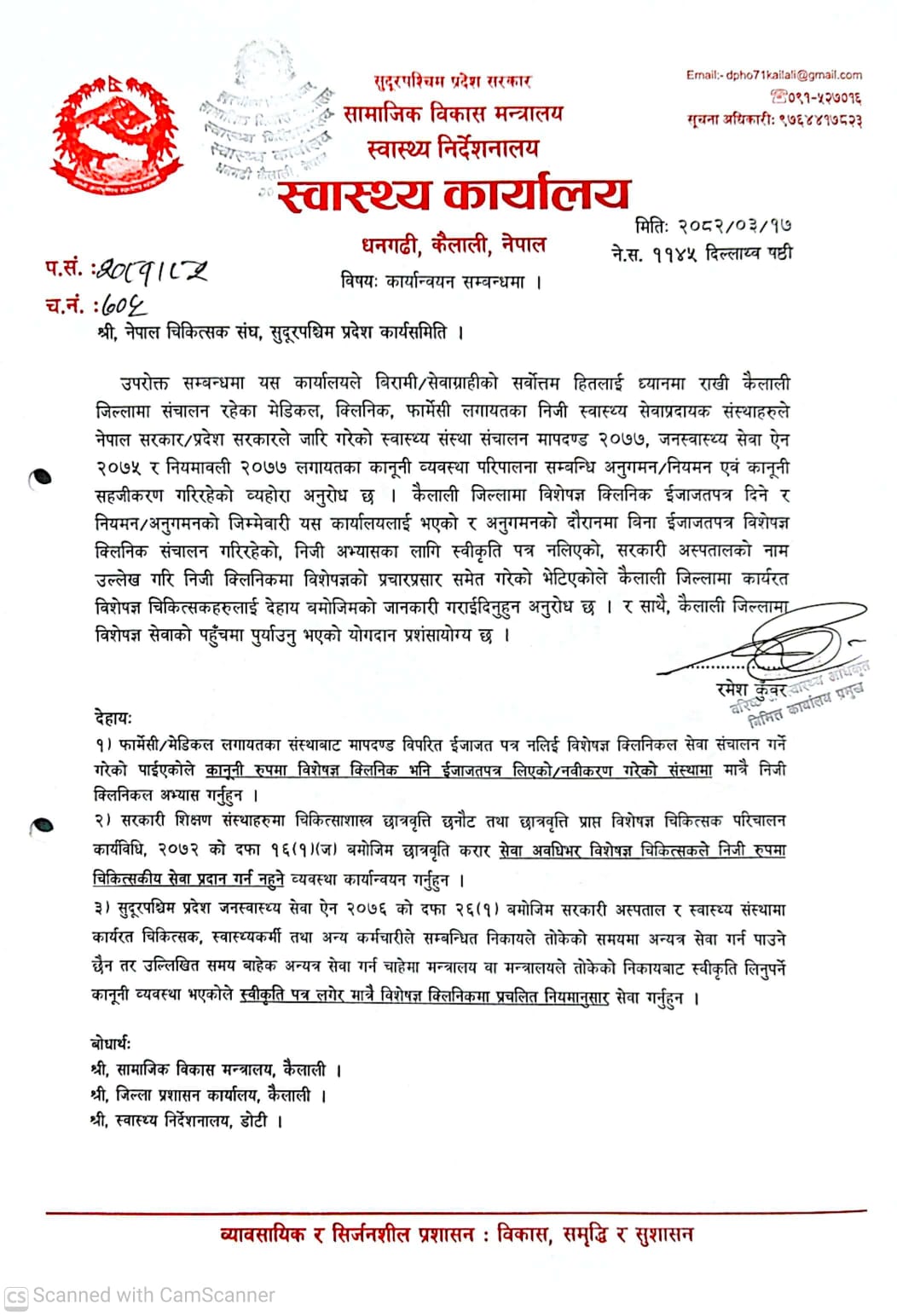
After finding out irregularities in health institutions operating without licenses, the Kailali Health Office sent a letter on July 2, 2025 to the Nepal Medical Association Sudurpashchim Provincial Committee, requesting facilitation to stop such activities and bring them under legal regulation.
The president of the Nepal Medical Association Sudurpashchim Province is Dr Khagendra Bhatta, who is himself associated with a specialist clinic that has not obtained a license. The Ugratara Medical Centre, where he works, also does not have an operating license. “We have completed all procedures and applied for a license, but it has been delayed because the local government has not provided a recommendation,” Bhatt said.
Krishna Prasad Bohara, a senior auxiliary health worker at the health section of the Dhangadhi sub-metropolis, obtained permission from the local government to operate a retail pharmacy under the name Kamana Medicines. However, under the same name, specialist services are being provided without a license using signboards of orthopedic and nerve specialist Dr. Bhushan Mishra—who is also the director of the Provincial Public Health Laboratory—and senior psychiatrist Dr Saroj Adhikari.
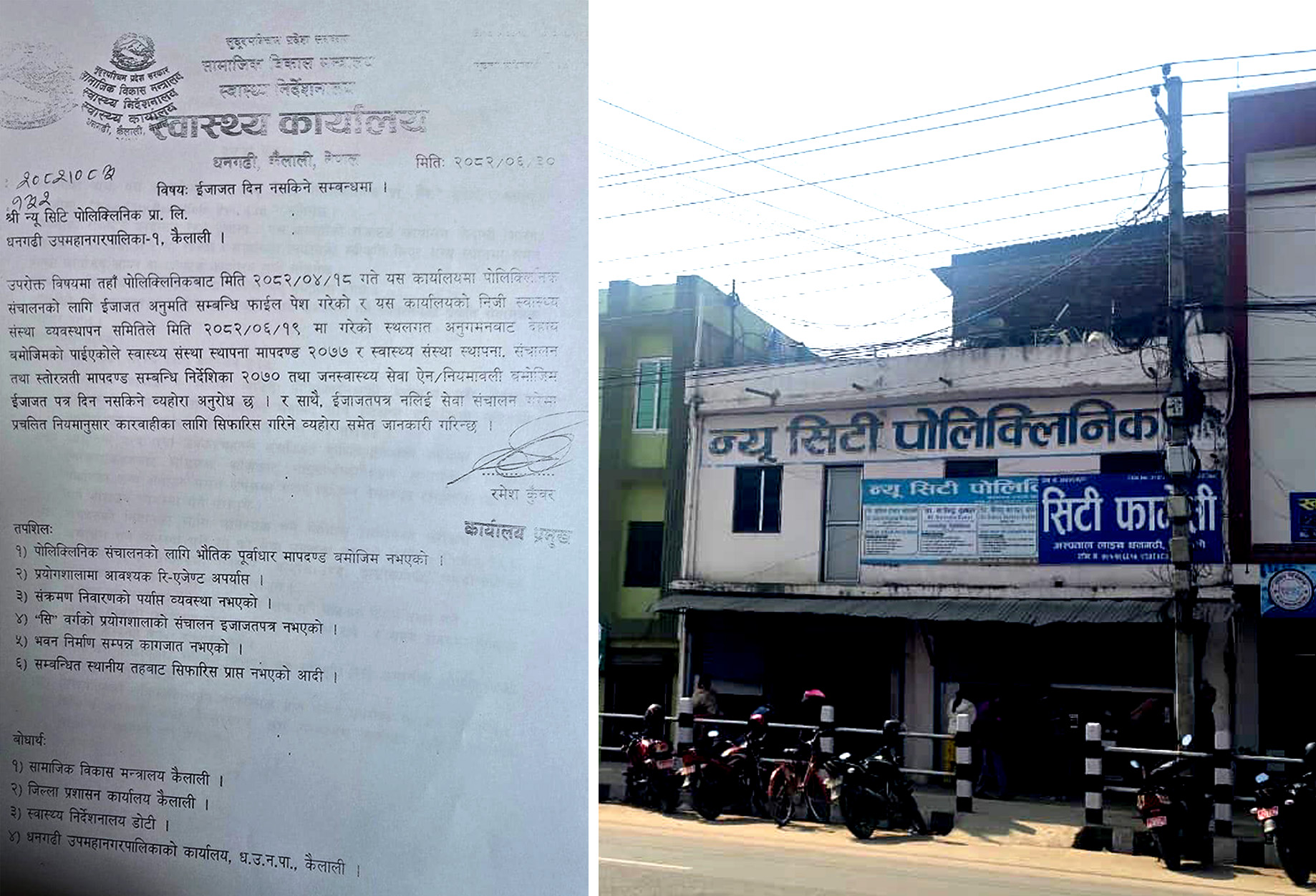
The District Health Office had issued a letter in November denying operation license to New City Polyclinic for not meeting standards, but the polyclinic is still in operation.
Other private health businesses operating without licenses are Yathartha Medical Centre and Clinic, Nirogya Specialist Clinic, Siddhi Diagnostic, Niko Clinic, CityMed Specialist Clinic, Budhiganga Specialist Clinic, and Kantipur Dental.
Problem rife across the district
In most local governments of Kailali, clinics are operating without permission. According to the Inland Revenue Office, although 47 clinics are registered in Ghodaghodi Municipality, only the CS Clinic has received permission from the municipality. Most clinics and laboratories in Chure and Kailari rural municipalities, as well as in Gauriganga Municipality, have not obtained permits.
Sunil Kumar Chaudhary, a public health inspector, said that none of the 19 clinics that had applied for permits in Gauriganga Municipality met the required standards. Most clinics lacked MBBS doctors, were not officially registered as businesses, and did not have other necessary infrastructure, Chaudhary said.
Similarly, in Bardagoriya Rural Municipality, 20 clinics, one polyclinic, and two hospitals are registered as businesses. But none of them has obtained permission from the local government. In Bhajani Municipality, none of the 23 clinics has taken permits. Likewise, in Mohanyal Rural Municipality, clinics are being operated without permits in almost every pharmacy.
Of the 57 clinics in Lamkichuha, only 22 have received permission from the local government. In Tikapur, among 41 clinics and 3 polyclinics, only three clinics and one eye hospital have obtained permits, according to Health Section Chief Bal Bahadur Rawal.
Patients are getting deceived
Chief of Kailali Health Office Ramesh Kunwar says there is a high likelihood of patients being cheated by health institutions operating without permit. “There are frequent reports of fake doctors treating patients and of problems arising when unqualified practitioners provide treatment,” he said. “Such cases may be due to these unauthorised, loosely operated hospitals and clinics.” Kunwar added that to ensure doctors’ credibility, patients’ rights, and the quality of health services, health institutions must obtain licenses.
A clinic operated by Bishwas Pharmacy in Attariya, Kailali, began attracting a large number of patients after advertising treatment for piles and hernia. During an inspection by the Provincial Directorate of Industry, Commerce, and Consumer Protection, the unauthorised clinic was found to be providing treatment through Indian health workers and charging high fees.
In Asar last year, the directorate fined the pharmacy Rs200,000. On the same day, during inspection, Deepu Subedi Medical Hall was also fined Rs20,000 on charges of consumer fraud. It was found to be selling banned and expired medicines.
Bishwas Pharmacy has not paid the fine yet. “We imposed a fine of Rs200,000 and instructed them to immediately stop deceiving consumers,” said Yashoda Bohara, head of the Commerce Administration and Consumer Protection Branch of the directorate. “But the pharmacy has not paid the fine and has relocated. It is no longer in our contact.”
Since then, the directorate has not conducted further monitoring of the health sector. Hemanta Bahadur Singh, chief of the directorate in Dhangadhi, says monitoring has not intensified due to a lack of authority to take action.
Previously, it was easier to take action because the Department of Commerce and Supplies under the federal government had assigned inspection authority to the director of this provincial directorate. But after Hemanta Bahadur Singh assumed the role as the new director, no inspection officer has been appointed, creating difficulties. Singh says they have repeatedly written to the department to assign the responsibility, but have yet to receive a response.
“We have requested the department to appoint an inspection official, but there has been no response,” he said. “In the absence of a provincial law, we have to seek authority from federal bodies even for minor actions.”
The federal Consumer Protection Act is still in effect in the province. But the legal requirement to obtain authorisation from the federal Department of Commerce and Supplies for enforcement has created complications, Singh added.
“So far, all activities have been carried out according to the Market Monitoring Guidelines and the federal Consumer Protection Act,” says Vijay Raj Ojha, legal officer at the Ministry of Industry, Tourism, Forest, and Environment. “There have been some issues due to the absence of a provincial law. We will now discuss this matter further.”
Why is there no action?
The directorate argues that it has been unable to take action against those playing with consumers’ health because the province has not enacted its own law and, under the federal law, the Department of Commerce and Supplies has not appointed an inspection officer.
But isn’t there any other body to take action against unlicensed hospitals and clinics? Khagendra Bam, chief of the Health Directorate, says the problem persists due to policy, technical, and legal complications.
He explains that although they have the authority to shut down services, they lack the power to impose penalties, and hence they could do nothing more than issue directives. “The bodies responsible for registration, licensing, monitoring, and enforcement are different in various cases,” he said. “We have coordinated with all of them.” Health Director Bam also claimed that a unit would soon be formed to identify illegal health institutions and initiate action against them.
The Kailali Health Office states that while it can monitor, issue directives, and make recommendations, the authority to take legal action lies with the District Administration Office and the courts.
According to the Public Health Service Act 2018, the authority to investigate lies with the Assistant Chief District Officer, while the power to settle cases rests with the District Court. However, Assistant Chief District Officer Kiran Joshi says that due to a shortage of personnel in the administration, such monitoring and investigations have not been effective.
“There is already a heavy workload of regular duties,” Joshi said. “Additional manpower is needed to fulfill such responsibilities. We have requested it from the ministry.”
Planned law amendment seeks to legitimise illegal operations
The provincial government has begun preparations to amend the law by removing the provision that restricts facilities within a 300-metre distance of government hospitals. The Ministry of Social Development has already registered the amendment proposal in the Provincial Assembly.
According to Minister for Social Development Meghraj Khadka, the amendment is being prepared because the 300-metre rule has been difficult to enforce. Meanwhile, some opposition lawmakers and private hospital operators have accused the government of trying to amend the law in a way that benefits only certain hospitals.
If the amendment proposal is passed, it will open the way to grant legal recognition to private hospitals, polyclinics, clinics, nursing homes, and laboratories operating near government hospitals across Sudurpashchim Province.
Former minister for Social Development Om Bikram Bhat says it is suspicious that the government is trying to amend a law it created itself in a way that benefits specific hospitals and clinics.
“We have received information that the law is being amended under financial influence and in the interest of business operators,” Bhat said. “We will not let that happen.”
The proposed amendment also seeks to remove provisions related to the deadline for relocating businesses, penalties, and the formation of a health technical committee.
“We are talking about free healthcare, but the government is trying to amend the law to suit the interests of private hospitals and clinics,” Bhat said. “We are against it”, added Bhat.
Provisions that contradict federal standards
According to the federal government’s Health Institution Establishment, Operation, and Upgrading Standards Directive 2013, there must be at least a one-kilometre distance between hospitals of a similar nature, as mentioned in Clause 13.
But the provincial government enacted a law setting a distance of just 300 metres between government hospitals and private health institutions. Now there are preparations underway to remove even this provision.
Akkal Rawal, chairperson of the Public Accounts Committee, says the law is being amended in a way that benefits a limited number of private hospitals and clinics. “At the time, there was significant maneuvering to reduce the proposed 500 metres down to 300 metres,” Rawal said. “Now the government itself is trying to remove even that provision. It is not appropriate to formulate or amend laws based on business influence or benefit. We will not allow this to happen.”
Health sector experts have raised concerns that this creates a situation that contradicts federal standards. Meanwhile, some stakeholders have accused the provincial government of attempting to change the law in the interest of a limited number of private health institutions.
Tirtha Panta, president of the umbrella organization of private hospitals, the Association of Private Health Institutions (APHIN), said the government has not been consistent in policy-making and amendments.
“Earlier, some hospitals were forced to relocate in the name of the 300-metre rule,” he said. “In whose interest is this amendment being made now? The government must provide a clear answer.”
Janak Raj Joshi, founding president of APHIN Sudurpashchim, also accused the government of not treating all health entrepreneurs equally. “The tendency to make laws easier for some and stricter for others has created confusion,” he said.
However, Dr Hem Raj Regmi, secretary at the Ministry of Social Development, claimed that the amendment proposal has been introduced to prevent the currently operating health institutions from shutting down.
Licenses based on self-declaration
While efforts are underway to remove the provision regarding the distance from government hospitals, the Kailali Health Office has been granting licenses and renewals to some private health institutions based on self-declaration forms.
The Health Office had sought guidance from the Ministry of Social Development on whether to grant licenses to private health institutions located within 300 metres of Seti Provincial Hospital, Tikapur Hospital, and other local health facilities. Following this, in early July, the ministry issued a directive to proceed with licensing and renewal through self-declaration.
According to the directive, the concerned health institutions must declare that they are not located within the 300-metre radius—or, if they are, they must commit to relocating if instructed by the relevant authority. Some clinics, polyclinics, and hospitals located within the 300-metre radius are currently receiving licenses based on this self-declaration.
More Investigative Stories
Who Does The Annapurna Belong To?
In fiscal year 2082/83 BS, the Annapurna Conservation Area Project (ACAP) received 508,000 visitors and collected more than NPR 1.77...
Politicized Budget Distribution in Madhesh is Contrary to the Spirit of Federalism
From small projects that local governments can implement themselves to the selection of projects based on political connections, the pattern...
Comment Here