Investigative Stories
Government Cuts Trees for Public Projects without Paying Mandatory Compensation
Thousands of trees are felled every year in the name of infrastructure development. More than NPR 8.54 billion remains unpaid by the Ministry of Finance to a fund established to support forest development and replace felled trees. The shortfall is affecting activities ranging from forest conservation and tree planting to biodiversity protection.

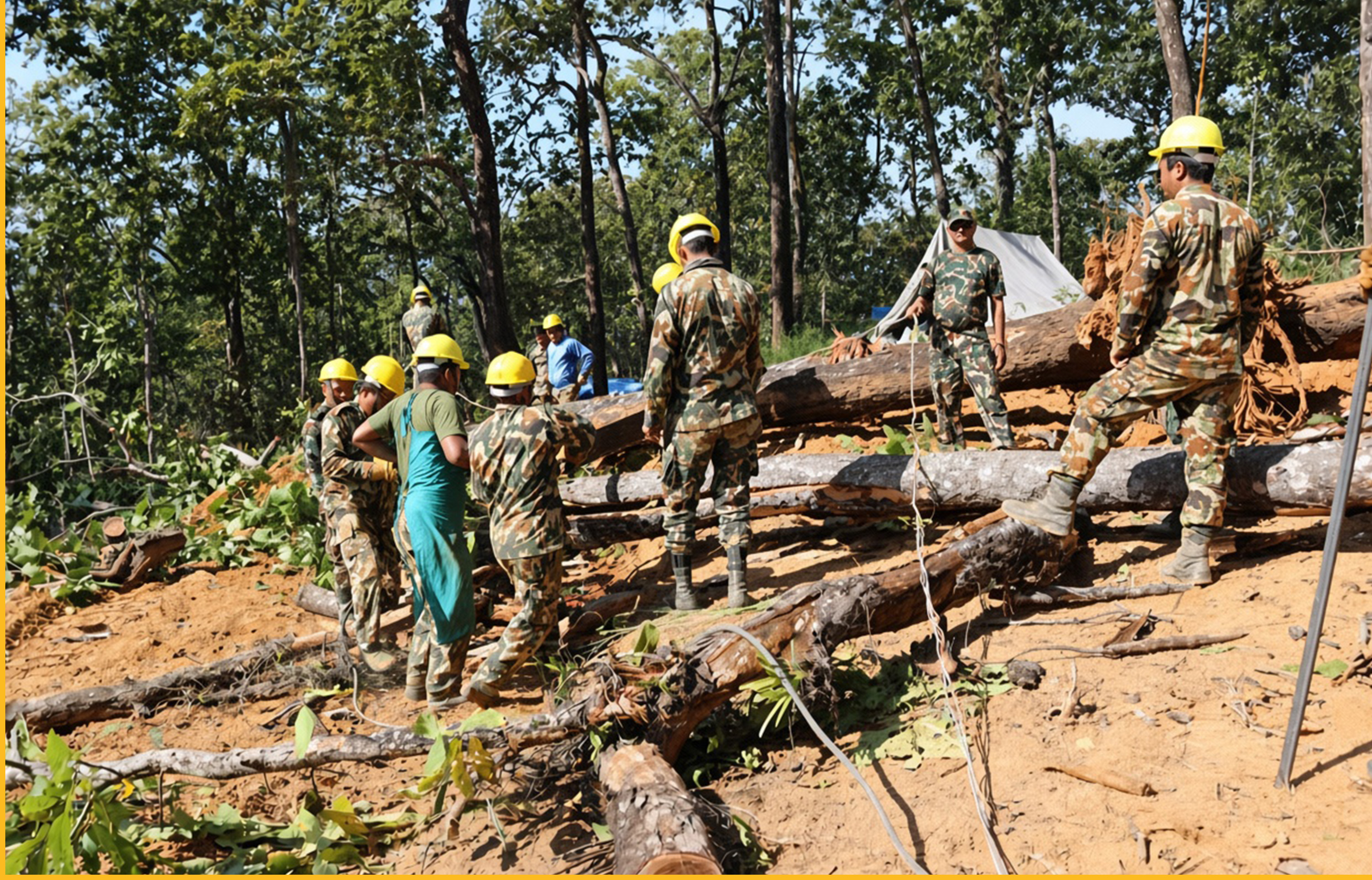
For the construction of the Kathmandu-Terai Madhesh Expressway, which is being built by the Nepal Army, the government allocated more than 98 hectares of national forest over the past two fiscal years. An agreement was reached to fell 29,646 trees. Under the law, approximately NPR 516.174 million should have been deposited into the Forest Development Fund as compensation for the felling. However, records obtained by the Center for Investigative Journalism (CIJ) from the Department of Forests and Soil Conservation under the Right to Information Act show that the expressway project has made no payment into the fund.
The Bardibas Medical College Infrastructure Construction Project in Mahottari was allocated 54.58 hectares of forest land, with an agreement to fell 1,967 trees. It is required to deposit NPR 264.776 million into the fund. Yet the department's records for fiscal year 2082/83 show a deposit of just one rupee against the project's name.
These two projects are among 19 public projects for which the Ministry of Finance agreed, over the past two years, to pay compensation for felling trees on forest land allocated for their use. According to the department, the ministry has yet to pay approximately NPR 8.5441 billion owed to the fund on behalf of these projects. Sabnam Pathak, the department's information officer, says that work on planting replacement trees has yet to begin because the money has not arrived, even though the projects are required to plant additional trees to compensate for those felled.
According to the Office of the Auditor General's 63rd Annual Report, published in 2083, the government had leased 21,868 hectares of national forest to 671 public projects for periods ranging from seven to 40 years by the end of the previous fiscal year. Of these, 497 projects had been allocated 18,879 hectares before the Forest Act 2076 came into force. After the Act took effect, another 174 projects received an additional 2,989 hectares. The report states that 43 organisations were granted the right to use forest land in fiscal year 2081/82. By the end of that fiscal year, NPR 3.37 billion had been deposited into the fund, while NPR 4.923 billion remained outstanding from 38 organisations.
Section 45(1) of the Forest Act 2076 provides for the establishment of a Forest Development Fund to protect, conserve and promote forests. The Act stipulates that payments received when forest land is made available for other purposes must be deposited into the fund.
On 6 Mangsir 2081, the Cabinet decided that compensation owed by 15 public projects would be deposited into the fund within fiscal year 2081/82. According to the department, these projects used 308.77 hectares of forest land and removed 80,803 trees. Together, they owe the fund approximately NPR 2.096 billion. Among the projects covered by the decision, the largest liability after the expressway project was for the 40-kilometre Thuligad-Seti-Budhiganga Confluence road section in Doti. The project, under the Ministry of Physical Infrastructure and Transport, used 80 hectares of forest land and is required to deposit NPR 402.7 million into the fund.
The Butwal Medical College Infrastructure Construction Project felled 11,000 trees across 34 hectares of forest, incurring a liability of approximately NPR 230 million. The Dharan-Kerabari-Letang-Madhumalla section of the Madan Bhandari Highway involved the felling of 7,700 trees across 36 hectares. The third phase of the Mahakali Irrigation Project in Kailali and Kanchanpur involved the felling of 7,400 trees across 37 hectares. The latter two projects owe approximately NPR 243.6 million and NPR 218.5 million, respectively.
The list of projects with outstanding compensation payments also includes the Pipaltar-Deudi road in Nuwakot and the Kalyanpur-Gaighat road section in Udayapur and Saptari. Two road projects under the Karnali provincial government, the Bheri Pumping Subproject in Surkhet and Rampur Hospital under Belaka Municipality, are also on the list. The outstanding payments thus involve projects at all three levels of government: federal, provincial and local.
According to the department, none of these 15 projects has made a payment into the fund. In fiscal year 2082/83, the Ministry of Finance agreed to pay the compensation owed by five additional projects. The Department of Forests says these five projects owe the fund NPR 6.448 billion. The Tanahu Hydropower Project alone accounts for NPR 5.859 billion. The Ministry of Finance confirmed its consent to this payment in a letter dated 19 Kartik 2082, with dispatch number 1101. This amount accounts for more than two-thirds of the total outstanding compensation owed by the 19 projects across the two fiscal years.
According to Chhabilal Gaire, managing director of Tanahu Hydropower, the project's financial liability had been substantial from the outset. The Department of Forests had assessed approximately NPR 6.07 billion in royalties alone. The amount was calculated to cover all costs associated with tree felling, plantation and related work over five years of land use. “We did not have the funds immediately available,” he says. He explains that the project, which is financed by donor agencies and the Government of Nepal, could not proceed with tree felling until the necessary funding was secured, resulting in a prolonged suspension of work.
Gaire says that after receiving a letter from the Ministry of Finance confirming the availability of funds in Kartik 2082, the project signed an agreement with the Department of Forests. It then corresponded with the division forest offices in Chitwan and Tanahu. Trees were first marked for felling, after which cutting began through community forest user committees. He says the project paid the costs of transmission-line works set by the Division Forest Office, as well as the expenses incurred in felling trees. “Royalties must be paid for using government land, and we are paying those as well,” he says.
Records obtained by CIJ from the Department of Forests show that no money has been deposited into the Forest Development Fund against Tanahu Hydropower's liability. The payments Gaire refers to were made to division forest offices and community forests for tree felling and royalties. The compensation that should have been deposited into the fund for the trees felled remains unpaid, despite the Ministry of Finance having agreed to cover it.
Fifteen Projects Approved to Use Forest Land and the Amounts They Must Deposit into the Forest Development Fund
|
Location |
Organisation or project allocated forest land |
Forest area allocated (hectares) |
Trees to be removed |
Amount payable to the fund (NPR) |
|
Makwanpur |
Kathmandu-Terai Madhesh Expressway Project |
51.871 |
27,747 |
454,419,000.00 |
|
Jhapa, Morang and Sunsari |
Madan Bhandari Highway Project Directorate, Dharan-Kerabari-Letang-Madhumalla road section |
36.323 |
7,710 |
243,636,368.00 |
|
Kailali, Kanchanpur |
Mahakali Irrigation Project, Phase III |
37.305 |
7,428 |
218,484,000.00 |
|
Surkhet |
Lakharpata-Khambagade-Murmuri-Jamu-Sunkada Road Project, Karnali Province |
9.36 |
3,126 |
69,678,000.00 |
|
Kailali |
Chisapani-Mangalsen (16 km) Road Project |
8.92 |
472 |
51,395,377.28 |
|
Jhapa, Ilam |
Bafalangphedi (Jhat are)-Shantinagar (13 km) road section, Madan Bhandari Project Directorate |
4.6 |
2,591 |
47,844,300.00 |
|
Jhapa, Ilam |
Geruwa-Sukhani Martyrs' Site-Bafalangphedi (3.926 km) road section, Madan Bhandari Project Directorate |
2.2 |
483 |
16,970,100.00 |
|
Jhapa, Ilam |
Shantinagar-Prapapur (13.867 km) road section, Madan Bhandari Project Directorate |
7.8 |
3,050 |
65,578,800.00 |
|
Udayapur |
Rampur Hospital |
2.12 |
55 |
3,720,948.00 |
|
Nuwakot |
Pipaltar-Deudi Road (20.87 km), Mid-Hill Highway |
5.1 |
8,542 |
89,173,170.00 |
|
Udayapur and Saptari |
Kalyanpur-Gaighat road section, Ministry of Physical Infrastructure and Transport |
15.8 |
3,219 |
104,237,437.00 |
|
Doti |
Thuligad-Seti-Budhiganga Confluence (40 km) road section, Ministry of Physical Infrastructure and Transport |
80 |
2,785 |
402,731,560.00 |
|
Butwal |
Medical College Infrastructure Construction and Development Project |
33.86 |
11,230 |
227,765,200.00 |
|
Surkhet |
Bheri Pumping Subproject, Department of Water Supply and Sewerage Management |
3.2 |
1,497 |
39,460,000.00 |
|
Surkhet |
Badichaur-Khambagade Road (13.1 km), Karnali Provincial Government |
10.32 |
864 |
60,669,998.00 |
|
Total |
308.77 |
80,803 |
2,095,761,558.78 |
The four other projects covered by the Ministry of Finance's agreement in the fiscal year 2083/84 are Bardibas Medical College (approximately NPR 264.1 million), the Millennium Challenge Account Nepal (MCA-Nepal) project for a 400 kV double-circuit transmission line in Nawalparasi (approximately NPR 223.7 million), the Kathmandu-Terai Madhesh Expressway (approximately NPR 61.8 million), and the Godawari Multipurpose Stadium (approximately NPR 39.1 million). Of the five projects, only the Godawari stadium has paid an initial installment of NPR 7.924 million. The total outstanding liability across the two fiscal years stands at NPR 8.5441 billion. According to Pathak, this is the amount the Ministry of Finance still owes the fund, and the delay has prevented tree-planting programmes from beginning.
CIJ Nepal repeatedly sought the Ministry of Finance's explanation for why the money had not been deposited into the fund. Ministry spokesperson Amrit Lamsal said the matter was being handled by Kamala Kharel, an undersecretary in the Budget Division. However, when CIJ met Kharel at the ministry, she said the spokesperson had not briefed her on the matter and declined to answer questions. When contacted again, Lamsal said he was in a meeting and offered no comment. He also failed to respond to questions sent directly to his mobile number and via WhatsApp.
CIJ Nepal emailed questions to the ministry's official address seeking a response but received a reply stating that the questions had not been submitted in the format required under the Right to Information Act. The ministry did not respond to a subsequent application submitted in accordance with the Act.
Many other projects have also signed agreements to make payments in installments for the use of forest land and the felling of trees. A review of departmental records shows that many have paid only a small fraction of their total liabilities.
The Department of Roads was allocated 135 hectares of forest land for the Chatara-Leguwaghat road section, also known as the Tamor Corridor, in Dhankuta, and agreed to fell 7,100 trees. This was the largest area of forest land allocated to a single project in fiscal year 2081/82. The project's total liability stands at NPR 634.694 million. According to departmental records, only NPR 200,000 has been deposited into the fund.
The Chaukune-Mayatal section of the Madan Bhandari Highway in Surkhet has a total liability of NPR 156.8 million. The project deposited NPR 100,000 into the fund in fiscal year 2080/81. Similarly, the 50-bed Communicable Disease Hospital in Kapilvastu, under the Lumbini provincial government, has a total liability of NPR 29.277 million. The hospital has paid NPR 20 million in three installments, leaving approximately NPR 9.3 million outstanding, according to departmental records.
The Office of the Auditor General has identified the Kathmandu-Terai Madhesh Expressway, the Madan Bhandari Highway, the Khambagade-Palaute-Vidyapur-Gutu-Mayatal road, the Lumbini provincial government's Communicable Disease Hospital, the Marsyangdi Corridor 220 kV transmission line, and the Praganna and Badkapath irrigation projects among those with outstanding payments. The Auditor General's figures cover liabilities through fiscal year 2081/82. The NPR 8.54 billion reported by the Department of Forests also includes liabilities for projects such as Tanahu Hydropower, for which the Ministry of Finance agreed to make payments in fiscal year 2082/83.
According to Rajiv Kumar Jha, deputy director general of the Department of Forests, private projects cannot use forest land without paying the required compensation. “They are not permitted to do so,” he says. Government projects, however, have been granted access to forest land on the basis of agreements with the Ministry of Finance.
According to the Auditor General's report, between fiscal years 2076/77 and 2078/79, ten organisations granted the right to use forest land deposited NPR 517.3 million with other agencies rather than into the Forest Development Fund. The report notes that the money was held by the former District Forest Offices and should be transferred to the fund's account.
The report also raises concerns about the department's record-keeping. It notes that the department has not updated records on royalty collection for leased forest land, the acquisition of replacement land as required by agreements, tree planting, or the protection and maintenance of plantations over the subsequent five years. The Auditor General has recommended updating these records and monitoring how the land is used.
Under Section 10 of the Procedures for the Use of National Forest Land for Projects of National Priority, 2074, projects that felled trees in forest areas were required to plant 25 saplings for every tree with a diameter exceeding 10 centimetres that was removed. They were also required to protect and maintain the saplings for five years. This requirement was subsequently reduced under Section 17(3) of the Procedures with Standards for the Use of National Forest Land for Projects of National Priority, 2076, which required ten saplings to be planted for every tree felled.
Rule 4 of the Forest Regulations, 2079, requires organisations granted the right to use forest land to deposit into the fund the cost of planting trees on land designated by the department and maintaining them for five years. In other words, projects are no longer required to plant replacement trees themselves. Instead, they pay the prescribed amount, and the fund is responsible for carrying out the planting.
Deputy director general Jha says payments were not being deposited into the Forest Development Fund because the Forest Development Fund Operational Guidelines, 2082, had not yet been prepared. Now that the guidelines have been issued, the department is discussing how the fund's money can be used and developing the necessary programmes, he says.
According to Sabnam Pathak, information officer at the Department of Forests and Soil Conservation, the arrangement was intended to offer projects an easier alternative to the lengthy process of planting trees themselves. “But when the money itself does not arrive on time, neither are trees planted nor is compensation provided for the forest that has been cut down,” she says.
Projects Covered by Agreements with the Ministry of Finance in Fiscal Year 2082/83
|
Location (district) |
Project |
Forest area (hectares) |
Number of trees |
Amount payable to the Forest Development Fund (NPR) |
Remarks |
|
Tanahu |
Tanahu Hydropower Project |
509.963 |
190,698 |
5,859,157,050.00 |
Cabinet decision dated 26 Bhadra 2074 |
|
Lalitpur |
Godawari Multipurpose Stadium, Godawari Municipality, Lalitpur |
3.45 |
903 |
39,051,300.00 |
Cabinet decision dated 20 Mangsir 2079 |
|
Lalitpur, Kathmandu, Makwanpur |
Kathmandu-Terai Madhesh Expressway Project |
46.39 |
1,898 |
61,755,435.00 |
Cabinet decision dated 3 Magh 2080 |
|
Nawalparasi |
MCA-Nepal, Dhan Khola-Lamahi road section and 400 kV transmission-line substation construction |
43.66 |
4,240 |
223,678,700.00 |
Cabinet decisions dated 5 Poush 2081 and 2 Jestha 2082 |
|
Mahottari |
Bardibas Medical College Infrastructure Development Project |
54.584 |
1,967 |
264,776,718.38 |
Cabinet decision dated 24 Chaitra 2082 |
|
Total |
658.047 |
199,706 |
6,448,419,203.38 |
With the money still not reaching the fund, tree-planting activities under the ministry's regular programmes are also falling short of their targets. In fiscal year 2081/82, the Ministry of Forests and Environment aimed to establish nurseries and produce and distribute 1.42 million saplings. Actual output reached only 1.17 million, leaving a shortfall of 250,000 saplings, or around 18 per cent of the target.
Controlling forest encroachment is another activity that can be financed through the fund. Section 49 of the Forest Act 2076 makes encroachment on national forest land a punishable offence. Yet, according to the Auditor General's report, the ministry's annual progress report records 104,000 hectares of forest land under encroachment across 65 districts. This is nearly five times the total area of forest land leased to projects to date. Although various programmes have been introduced to control encroachment, the Auditor General concludes that they have not been implemented effectively. The report recommends updating encroachment data and strengthening conservation efforts.
Environmental activist Pashupatinath Koirala says the fund is based on the principle of payment for environmental services. Money received for the use of forest land should be reinvested in forest development. Under the Forest Act, the fund can be used for Chure conservation, controlling forest encroachment, planting trees, expanding forest parks and urban forests, protecting riverbanks, controlling landslides, conserving wetlands, and reducing human-wildlife conflict. If the fund operates regularly, he says, it could ease the government's annual budgetary burden for forest conservation.
However, Koirala says the Ministry of Finance must also give final approval before money can be released from the Forest Development Fund. He says officials are reluctant to spend the money for fear of action by the Commission for the Investigation of Abuse of Authority (CIAA). “They are afraid the CIAA will come after them,” he says.
Environmental activist Aman Dangoura says much of the country's government land has already been converted into community forests, making it difficult to find vacant land for tree planting and adding another challenge to reforestation efforts.Another environmental activist, Kamal Thapa, says some forest areas serve as wildlife corridors for species such as tigers. Others contain sacred sites where Indigenous communities worship or perform ancestral rituals, while some provide habitats for endangered species. “You cannot buy all of this with money. It is not just about trees; there are many social and cultural dimensions involved,” he says. “Can you simply cut down trees in one place and pay money in Kathmandu?” He explains that planting trees in Nawalparasi after destroying forest in Chitwan cannot compensate for the damage caused by disrupting a wildlife corridor.
Kanchan Lama, a researcher at ForestAction Nepal, describes the policy as a decision against nature. “Money cannot replace a forest,” she says. The biodiversity of an old forest, she explains, cannot be restored by planting trees in a new one. Highlighting the central role of Indigenous women in community forest conservation, she says, “Compensation money does not restore local people's access to forest herbs and medicinal plants.”
Lama warns that even when projects are allowed to proceed after compensation has been paid, the benefits do not reach marginalised communities whose livelihoods depend on forests. As biodiversity continues to be destroyed, she says, Nepal will become increasingly vulnerable.
Published in Himal Khabar post on 27 September 2026
More Investigative Stories

Shifting Himalayas Above Put Hydropower and Local Revenue at Risk Below
Growing instability in the high mountains is clouding the safety of Nepal's hydropower projects and its dream of achieving prosperity...
Who Does The Annapurna Belong To?
In fiscal year 2082/83 BS, the Annapurna Conservation Area Project (ACAP) received 508,000 visitors and collected more than NPR 1.77...
Comment Here