Investigative Stories
Is Municipal Police a Public Service Mechanism or an Instrument of Power?
Conceived by the Constitution as a force to support local service delivery and law enforcement, municipal police have in many places become an instrument of coercion and crackdown against citizens. How did an institution intended to serve the public become a source of fear and disruption for the very people it was meant to protect?

Looking at the four different images in the collage above, did you make any assumptions? If not, click on the video and take a closer look.
Like the images, the video captures four different incidents.
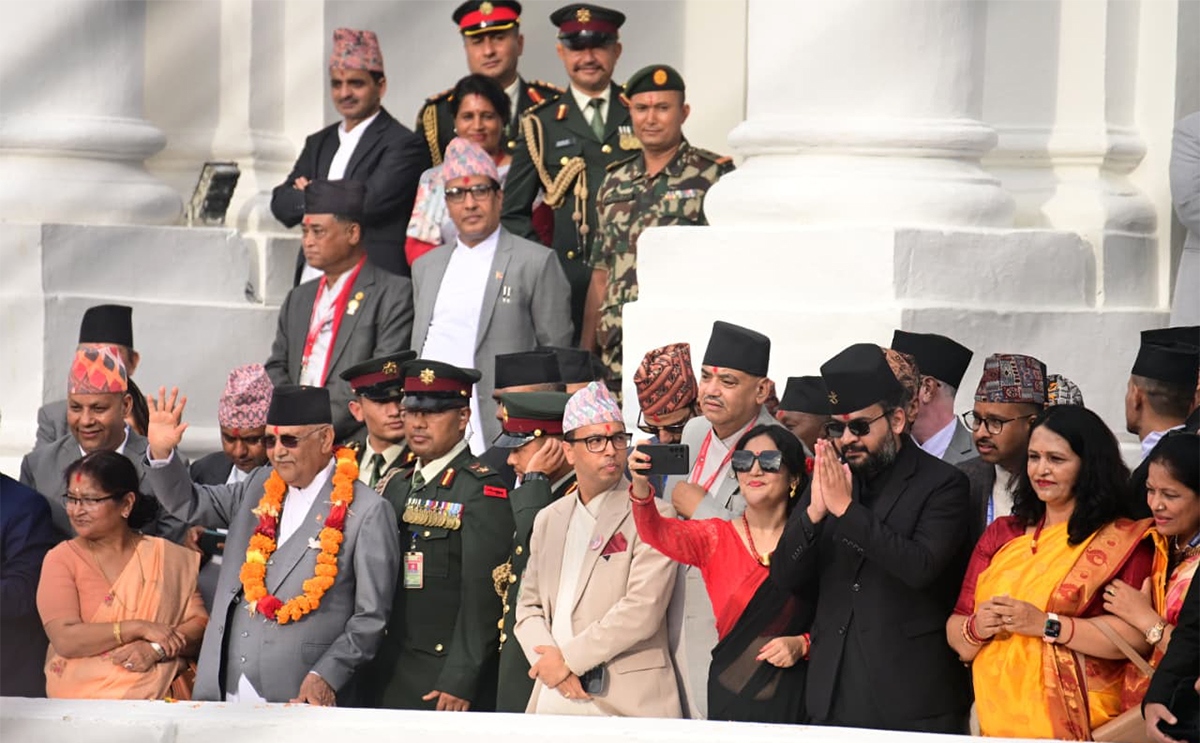
In the first, about two dozen municipal police officers can be seen running around then Kathmandu Metropolitan City Mayor Balendra Shah, forming what appears to be a bodyguard-like escort. The scene was recorded in Basantapur on September 6, 2025, during Indra Jatra, which was also attended by President Ram Chandra Paudel and then Prime Minister KP Sharma Oli.
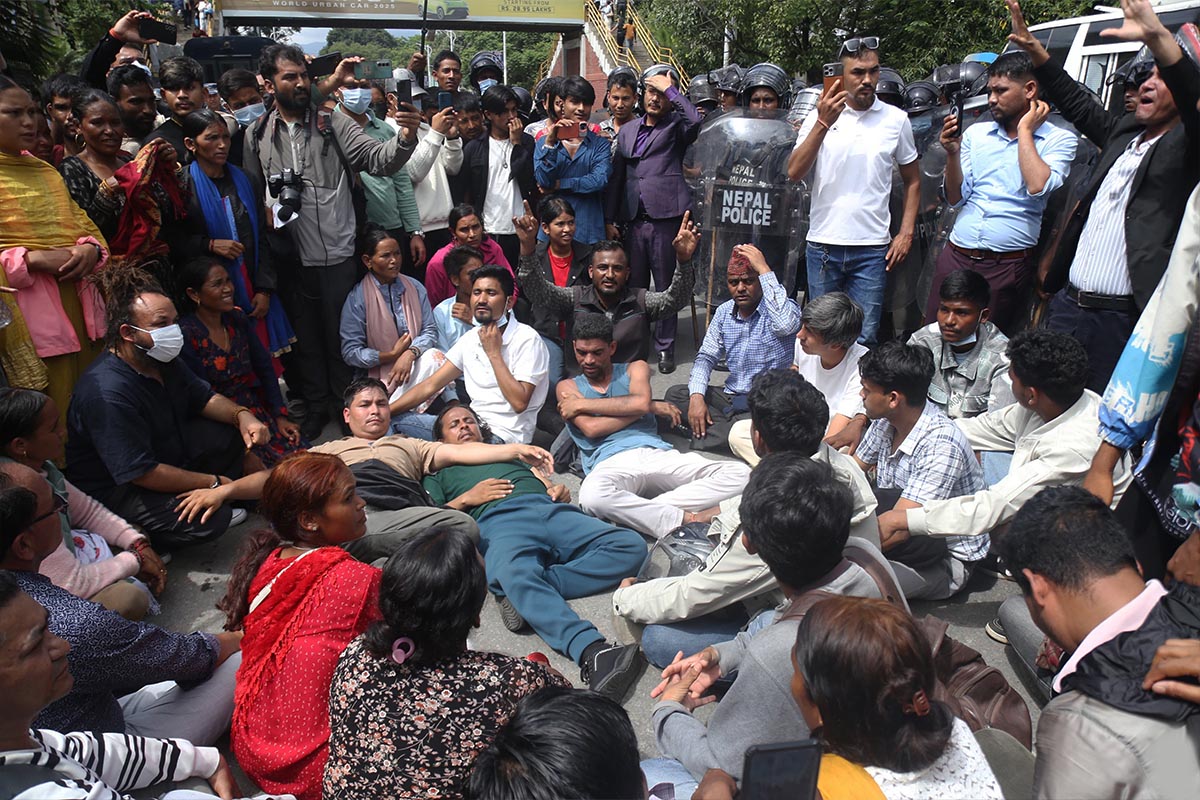
In the second incident, municipal police officers in Kathmandu can be seen shoving and detaining street vendors – those running small businesses from baskets, trays and pushcarts along pavements and roadsides.
The third incident took place in Butwal Sub-metropolitan City in April 2025. Municipal police officers there, apparently following Kathmandu's example, can be seen seizing goods from shops accused of encroaching on pavements, while pushing around and detaining those who protested.
The fourth is connected to the recent case of Ganesh Nepali, a young man from Mugu, in Tripureshwor, Kathmandu. Nepali, an agricultural technician who was making a living through ride-sharing, set himself on fire after he faced constant obstacles in continuing that work as well. There may have been other factors behind the incident, but the immediate circumstances raised serious questions about the role of Kathmandu Metropolitan City's municipal police.
Municipal police had first wheel-clamped his motorcycle and then attempted to seize it altogether. Even as he writhed in flames, a group of municipal police officers remained focused on loading his motorcycle onto a truck.
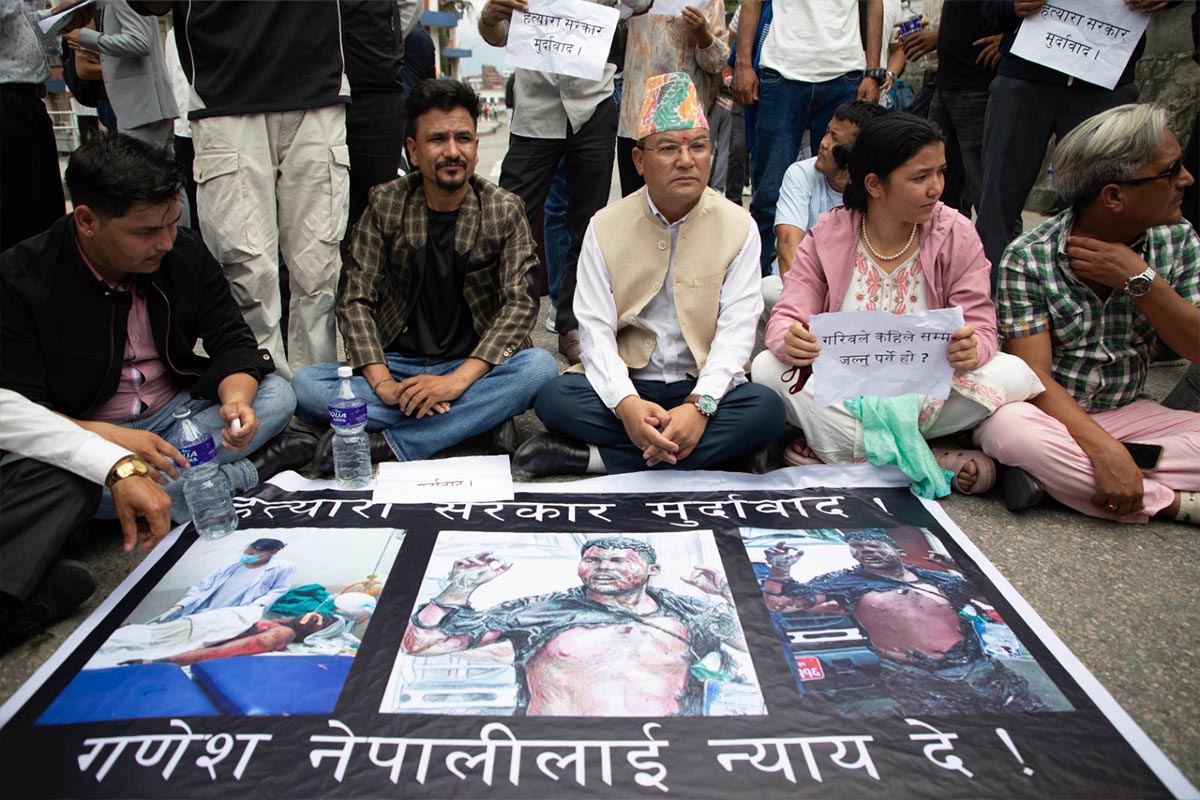
The Tripureshwor incident represents the most extreme case yet, bringing the conduct of municipal police squarely into the centre of public criticism. Yet the uncomfortable reality is that neither the Tripureshwor incident nor any of the other cases shown in the video fall within the core mandate of municipal police. The constitutional idea behind municipal police is to support local governments in service delivery, law enforcement and the protection of public property. So why have Nepal's municipal police become so deeply involved in precisely these kinds of activities?
That question lies at the centre of two very different stories – one of the municipal police envisioned by the Constitution and the other of the municipal police Nepal is actually practising.
The Urge to Rule
According to Ashok Byanju, former president of the Municipal Association of Nepal, the problem lies not primarily with municipal police themselves, but with how elected local leaders understand their role.
"Municipal police have been turned into the mayors' and deputy mayors' bodyguards and an entourage that runs ahead of and behind them. The current Prime Minister did the same when he was Mayor of Kathmandu, and we are seeing the same thing with the current acting mayor. Municipal police are not the bodyguards of mayors and deputy mayors," Byanju says.
Byanju, who was elected Mayor of Dhulikhel Municipality for two consecutive terms in 2017 and 2022, links the current state of municipal police to what he sees as a fundamental misunderstanding among elected representatives of local government.
"They won elections and became representatives of local governments, but they never properly understood the basic concept that winning an election is not the same as governing," he says.
In his view, elected representatives at the local level are not rulers. They are responsible for running a government that delivers the maximum possible services to citizens at their doorsteps.
In practice, however, the opposite often appears to be happening.
After being elected Mayor of Kathmandu as an independent candidate in 2022, Balendra Shah sent municipal police to demolish informal settlements with bulldozers within a short period of taking office. At the time, Kathmandu Metropolitan City did not even have a law governing municipal police.
It later emerged that Shah had not sought a decision from either the municipal executive or the municipal assembly before launching the operation. Not even a single ward chairperson had been informed.
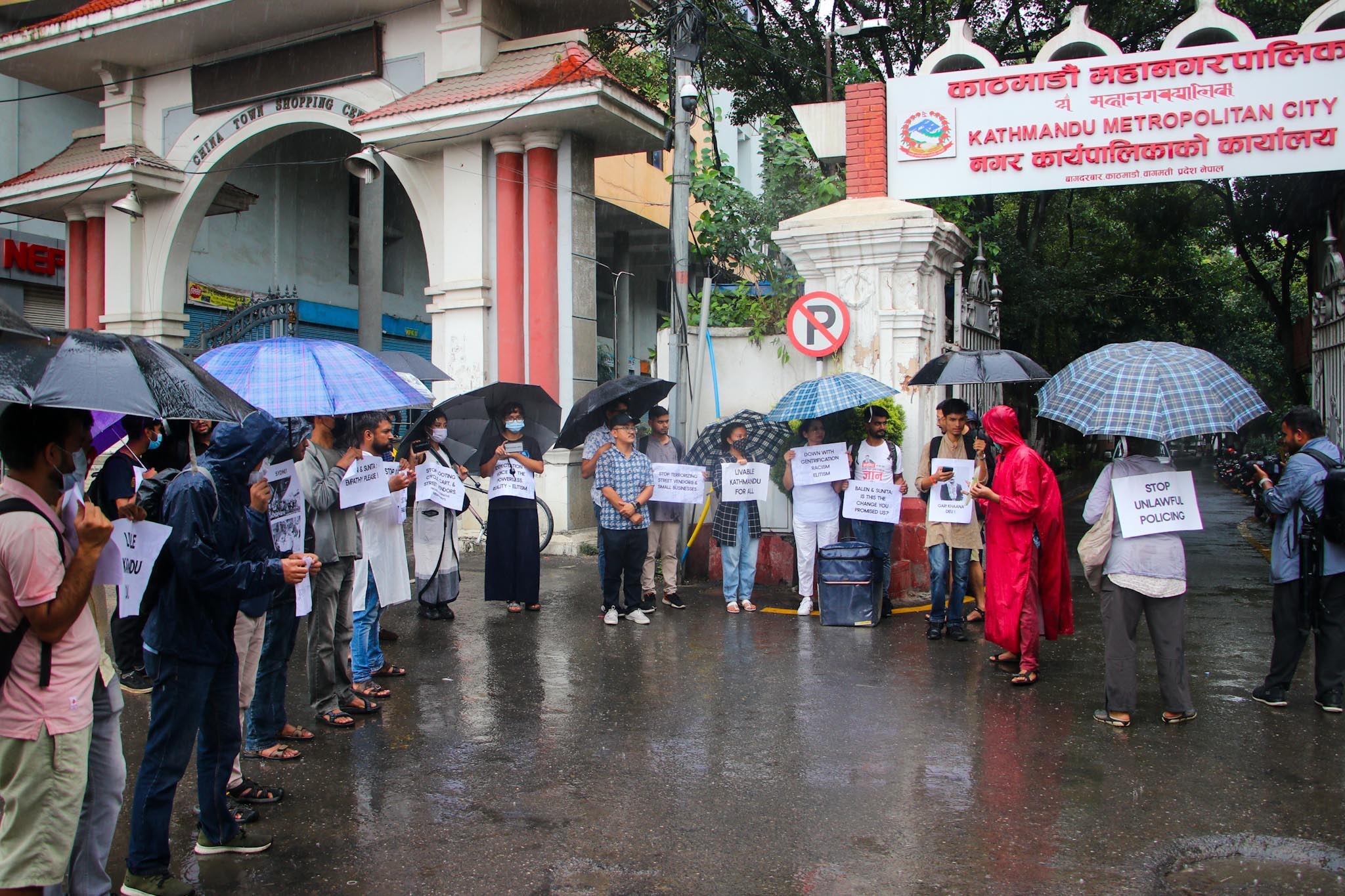
Photo Caption: A protest organised outside Kathmandu Metropolitan City's main office at Bagdarbar by civil society groups and people affected by the removal of pavement and roadside businesses, who said their livelihoods had been taken away without any viable alternative.
According to one ward chairperson at the metropolitan city, elected representatives only learned about the operation after municipal police officers whom Mayor Shah had quietly sent into the informal settlement returned injured following resistance from residents.
"After that, municipal police began operating as if they were his personal battalion, from demolishing informal settlements to chasing away street vendors," the ward chairperson says.
Following the incident, Shah decided to double the number of municipal police officers. Kathmandu Metropolitan City had 170 municipal police personnel at the time, and a decision was made to recruit another 164 on contract.
According to the ward chairperson, Kathmandu's municipal police were subsequently used even to obstruct other elected representatives and the chief administrative officer.
Kathmandu's model was gradually emulated by other municipalities. There has been little assessment of how many of Kathmandu's good practices other local governments have adopted, but the style and lawlessness of the municipal police in the city promoted as "Balen City" appear to have spread much more widely.
Within a year to eighteen months of the crackdown on municipal police, more than 10,000 street and roadside vendors were displaced from Kathmandu. According to a 2023 study by the Integrated Urban Development Centre covering 110 informal commercial locations in Kathmandu, there were more than 30,000 street vendors across the Kathmandu Valley, around 10,000 of them within Kathmandu Metropolitan City alone.
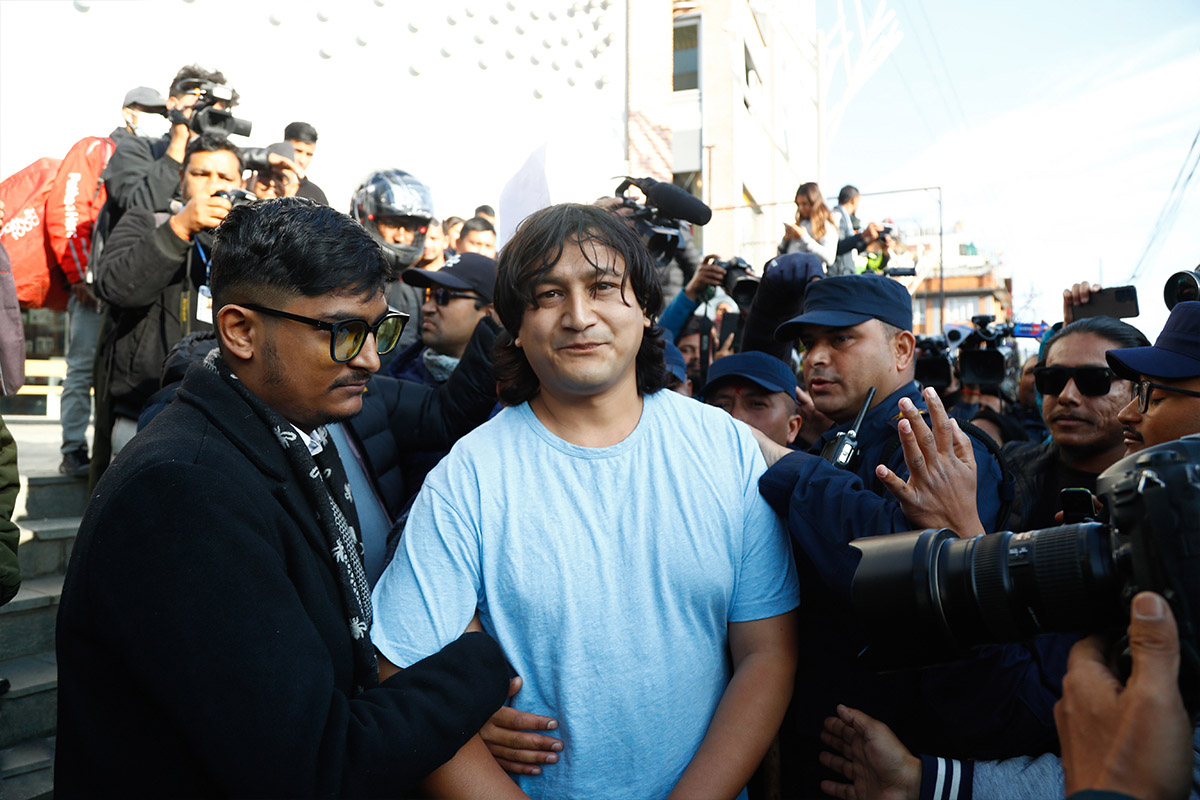
Arguing that people who depended on pavement and roadside businesses had been removed without being provided with viable alternatives, activist Iih: walked from Lumbini to Kathmandu beginning on February 11, 2024. He then staged a silent protest by standing continuously for 199 hours outside the mayor's office at the National City Hall.
The metropolitan city eventually agreed to return goods confiscated from street vendors and to work towards regulating businesses operating in the informal sector. The agreement, however, was never implemented.
"The idea that removing poor people from the city will make it clean has stripped street vendors of their right to earn a living," Iih: says. "A Constitution that is committed to social justice and describes the state as socialism-oriented does not permit the displacement of poor people without providing alternatives."
The Distortion of Constitutional Vision
Schedule 8 of Nepal’s Constitution lists the exclusive powers of local governments. Of the 22 powers included in the list, municipal police come first. But what was the constitutional thinking behind giving one of the three tiers of government, created through a fundamental restructuring of the state, the authority to maintain its own municipal police force?
Senior advocate Radheshyam Adhikari, who participated in the constitution-drafting process, says the idea was to create a community-oriented municipal police force that would enforce laws enacted by local governments, support service delivery, protect public property, engage with citizens in their everyday concerns and make things easier for both citizens and Nepal Police.

Ashok Byanju, former president of the Municipal Association of Nepal, similarly says the primary responsibilities of municipal police were envisioned as supporting service delivery in areas outside Nepal Police's jurisdiction, enforcing municipal laws and regulations in urban areas, and managing disputes that arise in the process.
“Municipalities need an entity with some legal authority to facilitate engagement with citizens while exercising their autonomous powers and implementing the law,” he said. “They also have responsibilities such as disaster management, tax administration and approving building plans. So, they need a force with certain powers, but one designed from the perspective of managing public services.”
But local governments appear to have begun deviating from the very point at which they started drafting laws governing their exclusive authority over municipal police. The first failure, it seems, was in answering a basic question: what kind of people should be recruited into a municipal police force, and why?
Section 5 of Kathmandu Metropolitan City’s Metropolitan Police Act, 2080, gives the chief administrative officer the authority to deploy, supervise, control and direct the metropolitan police. But Section 7, which sets out the duties, responsibilities and powers of the force, also requires it to implement the decisions and directives of the executive, ward committees, relevant departments, metropolitan office-bearers and authorized officials.
The contradiction between these provisions leaves the boundary between administrative control and the direct control of political leadership unclear.
The problem was compounded by a failure to consider what kind of personnel cities actually needed based on their particular character and requirements. Former police officers, temporary police recruited during elections, private security guards and even politically trained party cadres have been recruited into municipal police forces. A similar pattern appears to have emerged across local governments.

The police are often described as the state's stick. Local representatives increasingly developed an urge to wield that stick themselves. Nepal Police does not fall within the jurisdiction of local governments. Perhaps driven by the desire to exercise similar authority, local governments began creating ranks within municipal police that closely mirrored those of Nepal Police. Gradually, the structure of municipal police began to resemble Nepal Police itself.
In Kathmandu, a rank structure similar to that of Nepal Police was created, from the municipal police chief down to constables. Even the insignia were copied directly. The color of the uniforms was changed slightly, but the message was clear — municipal police were being presented as the equivalent of Nepal Police, despite the fact that the original concept never envisaged them playing a policing role.

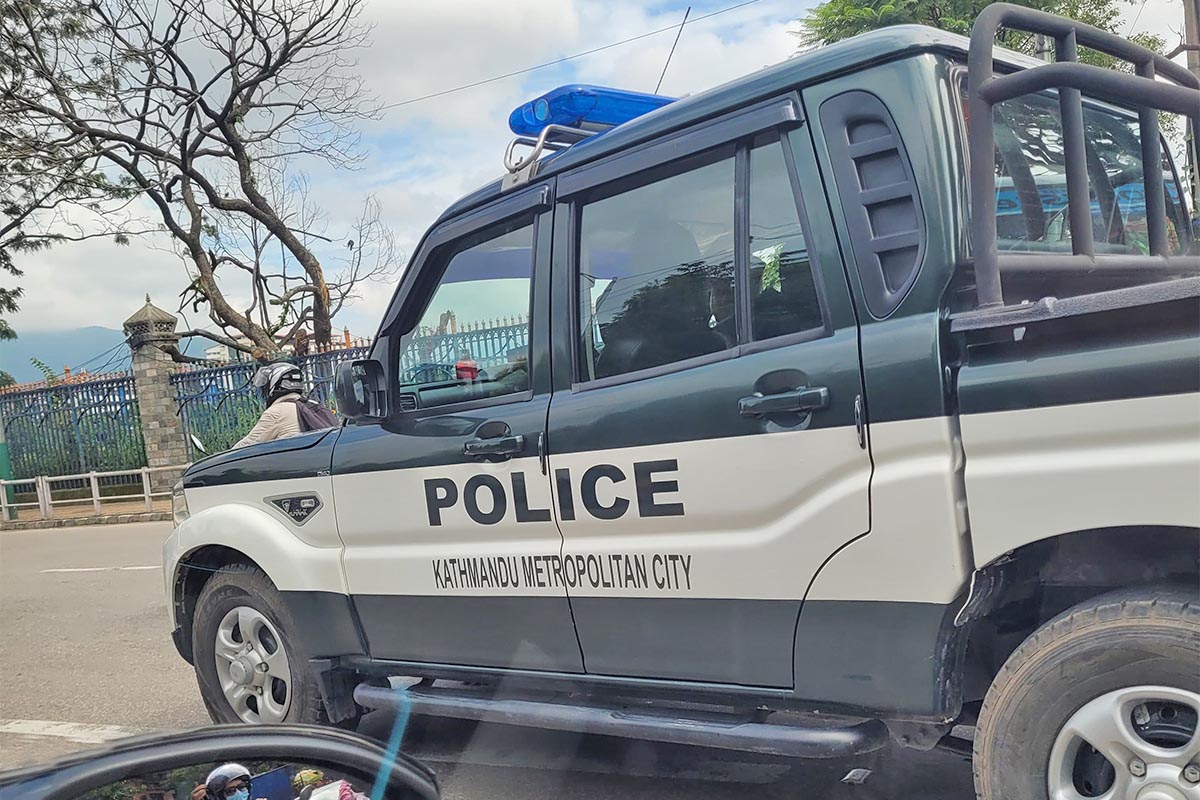
The urge has gone so far that municipal police vehicles are now marked not as Nagar Prahari but simply as Police. At a glance, municipal police vehicles speeding through the city can easily be mistaken for those of Nepal Police.
Former Deputy Inspector General of Police Hemant Malla Thakuri describes this as an example of anarchy by the local governments.
“This shows how far a beautiful constitutional vision can be distorted by an individual's arrogance and arbitrary exercise of power,” he says. According to Thakuri, turning municipal police into a replica of Nepal Police, assigning them similar duties and allowing them to encroach on the jurisdiction of the police creates serious risks.
The dangers of local governments treating municipal police as equal to, and in some cases even above, Nepal Police are already becoming apparent. On November 2, 2025, municipal police from Kathmandu Metropolitan City arrived at the traffic police office in Thapathali with a bulldozer, intending to demolish the structures there.

The municipal police team had written to the Kathmandu Valley Traffic Police Office just one day earlier, saying the structures would be demolished because they stood on public land. But when the team returned the following day and began operating the bulldozer, police personnel resisted.
The underlying reason for the sudden attempt to demolish a site occupied by traffic police since 1973 was an ego clash between Kathmandu Mayor Balen Shah and Om Prakash Aryal, the then Home Minister in the interim government. Aryal, who had previously served as an adviser to Shah, left the role after their relationship deteriorated. The incident also unfolded against the backdrop of Shah ally Sudhan Gurung actively campaigning for Aryal's removal as Home Minister. Fortunately, the restraint shown by Aryal and the police leadership prevented the confrontation from escalating.
Another incident, on April 17, 2025, at a scrap collection center in Chyasal demonstrated how municipal police, emboldened by elected representatives, have intervened in matters beyond their authority and within the jurisdiction of Nepal Police. When workers resisted the use of a bulldozer at the site, municipal police baton-charged them. One worker suffered a head injury, while others were injured. Videos of municipal police raining batons and kicks on street and roadside vendors are widespread on social media.
Senior advocate Raju Prasad Chapagain says municipal police have no authority to arrest or detain individuals or to use force.
“If such a situation arises, Nepal Police should be called in,” he says. “The primary responsibility of municipal police is to facilitate the implementation of decisions made by local governments. Arresting or assaulting street vendors or squatters, seizing their goods, auctioning them or destroying them are illegal acts and things municipal police simply have no authority to do.”
Yet such actions have become almost routine in many local governments.
On June 8, a video and photographs emerged from Birendranagar Municipality-6 in Surkhet showing municipal police pushing around a woman selling kafal fruits from her basket and throwing away her fruit in the busy City Bus Park area.
Following widespread criticism, Mayor Mohanmaya Dhakal met the woman the next day, expressed regret, provided compensation and initiated action against the municipal police personnel involved.
Dhakal says such incidents sometimes occur unexpectedly. In this case, she said, the confrontation began when municipal police attempted to remove the woman, who was selling kafal at the gate of the busy City Bus Park. While the incident did not appear to have been deliberate, the municipal police personnel involved were warned and instructed not to lay hands on members of the public under any circumstances.
“Even if someone is violating the rules, they must be persuaded and made to understand,” Dhakal says. “We have designated red zones at major intersections with heavy traffic and crowds, in coordination with the traffic police. Street vending is not allowed there, but we have identified specific sites where vendors can operate instead.
“Most people selling along roadsides and streets are women. Sometimes we, as elected representatives, go there ourselves to explain the risks of operating in crowded areas. We have clearly instructed the municipal police not to seize the goods of people carrying baskets or operating carts.”

In Kathmandu and elsewhere, however, there has been little sign of accountability. In some places, elected representatives have not even publicly expressed basic regret over the excesses committed by municipal police.
Why Are Municipal Police Behaving Like This?
One reason is the lack of institutional preparation. Even Nepal Police, with its 71-year history, has long faced criticism over its treatment of citizens. Its training curriculum and programs have undergone numerous reforms to address these concerns. Campaigns such as “Police Are My Friends” and “Police Service with a Smile” have been introduced at different times, while the concept of community policing has been pursued for years. Yet problems in the way police interact with citizens persist.
It is therefore not difficult to imagine what happens when municipal police officers, who may not have received even basic orientation on how to deal with citizens, are simply sent out onto the streets.
Former DIG Thakuri says, “This is what happens when an untrained and undisciplined group that does whatever its boss, or political leader, tells it to do in pursuit of his own interests is allowed to operate without restraint.”
Local governments are the grassroots tier of the state that citizens encounter most directly. Municipal police have now been placed on their front line. According to senior advocate Chapagain, people increasingly see the face of the state in municipal police officers.
“The sad part is that their very role is becoming a reason for people to develop a negative perception of the state,” Chapagain says.

The ‘Balendra-Rajunath Model’ and the Dhangadhi-Ghorahi Practice
Gopal Hamal, mayor of Dhangadhi, the only sub-metropolitan city in Sudurpashchim Province, has also launched campaigns to remove vendors from streets and roadsides, much like those seen in Kathmandu and elsewhere. There, too, there are voices saying that poor people are being denied the right to earn a living.
“The traffic police say that streets are not their responsibility, but when they become disorderly, the blame falls on the municipal police and the municipality,” Mayor Hamal says. “Municipal police do not go beyond their jurisdiction. But removing carts and shops that obstruct streets meant for pedestrians should not be turned into an issue.”
He argues that municipal police are simply implementing decisions passed by the municipal executive and assembly. Even so, municipal police in Dhangadhi have not faced the same level of criticism seen elsewhere.
“Elsewhere, the focus seems to be only on law enforcement. We deploy municipal police to rescue residents during disasters, provide ceremonial salutes at the funerals of those who have died, remove snakes that enter homes and pump water out of flooded houses,” Hamal says. “That has helped create a balance and earn public support.”
Ghorahi Sub-Metropolitan City in Dang has similarly deployed its municipal police for both law enforcement and service delivery. Unlike in many other places, municipal police officers assigned to monitoring duties operate under the command of the head of the relevant municipal department.
Mayor Narulal Chaudhary says the municipal police are not allowed to independently decide and take action. Instead, their role is limited to gathering information, explaining and persuading, and, where necessary, initiating the appropriate legal process.
“We have imposed restrictions to ensure that roadside and pavement businesses do not obstruct pedestrians or vehicles,” Mayor Chaudhary says. “But taking into account the livelihoods of the vendors, we also allow them to operate there during designated morning and evening hours. Of course, there must be some strictness when people act arbitrarily. But the question is whether you enforce the rules humanely or become inhumane. Our motto is to not look down on people trying to earn a living. Govern by winning the hearts of the people.”
Another practice in Ghorahi is particularly notable. Municipal authorities do not send in bulldozers or remove private property until a dispute has been settled by the courts.
“If the court clears the way, that is a different matter,” he says. “Until then, we do not touch anyone's property. And if people occupying public or government land must be removed but have no alternative housing, the municipality also provides housing.”
Practices such as those in Dhangadhi and Ghorahi remain rare. In many other places, the Kathmandu model is more visible, with municipal police exercising increasingly unchecked power. This has led some to question whether municipal police are even necessary.
But the question is not whether Nepal needs municipal police. The central problem is the lack of a clear demarcation of their role, authority, control and accountability.
Senior advocate Radheshyam Adhikari says problems are inevitable when municipal police move beyond the boundaries envisioned by the Constitution. Yet no one appears to have assessed how such problems may continue to grow or where they might ultimately lead.
“It is now necessary to legally decide what municipal police can and cannot do. Municipal police are necessary. That is why they need to be reformed through the law,” he says.
Senior advocate Chapagain likewise argues that the jurisdiction of municipal police must be clearly defined, either by amending existing laws or enacting new legislation.
“They need much more training. They need education on human rights and must be taught to behave supportively toward vulnerable citizens,” Chapagain says. “Local governments are supposed to be closest support to ordinary people. Instead, the exact opposite is happening. A feudal tendency to oppress the powerless has emerged.”
The risks extend beyond the confrontations currently seen on the streets. Because citizens see the face of the state in municipal police, Chapagain believes that unless the situation is corrected in time, public trust in the state could weaken, leading to growing social dissatisfaction and conflict.
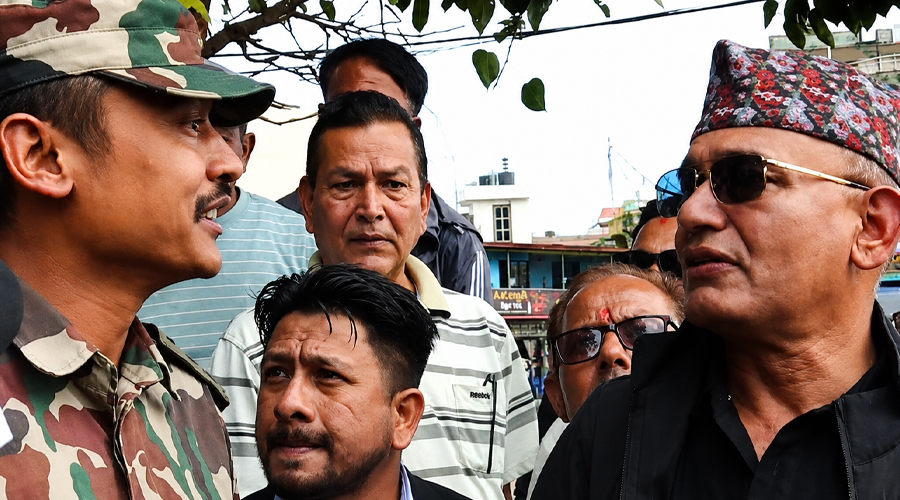
A recent incident in Kathmandu gives this debate even greater significance. On August 4, 2026, a video emerged showing Rastriya Swatantra Party lawmaker Rajunath Pandey, elected from Kathmandu-3, arriving in Gokarneshwar with a bulldozer, berating a military officer and demolishing a wall inside the military compound.
Three months after being elected mayor of Kathmandu, Balendra Shah removed the then municipal police chief Dhanpati Sapkota and appointed Pandey to the position. It was after this Shah-Pandey alliance that municipal police began to grow more powerful in Kathmandu, setting an example that many local governments across the country would follow.
Shah resigned as mayor, joined the Rastriya Swatantra Party and contested the March 5, 2026 election. He was elected and subsequently became prime minister. Pandey, who followed Shah's own trajectory by resigning as municipal police chief and becoming a member of parliament, repeated the same pattern of conduct in Gokarneshwar. What he did there offers a glimpse of what can result when municipal police are allowed to grow unchecked in the service of political leadership.
As mayor of Kathmandu, Balendra Shah repeatedly sent bulldozers into informal settlements but failed to remove them. Soon after becoming prime minister, however, bulldozers cleared settlements along rivers and streams across the Kathmandu Valley.
According to the study The Situation Following Forced Evictions: A Preliminary Report, conducted in the aftermath of the demolitions, more than 3,500 households, 8,750 families and more than 1,600 individuals were forcibly evicted. An Amnesty International study found that 93 percent of those affected lost their sources of livelihood, including wage laborers, domestic workers and people working in other parts of the informal economy, as well as self-employed roadside vendors selling goods from baskets and trays.
Unless the dangerous path of elected local leaders seeking to become rulers – and cultivating municipal police forces to serve that ambition – is checked in time, how much more will figures like Rajunath Pandey come to dominate Nepal’s politics and society?
More Investigative Stories

One River, Two Governments
The Local Government Operation Act gives local governments the authority to collect revenue from riverbed materials such as stone, gravel...
Into the Gutter: Madheshi Dalits and a Job Nobody Else Will Do
Accidents while cleaning septic tanks have claimed dozens of lives over the past decade. Yet most sanitation workers from Dalit...
Comment Here