Investigative Stories
Gender and sexual and minorities: Struggle for identity
People from gender and sexual minority communities have long been denied recognition of their true identity in citizenship and other official documents. Persistent humiliation and limited access to education and healthcare have made everyday life challenging for them.

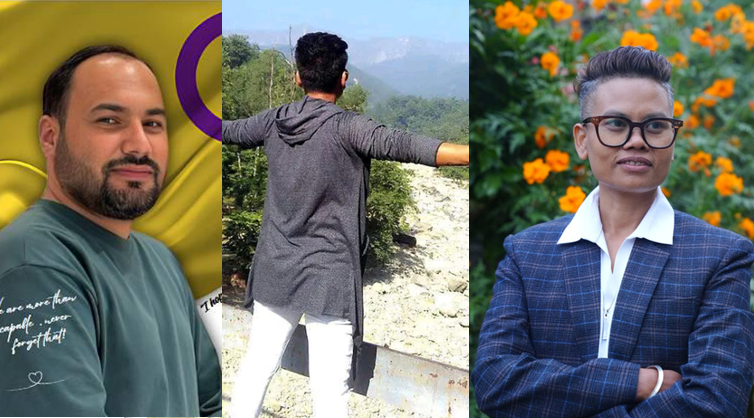
Most sexual and gender minorities, who have long faced social discrimination and rejection from their families, still do not receive recognition of their true identity from the state. When their gender identity does not match what is recorded on educational certificates, citizenship certificates, and other official papers, it not only limits their access to services but also subjects them to repeated humiliation.
Ishan Regmi, 36, from Bajura, is an intersex man. His childhood was spent being recognized as a girl. During adolescence, his voice deepened, and he began to grow facial hair. He started to feel himself as male. The behavior of neighbors and friends toward him also began to change.
For Ishan, being perceived by society as a ‘girl’ made the fact that his breasts never developed an even greater source of distress. He recalls being teased by friends, and teachers pinching his chest, experiences that left him questioning his identity.
After completing his bachelor’s degree in Bajura, he moved to Kailali in 2068 BS. There, he became associated with Sudurpaschim Samaj, an organization working for the rights of sexual and gender minorities. Around the same time, he got enrolled for a master’s program at Sudurpaschimanchal Campus. Although he presented himself with a male identity, his academic certificates still listed him as female.
In 2070 BS, Ishan was asked to leave the examination hall at Kailali Multiple Campus during his first-year Bachelor’s exam because his identity did not match his certificate. That same year, he was also barred from Teachers Service Commission exam because for the same reason. Earlier in 2068, he faced a similar situation in Dipayal, Doti, where he was labeled as “fake student” and turned away while attempting to sit for Public Service Commission examination.
“After repeated attacks on my identity, I lost all hope,” Ishan says. “I couldn’t apply anywhere and my further studies were disrupted. Everyone had a problem with my male identity- something I cannot abandon.” Today, Ishan is the executive director of Campaign for Change, an organization actively working for the rights of intersex individuals.
When name became the problem
It is not easy for individuals from the gender minority community to establish themselves in society. An even bigger challenge comes from the name listed on their citizenship and educational documents which do not reflect their identity.
According to Article 12 of Nepal’s Constitution 2015 (2072 BS), every Nepali citizen has the right to receive citizenship that reflects their identity. However, contrary to this constitutional provision, members of the gender minority community continue to face significant obstacles in obtaining citizenship and passport that matches their true identity.
Raj Chaudhary, 37, the president of Ekta Nepal, an organization advocating for the rights of gender minorities, has also faced similar challenges. He was assigned female at birth, but he identifies himself as male. His citizenship still bears the name ‘Rajkumari Chaudhary’ and lists his gender as female. He wants the word ‘Kumari’, which denotes a female identity and gender marker ‘female’ removed from his citizenship.
His attempt to correct his name and gender was no avail when he went to the District Administration Office in Kailali last Chaitra. The citizenship section hesitated and sent him to the local administration office in Sukhad.
He then, took recommendation letter from the ward office and went to Area Administrative Office where he was denied the desired change in his citizenship saying, “A woman cannot receive citizenship with a male name.” After pointing out the law and constitutional provision to the officer, he was counterquestioned, “Where did you learn such things from?”
At the time, Tek Bahadur Rawat was the chief of the Sukhad Local Administration Office. When Raj insisted on receiving citizenship as per his identity, he was asked to get a certificate from the local police proving that ‘Raj’ and ‘Rajkumari’ are the same person.
The officer Rawat told him, “To correct a citizenship previously issued in a woman’s name, a ward recommendation, birth registration, and medical report are required. We can issue citizenship based only on the ward recommendation and birth registration. For citizenships where the gender is listed as ‘other,’ one must go to the District Administration Office.”
Raj went again to the District Administration Office and met Assistant CDO Kiran Joshi. Although Joshi assured him that the correction would be made, his citizenship has still not been updated.
The Nepal Citizenship (Second Amendment) Regulations, 2078, Article 14, outlines the procedure for correcting details. According to the regulations, a person who wishes to correct any information on their citizenship certificate must submit an application to the ministry or the Chief District Officer. The law states “…Upon receiving an application for correction or amendment, the ministry or the Chief District Officer may, in accordance with Section 17(2) of the Act, collect the existing citizenship certificate and issue a new one with the necessary corrections.”
Despite this legal provision, Raj’s citizenship, which should have been corrected under this procedure, remains blocked due to bureaucratic hurdles.
Ishan, who was able to correct his name on his citizenship but not his gender, says the process was far from easy. He updated his name on his citizenship in 2076. However, his wish to change the gender from female to male was not fulfilled. Instead, the gender field was changed to ‘Other.’
Even getting a ward recommendation for citizenship under a male name was initially difficult for Ishan. Later, following advice from the CDO, the ward issued a recommendation with the gender listed as ‘Other.’
Kiran Joshi, Assistant CDO at the Kailali District Administration Office explains that while correcting basic details on citizenship is relatively easy, the process for changing gender is lengthy.“It is easier to issue citizenship based on gender at the outset. But changing gender on an already issued citizenship is difficult. It requires instructions from the Ministry of Home Affairs,” she says.
Similarly, Mohan Chandra Joshi, Assistant CDO at Kanchanpur district, says that changing gender on citizenship requires approval from the Council of Ministers. “The gender field cannot be corrected directly. The applicant must submit a ward recommendation, supporting documents, and a medical report to the District Administration Office,” he explains. “We, then send these documents to the Ministry of Home Affairs. The ministry forwards them to the cabinet. Corrections are made only with the cabinet decisions.”
Challenges in healthcare
For trans men, trans women, and intersex individuals, the struggle is not just about identity, it also extends to conflicts within their own bodies. Most people in society cannot even imagine a man menstruating. Yet, trans men do experience menstruation like women. During their periods, they neither feel comfortable being out in public nor can they take care of their health freely.
Arjun (name changed), a trans man from Kailali, shares a similar struggle. He faces harassment during his menstrual period, as he is seen as man other times. “If someone notices a pad in my bag, it becomes a source of humiliation. Even going to the hospital with stomach pain invites insult”, Arjun recalls. Public infrastructure, such as toilets and hospitals, are often unwelcoming to the people of gender minorities and fail to respect their identity. Arjun adds that often on long journeys, he avoids drinking water out of fear of facing discrimination in public toilets.
When sexual and gender minorities visit hospitals, questions about their identity and gender often outweigh inquiries about their illness, starting as soon as they register as patients. People ridicule them saying things like, “Your name is female, but your appearance is male.”
A life in hiding
Saraswati (name changed), 27, from Achham, came out about her gender identity at the age of 19. She recalls, “Ever since I was little, I liked wearing girls’ clothes and adorning myself, but fear of society held me back. After I turned 19 and lived outside of my home, I started presenting as a woman.” Even now, at 27, she still wears men’s clothes while at home.
Her family knows about her identity and desires. However, fear of the neighborhood and societal judgement-questions like, “How did the former son suddenly become a daughter?”- prevents her from fully living as a woman.

Her family has threatened her saying that if she wants to be a woman, she would be denied her share of parental property and will be thrown out. “Where would I go if I had nothing?” she asks. “They said that I could inherit the property only if I remained a son and married a daughter-in-law. I don’t want their property anyway.” Saraswati also had to drop out of college due to discrimination. She says, “You hear offensive words even from your own family; the outside world is worse.”
Similarly, Samir (name changed), a trans man from Kanchanpur, was identified as female for the first 20 years of his life. At 21, he realized he was attracted to women. No matter how much he tried to present as female outwardly, his heart refused to accept it. Eventually, he came to accept himself, saying, “I am a man.”
When their daughter’s behavior suddenly changed, his mother asked, “Why are you acting like a boy? Why did you cut your hair? Why are your clothes like that?”. Initially, Samir avoided his mother’s questions, but eventually revealed to his family that he identifies as a man. His coming out led the family to perform exorcism rituals, believing he was possessed. Samir reflects, “My family is ready to lose me, but is not ready to accept my existence.”
Four years ago, Samir secretly married his girlfriend, but fear of societal backlash prevented them from revealing it. Recently, when the girls’ family began discussing about getting her married, they disclosed about their marriage to both the families. Neither of the families accepted their relationship. In Chaitra of last year, as they tried to elope from Dhangadhi to India, the police stopped them, questioned them, and summoned both the families, holding them responsible.
Following this, Samir’s family confined him to a room, confiscated his phone, and subjected him to rituals performed by Jhakris (the witch doctor). Traumatized, Samir attempted to poison himself but survived after timely medical treatment.
He says, “Seeing the behavior of my own family drove me to mentally illness. Is it a crime to reveal my identity and try to live freely?”
Samir now has only one dream: to bring his girlfriend home. But when that will happen, he has no answer.
Mental health crisis
Discrimination and humiliation experienced from society, family, and the state, along with continuous struggles, have serious effects on mental health, says neuropsychiatrist Dr. Ram Prasad Lamichhane.
According to him, most individuals from the sexual and gender minority community face severe mental health challenges, yet they rarely receive support from their families. In some cases, parents even approach doctors requesting for medication, saying things like, “Since she is a girl and likes girls, give her medicine to like boys,” or vice versa. Lamichhane adds that parents refuse to accept their child’s self-identified gender. “When we try to explain, they often walk away in anger,” he says.
Most sexual and gender minority patients come to hospitals with the support of organizations. In Lamichhane’s experience, very few cases are brought directly by family members.
Data from Ekta Nepal shows that 38% of people from this community in Nepal have faced unequal treatment from doctors. Lamichhane explains that such discrimination happens because hospital staff often lack awareness about these communities.
“To reduce this problem, not only doctors but all hospital staff should be trained. Every hospital should have a focal person from the LGBTQIA+ community to create a welcoming environment and help patients access services more easily.”
Laws limited to paper
The Citizenship Act, 2063 (Amendment) provisions for issuing citizenship based on gender identity. It mentions that transgender individuals can obtain citizenship by listing their gender as ‘Other.’ However, what is written in law is often difficult to implement in practice.
In Nepal, citizenship is generally issued based solely on birth registration. As a result, individuals with a different gender identity face challenges in obtaining citizenship that reflects their true identity. This happens because citizenship is issued according to the gender recorded at birth. Parents record the gender on the birth certificate, which is carried over to the citizenship document. Additionally, until the age of 16-the minimum age to obtain citizenship-sexual and gender minority individuals often cannot openly assert their identity due to social and familial pressures. By the time they are able to live freely, updating their name and gender on citizenship becomes a complicated and complex process.
Although Article 12 of the Constitution guarantees Nepali citizens the right to citizenship that reflects their identity, lack of clarity regarding sexual and gender minorities has created significant problems, says Dr. Shashi Adhikari, a professor at Nepal Law Campus. She notes that another barrier is patriarchal thinking, which refuses to acknowledge any gender beyond male and female.
Referring to the same constitutional provision, Adhikari adds, “Those with access receive it easily. Those without access face tremendous difficulty in obtaining it.”
She points out that marriage laws present an even more serious challenge. The National Civil (Code) Act 2074, defines marriage as “if a man and a woman accept each other as husband and wife through any ceremony, formal or informal act, it shall be considered a marriage.” This law limits legal marriage to a man and a woman with no recognition of other identities. It does not mention same-sex marriage, nor does it acknowledge any gender beyond male and female.
While the Supreme Court has, in some cases, ordered the registration of same-sex marriages, resulting in some marriages being registered, Adhikari notes, “Even now, the proposed amendments to the Civil Code do not address sexual minorities.”
Jhankar Bahadur Rawal, Deputy Secretary at the National Human Rights Commission’s Sudurpaschim Province Office, says that this community has not been able to fully exercise the rights granted by the Constitution. “Even if a person is recorded as female at birth, today they should receive citizenship reflecting the identity they claim. This is their right,” he says.
He further points out that sexual and gender minority individuals face repeated humiliation and barriers in schools, hospitals, and public transportation. To address this, he suggests that efforts should be made at the ward level to create a safer and more inclusive environments.
What are local and provincial governments doing?
The Sudurpaschim Province government has issued the Gender Equality and Social Inclusion Policy, 2081 which includes all genders and communities, marginalized and disadvantaged groups. Under this policy, the Gender Equality and Social Inclusion (GESI) Directorate Committee, the Policy Implementation and Monitoring Committee, and Local Social Inclusion Committees have been established.
However, Nirang Chaudhary, president of Sudurpaschim Samaj, says that despite the policy, implementation has not taken place. “Creating a policy is not the main challenge. The real issue is weak implementation. The province government has not been able to bring targeted programs for our community in areas like education, health, and employment,” he explains.
Discrimination in schools often forces sexual and gender minority individuals to drop out, limiting the employment opportunities and exposing them to further discrimination. The mismatch between legal identity and self-identified gender adds to humiliation in multiple areas of life. The Sudurpaschim Province government has not included any programs targeting this community in the budget for fiscal year 2082/83 (2025/26).
According to Bindu Kumari Chataut, the GESI focal person at the Ministry of Social Development, in fiscal year 2079/80 (2022/23) Rs. 300,000 and in 2080/81 (2023/24) Rs. 1,000,000 were allocated. However, aside from interaction programs with sexual and gender minorities and stakeholders, no other initiatives were implemented.
Most municipalities in Kailali and Kanchanpur have also formulated gender equality and inclusion policies, but implementation weak. Dhangadhi Sub-Metropolitan City, for example, has allocated Rs. 200,000 in the fiscal year 2082/83 (2025/26) budget for the community. Deputy Mayor Kandakala Rana says the municipality is coordinating with organizations working for these community’s welfare, reserving quotas in training and inviting them to participate in vacancies. We are trying to ensure representation of this community in all programs,” she explains.
According to Rana, free stalls were arranged at the Saturday fair to help uplift this community economically. However, she says no members of the sexual and gender minority community came forward to set up stalls. “It’s difficult for them to come out openly, but we have extended invitations,” she explains.
In Kailali, both Dhangadhi and Godawari municipalities have implemented local curricula in schools from grades 1 to 8, including information about sexual and gender minorities. Ghuman Singh Badayak, Branch Officer of the Education, Youth, and Sports Department in Dhangadhi Sub-Metropolitan City, highlights this effort.
However, Ganga Awasthi, a health teacher at Panchodaya Secondary School in Dhangadhi, points out that the curriculum only provides a definition of sexual and gender minorities without covering challenges they face. “We have to research and teach these issues ourselves,” she says. She also notes that single lesson on sexuality education is insufficient to provide a comprehensive understanding.
Meanwhile, Bhimdatta municipality in Kanchanpur, though including the community in its policy, has not introduced any concrete programs targeting them. Municipal Women Development Officer Kunti Kumari Lekhak says that budget constraints have prevented the implementation of any programs.
Two years ago, Bhimdatta municipality attempted to collect data on this community, with Lekhak herself participating. According to her, nobody was willing to openly disclose their identity during the survey. Even when the municipality later collected data from organizations working in the area, Lekhak says it remained incomplete.
Sumitra Gurung, Women Development Inspector at Shikhar Municipality in Doti, shares an experience similar to Lekhak’s. “We tried to collect data, but no one openly came forward to say, ‘I belong to this community.’ If they had contacted the municipality, it would have been easier to work with them,” she says.
Some municipalities have allocated budgets for this community according to the GESI policy. However, when no one comes forward to engage, the funds often get spent elsewhere.
Mandira Shrestha, Information Officer at the National Human Rights Commission, Sudurpaschim Province, says many remain silent due to fear of facing additional socio-cultural difficulties if they reveal their identity. She suggests that trust must be built through coordination and collaboration with organizations working in the area to collect accurate data.
Karuna Nepal, former president of Sudurpaschim Samaj, emphasizes that before municipalities attempt data collection, they must plan how to reach sexual and gender minorities, how to gain their trust, how to design questionnaires, and how to encourage community members to come forward. She cites the example of Punarbas Municipality in Kanchanpur, which collected data in coordination with Sudurpaschim Samaj.
Shrestha adds that sexual and gender minority communities have not been able to fully exercise their constitutionally guaranteed rights. “There is a lack of coordination among the three levels of government on basic issues such as citizenship reflecting identity and registration of same-sex marriages,” she explains.
Dharmaraj Pathak, a member of the Sudurpaschim Provincial Assembly and chair of the Social Development Committee, says that all three levels of government should priorities minority issues, but this has not been happening.
According to Pathak, even though political parties include these issues in their manifestos, they have not taken concrete steps to address the problems. The main reason is the lack of political representation for the community. Pathak explains, “Previously, Sunil Babu Pant represented the community in the federal parliament through proportional representation. Since then, no one has come forward.”
Rights activist Goma Acharya believes that before allocating quotas or implementing token measures for sexual and gender minorities, local governments should work to change society’s perception of them. “Even reducing the discrimination, they face from their own families would solve half the problem,” she says. “When they have family support, they gain the courage to face society.”
More Investigative Stories
One Water Crisis, Three Governments, Three Directions
Despite the expenditure of millions of rupees on water, lake and watershed conservation in Kailali, groundwater levels are falling, lakes...
One River, Two Governments
The Local Government Operation Act gives local governments the authority to collect revenue from riverbed materials such as stone, gravel...
Comment Here