Investigative Stories
Despite Billions of Rupees in Insurance Subsidies, Farmers Remain Exposed to Risk
Although the government has spent billions of rupees subsidizing agricultural and livestock insurance premiums to attract smallholder farmers, crop insurance remains out of their reach, even as windstorms, floods, landslides and unseasonal rains inflict billions of rupees in losses across the farm sector.

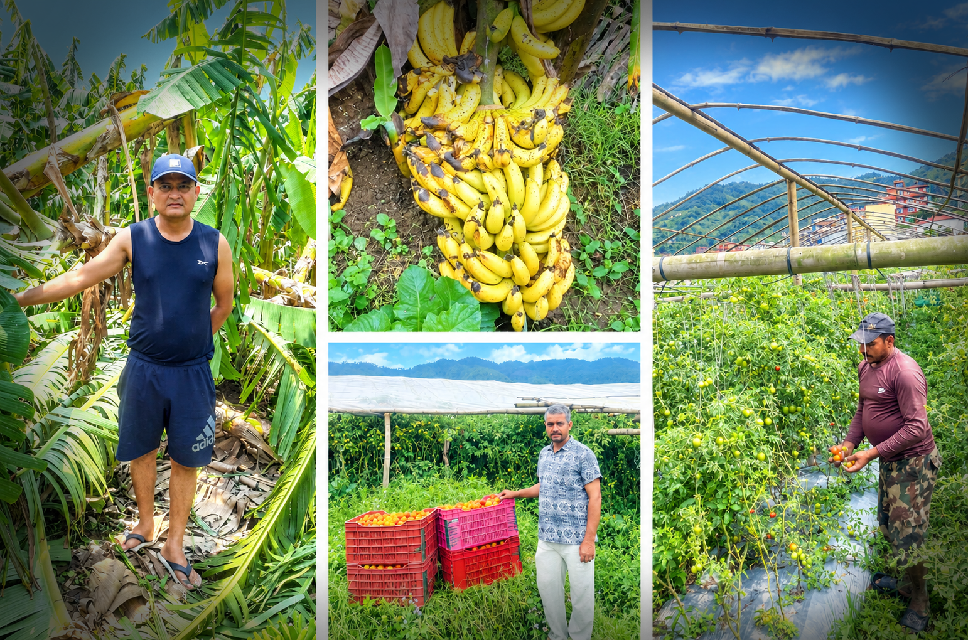
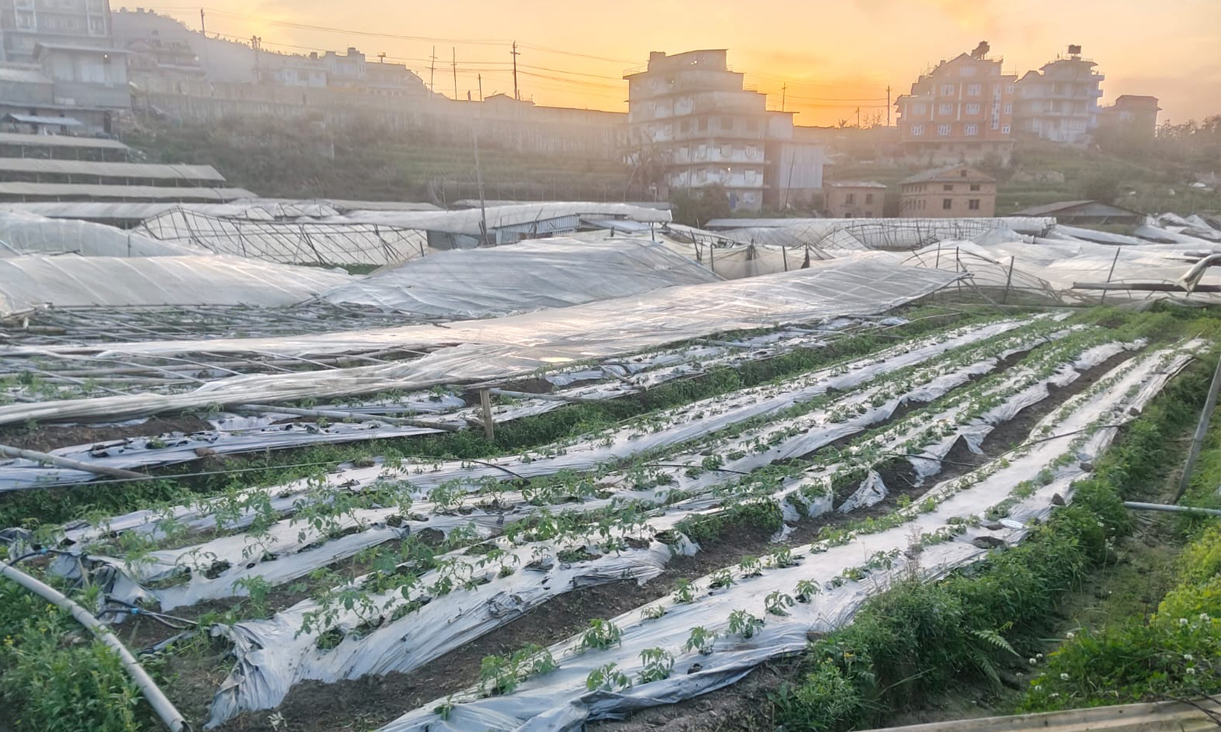
Across the fields of Chittapol and Nalinchok in Suryabinayak Municipality – 10, Bhaktapur, the tattered remnants of plastic polyhouse tunnels torn apart by windstorms still lie scattered about. The storms destroyed both the protective structures that farmers had built at a cost of hundreds of thousands of rupees for vegetable farming and the crops growing inside them. The hard work of husband and wife Bhakti Dahal and Shashi Upreti Dahal was also swept away by the winds.
Originally from Dolakha, the Dahal couple had built polyhouse tunnels across 70 ropanis (around 3.56 hectares) of land in Chittapol and Nalinchok to grow tomatoes. Operating through a registered agricultural firm, they had invested nearly NPR 10 million, a large portion of which was borrowed. A windstorm on 2 Chaitra 2082 BS completely destroyed the tunnels and tomato plants across 50 of those 70 ropanis.
"Starting over with a fresh investment would cost NPR 4 to 5 million. Since we couldn't afford it, we left everything as it was," Upreti said. For her, the windstorm was not merely a weather shock, but a disaster that wiped out years of hard work, investment and borrowed money.
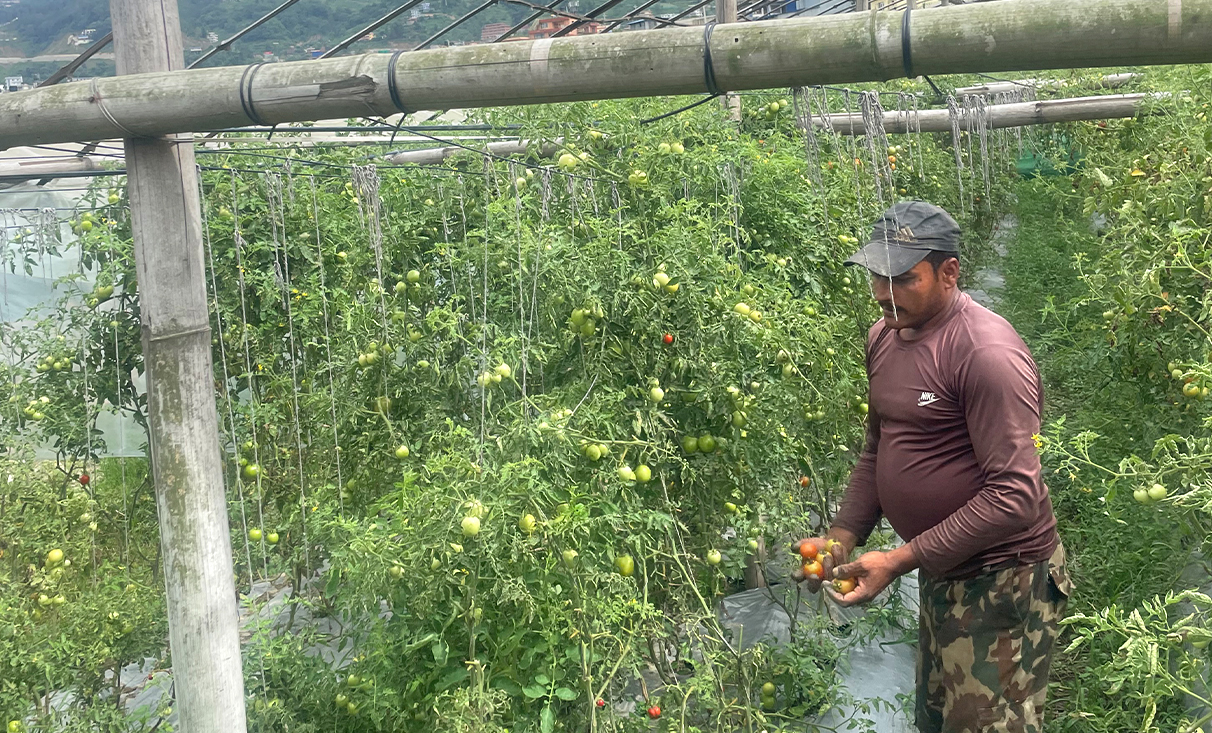
The plight of Tul Bahadur Bhattarai in the same area is no different. Through his Bhattarai Kundala Agriculture Firm, he had set up tunnels across 18 ropanis of land; the windstorm blew away 21 of them. To save his growing tomato plants, he immediately repaired nine tunnels. Within days, however, another windstorm struck.
The storm on 19 Chaitra 2082 BS tore away even the new plastic sheets he had just installed during repairs. Unable to afford reinvesting yet again, he has since left the tunnels abandoned.
Shifting Windstorm Patterns
In farmers' experience, the very nature of windstorms has changed in recent years. "In the past, windstorms would only blow away old plastic sheets," says Rikheshwar Bhattarai. "Now, whirlwinds come through and flatten the crops right inside the tunnels."
Data from the National Disaster Risk Reduction and Management Authority (NDRRMA) show a sharp rise in windstorm-related incidents in Nepal in recent years. According to the authority, while 17 windstorm incidents were recorded in Nepal in 2011, some 687 incidents were recorded in 2026 up to 23 September.
Figures from the past five years show 44 recorded incidents in 2021, 118 in 2022, 124 in 2023 and 410 in 2025.
The data show that districts including Jhapa, Kailali, Bara, Udayapur, Sarlahi, Achham, Morang, Dadeldhura and Chitwan have experienced the highest number of windstorm incidents.
According to Suraj Gautam, an early warning system and disaster risk management expert, localized wind systems have been intensifying alongside external weather systems in recent years.
"A windstorm in itself is not a disaster; what matters is how much damage it inflicts on our settlements, farmlands or infrastructure," Gautam says. "Lately, alongside external weather systems arriving from the Bay of Bengal or the westerly winds, intense localized wind systems have been forming more frequently. This triggers severe windstorms and heavy downpours over specific areas."
However, Gautam notes that improved reporting systems also partly explain the apparent surge in disaster figures. "Because the system for recording disaster data has become more organized than in the past, the number of recorded incidents also appears much higher," he says.
Rising Appeal of Tunnel Farming, and Mounting Losses
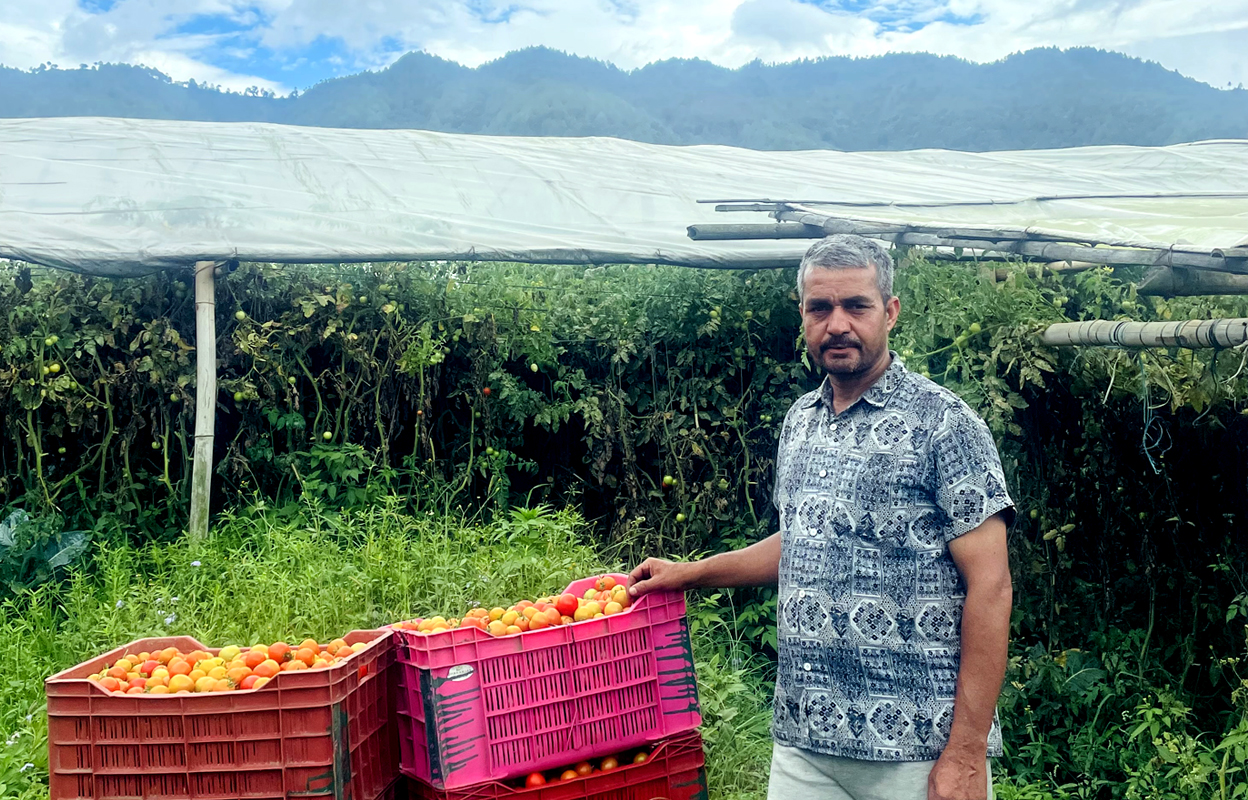
To protect crops from unseasonal rain, drought and unpredictable weather, polyhouse tunnel farming, or protected cultivation, has been expanding rapidly across Nepal.
According to the Report on Cultivation Technology for High-Value Crops in Protected Structures 2082/83 BS published by the National Potato, Vegetable and Spice Crop Development Centre in Kirtipur, protected structures are considered effective for shielding plants from adverse weather, pests, diseases and temperature fluctuations, as well as for producing off-season crops.
"Because of climate change, it has become difficult even to forecast the weather," says Bijay Giri, senior horticulture development officer at the centre. "Sometimes there is excessive rainfall, and at other times extreme heat. Under such conditions, tunnel farming has become indispensable for protecting crops like tomatoes."
According to the National Sample Census of Agriculture 2078 BS, around 97,000 farming households in Nepal practiced tunnel farming across roughly 5,000 hectares. Although both the area under cultivation and the number of farmers have likely grown since then, neither the Ministry of Agriculture and Livestock Development nor its subordinate agencies have updated figures.
The centre's report notes that tunnel farming is most widely practiced in districts including Kathmandu, Lalitpur, Makwanpur, Kavrepalanchok, Sindhupalchok, Kaski, Palpa, Nuwakot and Chitwan.
According to Giri, tunnel farming has been expanding on vacant plots in urban areas, particularly across the Kathmandu Valley. Yet the very farming method adopted for climate adaptation is increasingly falling victim to severe windstorms.
Farmers Left Outside the Safety Net
Disasters such as windstorms, unseasonal rains, floods and landslides inflict massive losses across the agricultural sector. According to data from the Ministry of Agriculture and Livestock Development, between Shrawan 2074 BS and 2082 BS, unseasonal rains, floods and landslides alone caused NPR 43.39 billion in losses across crops, livestock and fisheries. Of that total, crop losses alone accounted for NPR 24.78 billion.
The floods and landslides of Ashoj 2081 BS destroyed crops worth NPR 6 billion, while unseasonal rains in Ashoj 2082 BS wiped out another NPR 3.54 billion worth of crops.
A study prepared by the Institute for Integrated Development Studies (IIDS) with support from the United Nations Development Programme (UNDP) Nepal, titled Risk Management in Nepal's MSMEs: The Insurance Protection Gap, also highlights the scale of climate-related risks in agriculture. Released on 18 Shrawan 2083 BS, the report identifies windstorms and tempests as the leading climate hazards after floods and landslides.
The study notes that in fiscal year 2081/82 BS, floods and landslides alone caused losses equivalent to 0.8 percent of Nepal's gross domestic product (GDP).
According to the National Statistics Office (NSO), Nepal's GDP stood at NPR 6.107 trillion in fiscal year 2081/82 BS, meaning floods and landslides alone caused losses of around NPR 48.85 billion that year.
Yet despite risks of this magnitude, agricultural insurance, considered the primary tool for cushioning farmers financially, remains out of reach for most farmers. Even farmers in Bhaktapur, right next to the capital, say they lack adequate information about insurance.
"We had heard that insurance exists, but we had no idea where to go or what to do," Shashi Upreti says. "Nobody ever came to inquire or explain it to us either."
Rikheshwar Bhattarai, who farms 45 ropanis of leased land in Nalinchok, said that although he received some subsidies for plastic sheets, tunnel construction and drip irrigation equipment from the ward office and Suryabinayak Municipality, he remained outside the coverage of agricultural insurance.
Three years ago, he and a group of fellow farmers visited an insurance company in Lalitpur to inquire about coverage. "We went there to get insurance, but they showed little interest in vegetable crops," he said. "Many things were not made clear to us either."
The day after the windstorm struck, officials ranging from staff of the Prime Minister Agriculture Modernization Project to the Minister for Agriculture visited the farms in Nalinchok and Chittapol. Farmers were promised that insurance access would be facilitated, but they complain that those assurances never materialized.
"There is simply no information about crop insurance," Tul Bahadur Bhattarai said. "We don't know which institution or bank handles it, even though we did try to look into it."
An Ordeal Even for Insured Farmers
It is not only uninsured farmers who suffer; even those who have insured their crops face hurdles when claiming payouts.
Thakur Sapkota of Chitwan cultivates bananas across 18 bighas (around 4.5 hectares) in the Ratnanagar, Kalika and Khairahani areas. A commercial banana farmer for the past 13 years, he insures his crop every year.
The windstorm of Chaitra 2082 BS flattened six bighas of his bananas that were ready for market. When he filed an insurance claim afterward, he had to endure numerous bureaucratic hurdles to get compensated. According to Sapkota, insurers' reluctance to issue policies on time directly reduces the compensation farmers can receive.
"Only if the policy is issued by Shrawan does the coverage reach the nine-month mark by the time the Chaitra–Baisakh windstorms hit, qualifying us for maximum compensation," Sapkota says. "But companies refuse to insure in Shrawan and only issue policies in Ashoj. As a result, when damage occurs in Chaitra, the policy has only run for six months, and we receive just 50 percent of our claimed amount."
Under the Agriculture, Livestock and Herbs Insurance Directives 2079 BS, insurers are required to settle claims within 57 days of receiving all required documents. Yet Sapkota says farmers are forced to wait up to a full year.
"You don't get paid until a full year has passed and the next year has begun," he said. "Even then, there are endless hassles. You submit a document one month, and the next month they ask for the exact same paper again, claiming it was lost and putting you through constant stress."
According to Bishnu Hari Pant, president of the Nepal Banana Producers Federation, insurers' refusal to issue policies on time has prompted many banana farmers across the country to stop renewing their coverage altogether.
He contends that farmers are losing interest because the government's failure to release premium subsidies on time has led insurers to halt policy issuance, while the claims process remains cumbersome and payouts are delayed. Although the issue has been discussed repeatedly at the ministerial level, Pant said no practical improvements have followed.
According to the IIDS Insurance Protection Gap study, over the past three years, insurance covered an average of just NPR 440,000 per enterprise, equivalent to 58 percent of total losses, among disaster-hit small and medium agricultural enterprises. Fully 42 percent of the total losses suffered by farmers were deemed ineligible for insurance claims.
The study identifies incomplete documentation, a lack of policy clarity and insurers rejecting claims as "fraudulent" as the main reasons behind such exclusions. Inadequate risk coverage and a tedious claims settlement process have further eroded trust in the insurance system, the report notes.
According to the latest figures from the National Statistics Office, agriculture contributes 24 percent of Nepal's GDP and employs 57.3 percent of the total population.
Yet the study concludes that although a sector tied to such a vast share of the population and economy is highly exposed to climate disasters, weak access to reliable insurance and safety nets leaves small and medium agricultural entrepreneurs even more vulnerable.
Crop Insurance Confined to Paper
Nepal launched the Agriculture and Livestock Insurance Program in Magh 2069 BS to protect farmers and agribusinesses from potential losses caused by natural disasters. To attract farmers to commercial cultivation, encourage investment and boost production and productivity, the government has been subsidizing up to 80 percent of insurance premiums. Yet official data show that the overwhelming share of this subsidy has gone to livestock insurance rather than crop insurance.
Between fiscal years 2070/71 BS and 2082/83 BS, the government spent NPR 11.82 billion on premium subsidies for agricultural and livestock insurance. According to data from the Ministry of Agriculture, nearly 91 percent of that amount went to livestock insurance, while only 9 percent, around NPR 1.15 billion, was spent on crop insurance.

In fiscal year 2082/83 BS alone, the government distributed NPR 1.19 billion in premium subsidies. While 186,111 livestock insurance policies were issued nationwide that year, just 1,948 policies were issued for crops. The subsidy allocated to crop insurance amounted to only NPR 47.2 million.
According to the National Sample Census of Agriculture 2078 BS, Nepal has 4.131 million farming households. However, only around 4 percent, or 182,000 households, participated in agricultural and livestock insurance. Among those insured households, just 14,560, around 8 percent, had crop insurance, and vegetable farming accounted for a mere 2.21 percent of those crop policies.
According to Lal Kumar Shrestha, a senior agricultural economist at the Ministry of Agriculture, Forestry and Environment, agricultural insurance has failed to gain traction due to insurers' reluctance, a failure to inform farmers adequately about the program's benefits, and low interest among farmers themselves.
"On the farmers' side, there isn't much interest in insuring food and vegetable crops, and the government hasn't been able to explain it effectively either," he said. "There are still farmers who ask whether crops can even be insured. That is why this gap persists."
Now that the insurance program has been devolved to the provincial level as well, Shrestha says it could become somewhat more effective.
The 62nd Performance Audit Report of the Office of the Auditor General also pointed to a lack of trust in insurance among farmers, poor access for smallholders, delays and procedural complexities in claim settlements, and complicated valuation methods for determining the sum insured for farm produce.
The Nepal Insurance Authority assigned mandatory jurisdiction across all 77 districts to 14 non-life insurance companies, requiring each insurer to serve four to five districts. Yet according to the Auditor General's report, as of fiscal year 2080/81 BS, agricultural and livestock insurance had still not reached 57 of the country's 753 local governments.
Insurers and Regulators Trade Blame
While farmers and experts point to insurers' reluctance as a core problem, insurance companies argue it is unfair to blame them alone.
Nisha Ghimire, deputy director and head of the Agriculture and Livestock Division at the Nepal Insurance Authority, says low farmer participation in crop insurance stems from shortcomings on the part of all three sides: the government, insurance companies and farmers.
"Insurance companies are reluctant to go to rural villages, and interim delays in the government's release of premium subsidies also created problems," Ghimire says. "Meanwhile, farmers tend to think that they only get money if a disaster strikes, and that otherwise their premium money is wasted."
Although there were bottlenecks in releasing government subsidy funds to insurers in the interim, she said all dues up to Baisakh 2083 BS have now been cleared.
Rena Rijal, acting chief executive officer of United Ajod Insurance, likewise points to fraudulent claims, delayed subsidy payments from the government and a lack of technology to assess crop losses as the main challenges in crop insurance.
"It is impossible for a company to be physically present and conduct direct monitoring in every area," she said. "Under these circumstances, many fraudulent claims are filed, and the current system cannot accurately detect them."
As public limited companies with ordinary citizens as shareholders, Rijal argues, insurers can neither make indiscriminate payouts without managing risk nor walk away from paying legitimate compensation once a policy has been issued.
Although insurers have introduced weather index-based "parametric" insurance to mitigate risks in crop coverage, she says the lack of comprehensive technological access and scientifically calibrated trigger points continues to hamper implementation.
"We ran a heat-stress-based insurance program for maize crops in Banke and Bardiya," Rijal said. "Because we had to rely on data from a limited number of stations operated by the Department of Hydrology and Meteorology (DHM), recorded temperature spikes forced us to pay out massive claims exceeding 100 percent of premiums. Alongside DHM stations, satellite-based technology is essential in such cases."
Because agriculture is the backbone of the economy, Rijal acknowledges that insurance companies cannot shy away from it, adding that expanding coverage requires both deploying technology and raising awareness among farmers. Yet official figures show that not all insurers have complied even with mandatory targets set by the regulator.
Through the Agriculture, Livestock and Herbs Insurance Directives 2079 BS, the Nepal Insurance Authority mandated that agricultural, livestock and herbal insurance must account for at least 5 percent of the total policies issued by every non-life insurance company.
However, according to the Nepal Insurance Authority's annual report for fiscal year 2081/82 BS, agricultural and livestock insurance made up less than 5 percent of total policies at nine of the 14 non-life insurers. Most companies had failed to meet the requirement in fiscal year 2080/81 BS as well.
Smallholders Sidelined as Large Operators Reap the Benefits
To encourage smallholder farmers, the government introduced the Crop and Livestock Insurance Premium Subsidy Procedure 2081 BS, providing an 80 percent premium subsidy for sums insured up to NPR 5 million.
Similarly, the procedure provides a 65 percent premium subsidy for sums insured between NPR 5 million and NPR 10 million, and a 50 percent subsidy for policies above NPR 10 million. Yet the Auditor General's report points out that smallholder farmers have failed to benefit from the very subsidy structure designed in their name.
For instance, if a total premium is set at NPR 5 million under the 80 percent subsidy tier, the government covers NPR 4 million while the farmer bears 20 percent, or NPR 1 million.
However, according to the Auditor General's 62nd bPerformance Audit Report, participation by smallholder farmers with a sum insured below NPR 100,000 is extremely low. Instead, large farmers and commercial firms insuring between NPR 1 million and NPR 5 million have captured the lion's share of the subsidies.
The report also flagged a loophole allowing a single farmer to take out multiple policies, enabling large investors to split their coverage into several policies below the NPR 5 million threshold to claim the highest 80 percent subsidy rate.
This inflates subsidy payouts, placing an additional financial burden on the state while undermining the effectiveness of the insurance program, the Auditor General noted.
"Overall, smallholder farmers' access to the insurance program was found to be extremely low. The reasons include limited awareness of the insurance program among smallholders and a cumbersome claims settlement process," the report states.
Farmers Bear the Risk, But Who Bears the Responsibility?
Since the introduction of federalism, local governments stand closest to farmers. Yet in times of disaster, municipalities lack a clear mechanism to facilitate insurance, while neither provincial nor federal authorities have built a structure capable of absorbing the risks faced by working farmers. When crops are destroyed, it is the local government that farmers turn to first for relief.
However, none of the three tiers of government has been able to guarantee proactive risk management or accessible insurance for them.
Shantila Budhathoki, assistant crop development officer at Suryabinayak Municipality in Bhaktapur, says farmers come to the municipal office every year after disasters demanding compensation. Beyond compiling damage assessments and forwarding them to the province, however, the municipality has been unable either to facilitate insurance or to provide compensation.
"Farmers come to us saying windstorms, floods, landslides or pests have damaged their crops, but they are unsure about how to take out agricultural insurance or claim compensation," Budhathoki says. "All we do is conduct technical field visits to assess how many tunnels or plants were damaged and send a recommendation to the provincial Agriculture Development Office."
The absence of a dedicated insurance technician or focal person at the municipality has also prevented them from assisting farmers, she adds.
"Because the federal government itself hasn't facilitated the process with a clear policy and designated focal persons, local governments haven't been able to act even when they want to," she said. "We are now thinking about how to move forward by allocating a dedicated budget next year."
The role of provincial governments is much the same as that of municipalities. Kranti Rai, an agricultural economist at the Agriculture Development Office in Lalitpur under Bagmati Province, says her office has only been providing nominal relief to farmers in districts under its jurisdiction, in line with the Provincial Disaster Fund Operation Procedure 2075 BS.
Under the current agricultural insurance system, once a company issues a policy, a recommendation from the provincial Agriculture Knowledge Centre or District Agriculture Development Office is mandatory. Officials at both the Department of Agriculture and the Nepal Insurance Authority admit that delays in obtaining recommendations from the district level often prolong payouts. Agricultural economist Kranti Rai says complex administrative procedures are a primary reason farmers do not receive insurance payouts on time.
"First, an insurance agent visits the site to assess the damage," she said. "Then the District Agriculture Development Office verifies the documents and prepares a recommendation. Only after the file sent from the district passes through the Insurance Authority and reaches the Department of Agriculture is the claim amount approved. We simply work within the jurisdiction granted to us by law."
Promises of Easier Access Under Provincial Control
A decade after the implementation of federalism, the insurance program, until now operated under the federal government, has been transferred to the provinces starting in fiscal year 2083/84 BS. The Procedure on Providing Subsidies on Agriculture, Livestock and Herbs Insurance Premiums 2083 BS, which came into effect on 1 Bhadra 2083 BS, has handed all powers previously vested in the federal government over to the provinces.
Under the currently enforced Agriculture, Livestock and Herbs Insurance Directives 2079 BS, a farmer registers an agricultural insurance proposal with the help of an agent through the Insurance Authority's online Agriculture and Livestock Insurance System (ALIS); the insurer issues the policy only after receiving a technician's recommendation.
Once a policy is issued, the provincial Agriculture Knowledge Centre or District Agriculture Development Office verifies whether the insurance complies with regulations. After the documents, along with the Knowledge Centre's recommendation, reach the Nepal Insurance Authority, the policy undergoes technical verification against legal standards. Finally, only after the Department of Agriculture conducts a final verification of the sum insured is the government subsidy released to the insurance company.
Until now, this entire process was administered under the federal government. Henceforth, the same workflow will operate under provincial governments.
According to Ritesh Kumar Jha, horticulture development officer at the Department of Agriculture under the federal Ministry of Agriculture, following the implementation of the new procedure on 1 Bhadra 2083 BS, the federal government has already transferred insurance subsidy funds to the agriculture ministries of all seven provinces as conditional grants.
"The procedure itself remains the same," Jha said. "Whereas policies issued by companies used to be sent to the center, provincial offices of the Insurance Authority will now verify them, and the provincial ministries themselves will disburse the subsidy funds."
Because provincial agencies are closer to farmers, Jha expects the shift to make it easier to determine accurate sums insured for farm produce and streamline claim settlements.
"Previously, there were complaints that delays by provincial Agriculture Knowledge Centres in issuing recommendations prolonged the process," he said. "Now, if problems arise, complaints can be lodged directly with the provincial office of the Insurance Authority. Because provinces are closer to farmers than the federal government, claims will be settled faster."
Kranti Rai, the agricultural economist at the Agriculture Development Office in Lalitpur, also believes that reducing procedural delays and settling claims more quickly through district and provincial offices will benefit farmers.
Fourteen years after the launch of the agricultural insurance program, a vast majority of at-risk farmers remain outside its reach. As windstorms and other natural disasters continue to destroy crops and farm structures, farmers can still petition for post-disaster relief, but an effective insurance mechanism to transfer risk before disaster strikes has yet to reach them. Even farmers who do insure their crops must navigate a drawn-out administrative maze to get their claims paid.
With the implementation of federalism, responsibility for agricultural insurance has gradually been linked to provincial and local governments. Yet so far, the role of local governments, the tier closest to farmers, has been confined to collecting damage details and issuing recommendations. With the move to operate the insurance program under provincial jurisdiction starting in fiscal year 2083/84 BS, the government expects provincial structures to ease insurance access, damage assessment and claim settlements.
Yet the question does not end there: will simply changing the tier of government bring insurance within farmers' reach?
In the experience of Shashi Upreti in Bhaktapur, there is still no answer to that question. When the windstorm wiped out the tunnels and tomatoes across 50 ropanis of her farm, she received NPR 14,000 in relief compensation. Although she now knows that insurance would have provided real relief, nobody told her before the storm struck that her crops could even be insured.
"The windstorm wiped out all the tunnels and tomatoes across 50 ropanis, and we got NPR 14,000 in compensation," Shashi says. "If we had been insured, we might have received some real relief. But nobody ever told us that insurance was even an option."
More Investigative Stories
As Mustang Warms, Farming Shifts Uphill and Challenges Mount
Rising temperatures and rainfall are transforming agriculture in Mustang. Yet efforts by farmers and the government to cope with the...
Shifting Himalayas Above Put Hydropower and Local Revenue at Risk Below
Growing instability in the high mountains is clouding the safety of Nepal's hydropower projects and its dream of achieving prosperity...
Comment Here