Main Banner English
The social cost of Gen Z uprising
The Gen Z protests of September changed the government but what kind of change is it bringing about to Nepal’s future? Orphaned children and families of the victims are currently asking a question—will the uprising follow good governance or will it be just another incomplete revolt?
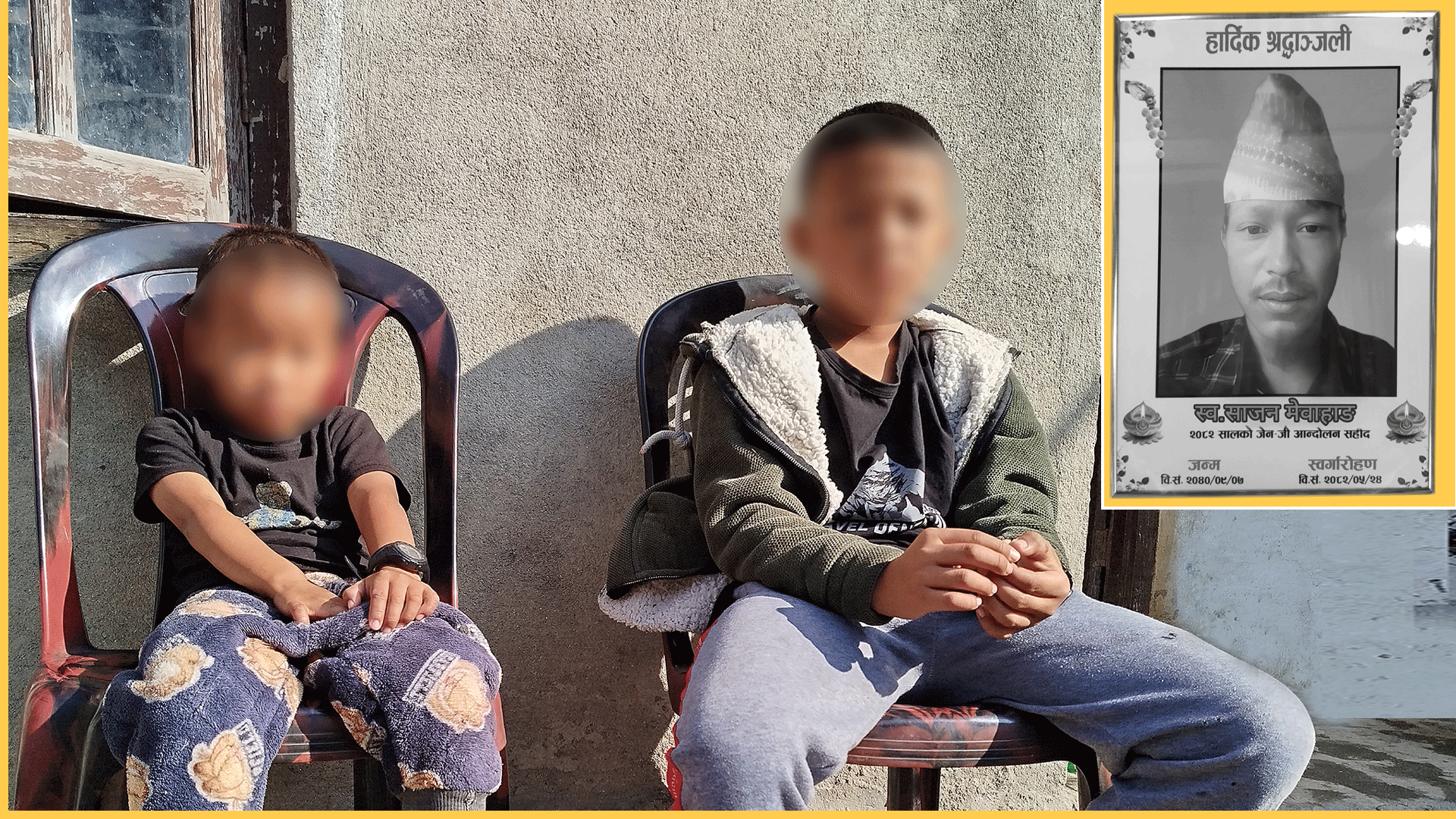
At around 10 am on December 2, 2025, 13-year-old Rekjan Rai was seated on a chair at his rented flat in Dhunchepakha, Bhaktapur. “I didn’t know protests would be so ugly,” he said wistfully, as we got talking.
“Why do you think so?” I asked. “My father died in the protests last time,” he replied, his head sunk.
Rekjan’s father, 42-year-old Sajan Rai, was one of the protesters shot dead during the Gen Z uprising in September. For Rekjan and his six-year-old brother, Jimi, their father was someone who would provide food, clothes, pocket money, and much else. Their mother had passed away 22 months before their father. Sajan, therefore, was their only support.
Sajan, who hailed from Dharan, was a laborer living at a rented room in Pepsicola. He had a simple goal: to earn enough to provide for his sons. But the protests cut that goal short. Now Sajan’s cousin, Bharat, is taking care of Rekjan and Jimi.
Bharat, who himself comes from a lower-class family, is now under pressure to take care of the two children and is struggling to find a way to fund their education. Bharat, who lives in Bhojpur with his family, comes to Kathmandu to meet his brothers only occasionally.
“He would bring us biscuits and take us on trips,” Rekjan recalled, on the 85th day of his father’s death. “But we no longer have him. Nor do we have our mother.” His brother, Jimi, was playing around nearby, oblivious of what was going on around him.
“These children have had to face such a tragic situation, they have endured the most harm from the protests,” Bharat said. “For others, Sajan might be just a number. But for our family, he was everything.”
The ones who died, and for what?
Fed up with rampant corruption, impunity and political mishandling of the country, young people took to the streets on September 8. The government’s ban on 26 social media, including Facebook, was the immediate trigger point. The protest began peacefully at Maitighar Mandala but went out of control by the time it reached New Baneshwar.
When the police fired at the protestors forcefully, without paying attention to the protocols of crowd control, as many as 21 people were killed within a few hours. Data from Nepal Police Headquarters, however, shows that 17 people died at New Baneshwar and two in Itahari.
The next day, on September 9, there were protests, vandalism, looting and arson throughout the country. That day, as many as 21 people died from police bullets in Kathmandu, Lalitpur, Bhaktapur and Jhapa.
“Lower- and middle-class people bear the brunt of the state’s discriminatory policies and corruption, and they tend to be the ones on the forefront of the protests,” says Janak Rai, an assistant professor of anthropology at Tribhuvan University. “Those who struggle to make a living, youths seeking to go abroad, students, laborers, drivers and conductors—those who are already on the streets—they tend to fall victim to state crackdown.”
According to police headquarters, as many as 76 people died during the uprising. According to postmortem reports, media articles and conversations with families and relatives of the deceased, as many as 42 of them were killed by police bullets.
According to our investigation, as many as 14 of those who died by bullet wounds were preparing to go abroad. Ten others were laborers like Sajan, while 10 were students. Six were small-scale businessmen; one was a sculptor, one painter and one other foreign returnee. Of the dead, five were from Kathmandu Valley while 37 were from outside the Valley who had been temporarily living in Kathmandu for jobs or studies.
On September 9, rioters killed three policemen through beating or sharp weapons. Twenty-one others were dead in the arson in business complexes, private residencies, and police offices. As many as 10 prisoners died after police fired at inmates who tried to flee. As many as 2,429 were injured across the country during the protests, according to data from the health ministry.
Sajan, who was literate, would get out of his room for work every morning and return at about 8 in the evening. He was not a cadre of a political party. According to Bharat, he had been living in Kathmandu for the past 17 years. He was angry about the country’s politics. “We have to bear the brunt of the politicians’ incompetence,” Sajan used to say, as Bharat recalls. Sajan didn’t cast his vote, because he had given up on what he perceived to be a dysfunctional state and did not want anyone ruining the country in power.
Of those who died by bullet wounds, 26 are between the ages of 19 and 28, the Gen Z-ers. Nine of them from 29-40 age group, and seven of them from 41-63 age group. As many as 41 are men and one woman.
Kailash Rai, a writer and independent researcher explains that those who have nothing to lose remain on the streets, and express their dissatisfaction through the streets. They also fall victim to police crackdown. “Those who had family members and relatives calling and texting them to stay safe during the protests were less affected,” Rai says. “Those who had their families and relatives in villages died.”
On September 8, Sajan was in his room the whole day. Bharat had come to Kathmandu to send his younger brother to Saudi Arabia. “Among social media, only TikTok was functioning that day, and we knew the news of the killings of 19 people from TikTok. We were angry but also scared,” Bharat recalls. “During dinner in the evening, my uncle [Sajan] had worried what would happen if his two sons had died like that.”
The next day, Bharat went to Pepsicola Chowk with some friends, and then to New Baneshwar with the protest rally. After vandalism and arson began, he returned to the room at around 2 in the afternoon. “I had already returned to the room but uncle had gotten out of the room to search for me,” Bharat said.
Later, it was known that Sajan had fallen after he was shot by the police at Sanothimi Police Circle, about one-and-a-half kilometers away from his room. At about 5 pm, Bharat knew that Sajan’s body was kept at the nearby Nepal-Korea Friendship Hospital in Madhyapur Thimi.
“The bullet had pierced through his chest,” Bharat says. “The death certificate provided by the hospital has mentioned ‘gun shoot’.”
Sajan’s final rites were performed in Dharan on 15 September, 2025.
Raining bullets
On September 8, the protest rally that moved forward from Maitighar halted at the barricade set up by the police near Everest Hotel. According to journalist Dinesh Gautam, who was reporting from the field that day, the rally reached there at about 11 am. But it didn’t stop there for long; they clashed with the police.
About half an hour later, at around 11:33 am, groups of youths from Chhakkubakku Marga and other nearby areas joined the rally. “Most of them were students in school uniforms,” Gautam says. “The police that were struggling to stop the protesters coming in from Maitighar got overwhelmed after the new groups joined.”
At around 11:35 am, the protesters breached the barricade and moved towards the parliament building. The police used water cannons to disperse the crowd at first and then tear gas cells. But the protesters marched on.
“When my friend and I crossed the overhead bridge and reached Everest Hotel, another group of protesters had breached the barricade and were running towards the parliament building,” said Rishi Jung Thapa, 26, who had come to New Baneshwar from Banepa to take part in the protest. Thapa also mingled with that crowd and reached the southern gate of the parliament.
“Some were trying to get past the gate, while others were vandalizing the railings and walls,” Thapa said. “Police would fire tear gas cells and the protesters would pick them up and fire right back at the police.”
Thapa added that he had a loudspeaker taken from someone in the crowd, and he used it to urge everyone to not enter the parliament. “But nobody would listen,” he said.
According to video footages received from the protesters, a group had already reached the parliament’s southern gate at about 11:40 despite the police using lathis, tear gas and water cannons.
The protestors agitated by the use of force by police had already carved a hole through the wall and entered the parliament premises by about 12:20 noon. “I can’t come to terms with what happened within seconds that day,” says Dal Prasad Karki, who had taken part in the protests.
Amid this, the Kathmandu District Police Circle announced a curfew, effective from 12:30. The police announced the decision to the protesters through a loudspeaker. But the protesters didn’t listen to it, or even if they did, they didn’t pay heed to it. Only a few returned homes.
The number of protesters kept on rising instead. They encircled the parliament building. As the situation escalated further, the police started firing bullets to the protesters in front of the building.
Analyzing the footage of protesters running towards the Civil Hospital, we found that an ambulance carrying bloodied protesters had reached the hospital at 12:41. Within four minutes, the number of injured rose sharply.
“The bullets kept on raining for about an hour,” Dal Prasad said. “Ambulances became scarce, and the injured were carried to the hospital on bikes and on backs.”
After the news of the death emerged at around 2pm, the protest got further enraged. “The police were firing all sorts of ammunition, tear gas cannons, rubber bullets and metal bullets, all at once,” Thapa said. “The firing would stop for a while, then intensify again. The pattern continued.”
According to officials at Civil Hospital, as many as 250 injured were admitted to the institution on the first day of protests.
International human rights organization Amnesty International unveil a study report on December 8 which mentions that protesters were getting killed from about 12:30-1 after the special security force deployed to guard the parliament began to fire lethal weapons such as SLR, INSAS and pistols.
“The police atrocities of that day are unspeakable,” says Rishi Jung. “We three friends had run away to Thaha Sanchar’s building. One of my friends collapsed right there. And when we tried to pick him up, we had cerebrum on our hands.”
Police brutality and protesters’ resistance didn’t subside. Some injured protesters had returned to the demonstrations after receiving care at the Civil Hospital. One such youth who had returned to the protest, lost his eye after sustaining a bullet wound.
Rishi Jung says that he tried to rescue another man who was pelting stones at the parliament building but succumbed to bullets coming in from the parliament premises.
Amnesty report further states that officials at Civil Hospital had to intervene after police tried to enter the hospital’s emergency room and chase the injured protesters away.
According to a Nepal Police report, as many as 13,182 rounds were fired on September 8 and 9, including 2,642 metal ones and 1,884 rubber bullets. Likewise, 2,377 were warning shots and 6,279 cells of tear gas. Most of them were fired in Kathmandu—1,329 metal bullets, 1,420 rubber ones, 1,046 warning shots and 3,096 tear gas cells.
Rishi Jung who is from Bethanchok, Kavre, is a bachelor’s student at Ratna Rajya Laxmi Campus and lives in Banepa. Three days before the protests, he had got together with his friends to fight against corruption, irregularities and social media ban. He took the responsibility of writing the slogans.
“Thinking it would be a creative protest, I had gone to the demonstration without a mask, handkerchief or even water,” he said. “But the situation soon spiraled out of control. Trying to rescue the injured, I was covered in blood myself,” he recalls.
The Amnesty report has concluded that the Nepal government had failed in its duty to protect the rights of peaceful assembly and protests enshrined in the constitution. The report states that as many as 19 died on the first day of the protests and over 300 were injured.
“That day, authorities made unlawful use of force and weapons against the protesters, an act that breaches the international human rights protocol,” says Nirajan Thapaliya, director of Amnesty's Nepal secretariat who was involved in the study. “There are stages of controlling the crowd. But our study shows water cannons were fired at sensitive organs, tear gas cells were fired indiscriminately, and bullets were fired without providing warning in a way that everyone could hear.”
According to Hemanta Malla, former DIG of Nepal Police, the government and the security agencies had not prepared to prevent the possible damages on September 8. The ill-prepared security forces fired at the protesters indiscriminately and 19 people died within a few hours, Malla adds.
“To disperse the crowd using the least possible force, security personnel should be trained, provided with enough security equipment and non-lethal weapons,” Malla said. “But that day, there was none of that. When the crowd turned unruly, security personnel became nervous and began firing with whatever they had with them.”
Postmortem of the 35 who died of bullet wounds was performed at the Teaching Hospital in Maharajgunj. According to Dr Gopal Chaudhary, chief of the forensic department, 12 of them had been shot on the head, 16 on the chest, 4 on the stomach, and 3 on the neck. Postmortem of the rest of the seven was done at Lalitpur, Bhaktapur, Sunsari and Jhapa. According to media reports and relatives’ testimonies, two of them were shot on the chest, and others on the head, stomach, back and shoulder.
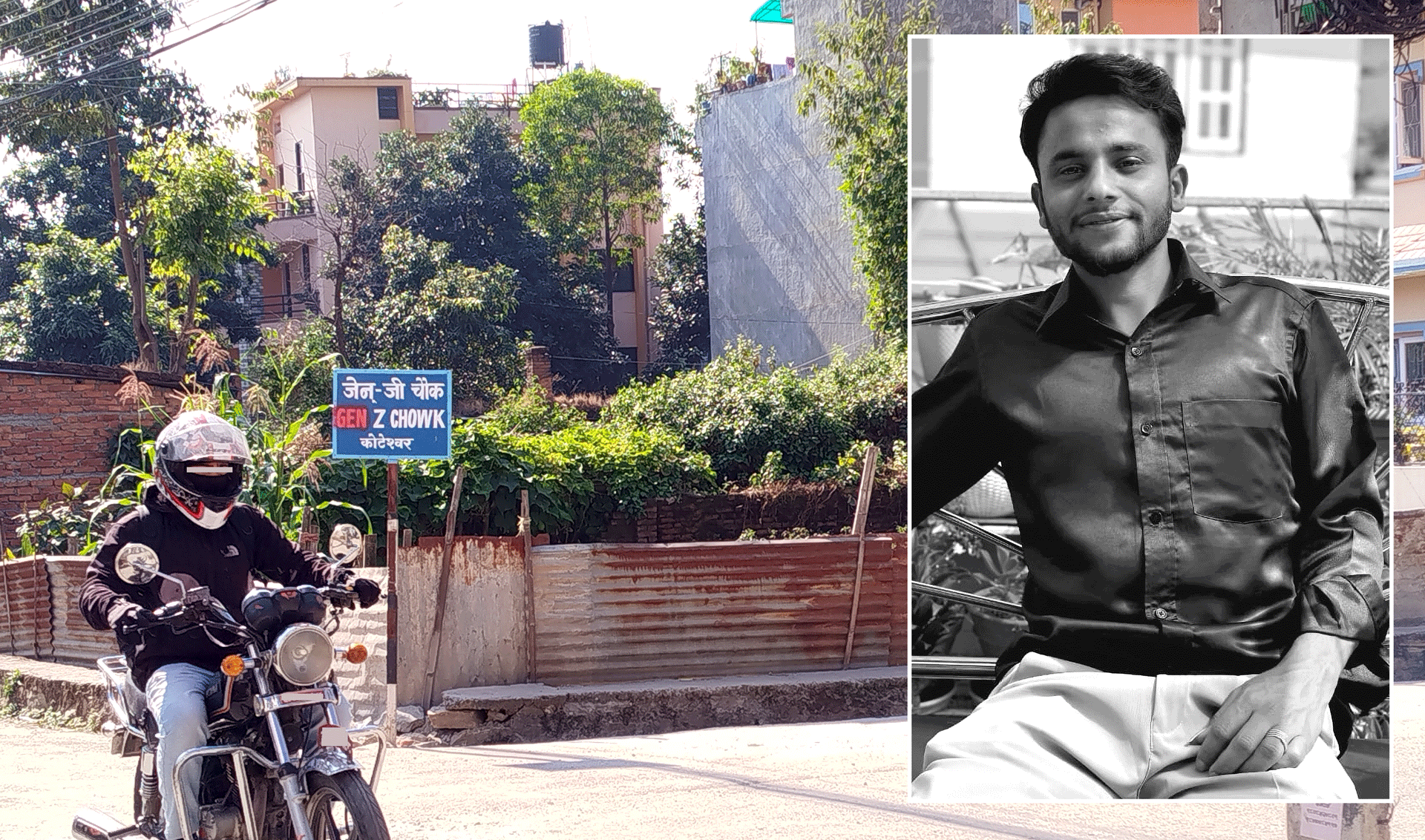
Bimal Babu Bhatta, 24, an 11th-grader living with his maternal uncle’s in Koteshwar to study, was trying to go abroad for work. He had tagged along with his friend on September 8 to the protests where he died after being shot.
“We urged him not to go but he went anyway,” said Bimal’s maternal uncle, Hariram Bhatta. “He got out of home at 11:30 and was shot at about 12:58. When we reached Civil Hospital, he was already pronounced dead. He was shot on the forehead with the police’s 7.2mm bullet.”
Bimal’s parents live in Gorkha. “He was smart and was aiming to go to Romania or Portugal,” Hariram said. “He wanted to provide for the family but now he is gone.”
According to Bimal’s elder brother Anil, he had submitted Rs700,000 and passport to the Asian Manpower Company in Sinamangal. Now his friends who also wanted to go to Europe have brought back the passport. And the locality he lived in Koteshwar has been named ‘Gen Z Chowk’.
Rishi Jung says that if the government had not used so much force on the first day of the protests, the country wouldn’t have to face so much loss of lives and property. “Most of those during the protests were peacefully raising their voices,” he said. “I barely survived. Those who died won’t return. If there is good governance and people get to feel democracy, then the families of the martyrs would perhaps feel some relief.”
The 12 unknown who were burnt
Of the 21 who died in arson at business complexes, private houses and police offices, final rites of 12 have yet to be performed, including 7 found in Bhatbhateni Supermarket in Chuchchepati, four in Bhatbhateni Dharan and one in Bhatbhateni Biratnagar.
The remains of seven dead in Bhatbhateni Chuchchepati were taken to Teaching Hospital in Maharajgunj. “Even their bones were burnt, and the remains include whatever could be salvaged of their body parts,” says Chaudhary, the forensic department chief. “They are yet to be identified.”
Of those whose final rites were performed, the dead body of 22-year-old Bikas Rasaili who hailed from Khadadevi-6 in Ramechhap and was studying in bachelor’s second year was found on the fourth floor of Koteshwar Bhatbhateni. According to his friends, he took part in the protests on both days. He had gotten out of home after having an evening meal on September 9 and his burnt body was found a week later. He was identified through his cellphone and a piece of cloth he was wearing.
The body of 24-year-old Saroj Khatri was found burnt inside the house of then Maoist leader Ganga Dahal in Lalitpur. Khatri, who worked as a dozer driver, used to live with his family in Sunakothi, Lalitpur. He had joined the rioting group.
Likewise, the body of 40-year-old Mahendra Pariyar, who lived in Chandragiri-5 and had taken part in the protests on September 9, was found burnt inside the Bishal Group’s building in Chandragiri. Pariyar worked as a tailor and construction worker.
Bijaya Lama, 42, from Tanahun, died after getting caught in arson and vandalism at the District Police Office in Pokhara. He was living in Pokhara at the time. Likewise, the body of 36-year-old Swasthani Khadka, also from Tanahun, was found at a commercial complex in Pokhara. Khadka had gotten out of the Amshubhara Square Building after vandalism but returned to pick her belongings. She was trapped in the fire at the building thereafter.
The house of Dhurba Bahadur Thapa, former central chair of Nepal Automobile Association, was also burnt during the protests. Kanchhi Nagarkoti, 50, who worked as a domestic help, was burnt in that house.
Likewise, 45-year-old Soshila Devi Paswan was found burnt inside the house of Congress central committee member Anil Rungata. She was also working as a domestic help at the house. Meanwhile, 19-year-old Saroj Gurung died after he was hit by a gas cylinder that exploded during fire at the house of Bharatpur metropolis’s deputy mayor Chitrasen Adhikari.
A 67-year-old Indian tourist Rajesh Singh Gola died during the fire at Hyatt Hotel in Kathmandu. Ten prisoners died after they were shot at by the police as they tried to flee, including five of age group 19-21 at Banke’s Naubasta Correction Home, two aged 36 and 61 at Dhading prison, and three aged 40, 51 and 58 at Ramechhap prison.
Comment Here